Loading...
Stool
Stool
Object ID
X65.1625
Edo designations
English designations
Categories
Institution Location
308 Charles E Young Dr N, Los Angeles, CA 90024, United States
Object ID
X65.1625
Edo designations
English designations
Stool
Categories
Ceremonial Objects
Institution Location
308 Charles E Young Dr N, Los Angeles, CA 90024, United States

Iconographies

13 annotations

Umbrella
Ekhara
Umbrella

Ekhara (umbrellas) play a multifaceted role in Benin art, reflecting both their function as status symbols and their association with European visitors. On some Ama-Ẹrọnmwọn (bronze relief plaques), sunshades resembling Asa are held by the Ọba’s attendants to protect him from the sun. European-style Ekhara, as we know them today, are also depicted in late 19th-century wooden carvings produced by the Emada. In her analysis of the Aken'ni Elao, Barbara Blackmun observed that on earlier objects, umbrellas were generally depicted only in the hands of foreign figures rather than those identified as members of the Benin Kingdom.

On later objects, particularly those dating to the late 19th century, this changes. The Ọba and high-ranking chiefs such as the Ezọmọ are depicted being shielded from the sun by attendants carrying Ekhara, a practice also described by Europeans visiting Benin City. Like many imported luxury goods, the Ekhara was incorporated into the visual language of royal power and became an important status symbol, associated with the wealth, authority, and elevated position of those permitted to use it.

2 annotations
Ekhara
Ekhara
Portuguese Figure
Ikpotoki
Portuguese Figure

Ikpotoki figures (Portuguese figures) are easily distinguished by their European-style clothing, including hats and helmets, as well as by their facial features, particularly their thin, straight noses and straight hair. The objects Ikpotoki figures are shown wearing or holding provide further indications of their relationship with the Benin Kingdom. When they hold or are positioned alongside Ugianran (manillas), for example, they indicate trade, commerce, and wealth, while weaponry such as firearms, swords, or spears indicates their role as mercenaries in the service of the Ọba. In 1515, Ọba Ẹsigie went to war against the Attah of Idah, the ruler of a neighbouring kingdom. Portuguese mercenaries and weapons assisted the Edo in winning the battle, enabling the further expansion of the Kingdom. Ẹsigie’s reign was particularly important for strengthening ties between the Benin Kingdom and the Portuguese Empire, and he is believed to have spoken fluent Portuguese. With Ẹsigie’s encouragement, Portuguese missionaries established churches in the Benin Kingdom, while Portuguese trading factories were also established. Ọba Ẹsigie allowed his son to be baptised and sent him to Portugal to be educated; following his return, he became Ọba Orhogbua.

2 annotations
Ikpotoki
Ikpotoki
Sword
Agbada
Sword

Agbada is a type of short sword with a double-edged blade, used by warriors in hand-to-hand combat. Warrior figures carrying Agbada are often depicted on the Ama-Ẹrọnmwọn (bronze relief plaques), both in scenes of combat and in ceremonial contexts.

1 annotation
Agbada
Portuguese Head
Uhunmwu Ikpotoki
Portuguese Head

These motifs are known as Uhunmwu Ikpotoki in Edo, which translates as ‘Portuguese head’ in English. Portraits of Portuguese men, featuring only their heads and sometimes their shoulders, were used by artists as motifs on the Emwin Arre (royal treasures), in particular on the Ama-Ẹrọnmwọn (bronze relief plaques) and Aken'ni Elao (carved altar tusks). Also included here are a series of two or three conjoined spirals, which are interpreted as abstract forms of this motif.

One of the earliest suggestions that many of the European figures depicted on objects were Portuguese was made two years after the 1897 British Colonial Military Campaign on Benin City by the British Museum curators Charles Hercules Read and Ormonde Maddock Dalton, based on testimony from seven chiefs in the aftermath of the military campaign. The long, straight hair, beards, and domed hats together led to the identification of these representations as Europeans.

When included within the visual imagery of the Emwin Arhe, the Portuguese are associated with the new Atlantic trade and the consequent wealth that emerged following first contact with the Portuguese in the late 15th century. For this reason, Portuguese heads are also often associated with the sea deity Olokun. Eisenhofer argued that the Portuguese figures and heads as motifs on the royal treasures are symbols of the king’s power: “these depictions of foreigners helped to build and strengthen the king’s image.”

When incorporated into the design of the Ama-Ẹrọnmwọn (bronze relief plaques), Curnow instead argued that these motifs could in fact indicate events that took place during Ọba Esigie’s reign. Ọba Esigie is associated with the Portuguese, as they became increasingly important during his reign, assisting with battles against the Igala from Idah, bringing Catholicism to Benin, and introducing weaponry such as guns and cannons, which were instrumental in the expansion of the kingdom.

1 annotation
Uhunmwu Ikpotoki
Mudfish
Ewi
Mudfish

Depictions of Ewi (mudfish) are among the most frequent motifs in the Emwin Arre (royal treasures). Mudfish hold an important place in Edo belief, both as representations of the god Olokun and as symbols of royalty, as well as of “prosperity, peace, well-being and fertility”. Mudfish are also particularly common animals for sacrifice, and mudfish-shaped Orhiẹvbẹ (kola-nut boxes) were used to make offerings or store kola nuts.

Yet, the appearance of Ewi across the Emwin Arhe is not consistent, and it has been argued that different species of mudfish were depicted by Edo artists, each with different qualities and capabilities. For example, the electric shock of Malapterurus electricus resembles the fierceness of the Ọba, while the liminal qualities of the Synodontis clarias mudfish, which lives both on land and in water, similarly reflect the Ọba’s rule over land and sea.Gallagher 1983, p. 93 With these different qualities in mind, the mudfish is an important symbol of Benin kingship and royalty.

Sometimes the Ọba was depicted by artists with mudfish rather than legs (see Ọba with Mudfish Legs).

1 annotation
Ewi
Crossed Beaded Baldrics
Ukpan obọ eva
Crossed Beaded Baldrics

The Ukpan obọ eva (coral-bead crossed baldrics) were worn as part of the ehaingbehia, the full ceremonial regalia, by only high-ranking members of the palace, including the Ọba himself, the Iy’Ọba, the Edaiken, and the Ezọmọ.

1 annotation
Ukpan obọ eva
Colar Bead
Odigba
Coral beaded collar

Odigba (beaded collar) is a rigid neck collar made of beads, worn as part of ceremonial attire only by senior princes who have been made Enigie. Although Ibafe (2007, p. 43) argued that the Odigba was introduced during the Ogiso period (c. 900–c. 1170 AD) by Ogiso Ere, along with other symbolically important Emwin Arre, such as the Ada (ceremonial sword) and the Ebẹn (ceremonial sword). The Odigba was initially made of beads, while coral was incorporated only later, following its introduction through trade with Portuguese merchants in the late fifteenth century.

1 annotation
Odigba
Palace Page
Emada
Palace Page

The Emada (singular: Omada) are palace pages who serve the Ọba and belong to the Iwegue Palace Society. Standing at the Ọba’s side, they carry the stately Ada (ceremonial sword) during public appearances and are therefore sometimes referred to as “Ada bearers”. Emada typically served the Ọba for between six and twenty years, beginning in childhood. At the end of their service, the Ọba would provide each Omada with a wife and a plot of land, formally releasing him from palace service and marking his transition into adulthood.Kaplan 2007, p. 149

Although the institution of the Emada predates his reign, Ọba Adolo was the first to allow his palace pages to train in woodcarving. This led to the development of a distinctive carving style and visual language that differed from that of the Igbesamwan, the royal guild of wood and ivory carvers.

Emada are consistently depicted naked, signifying their unmarried status, and are most commonly shown accompanying representations of the Ọba. In addition to carrying the Ada, they may hold Ẹzuzu (fans), used to cool the Ọba, or Ugianranran (manillas), which signal wealth and overseas trade. Emada appear across several types of Emwin Arhe (royal treasures), particularly Ama-Ẹrọnmwọn (bronze relief plaques), Aken'ni Elao (carved tusks), and Urhotọ (altar tableaux).

1 annotation
Emada
Ada Ceremonial Sword
Ada
Ceremonial sword

The Ada is a symbol of authority usually borne in the presence of the Ọba by a designated holder, the Omada, which translates as ‘Ada bearer’. The Ọba has almost exclusive rights to the use of the Ada, except when he permits titled chiefs, such as the Oliha, to possess one. During the Ogiso period, predating the current Ọba dynasty, the Ada is said to have been a symbol of ancestral power, with the ability to control the future. The Ada is ranked higher than the Ẹbẹn, another symbolically important ceremonial sword.

1 annotation
Ada
snake
Ẹyẹn
Snake

Ẹyẹn (snakes) are among the most common animals depicted by Edo artists on the Emwin Arre (royal treasures). The varied depictions of these reptiles suggest different snake species, including the Ikpin (python), Arhunmoto (puff adder), and Olose (red-black striped snake); therefore, here we use the generic term for snake: Ẹyẹn.

The identification of snake motifs and depictions as Ikpin, as well as the importance accorded to this species, is a subject of scholarly debate. Paula Ben-Amos argued that the Edo admired the “stature, colouration and crushing power” of the python, which was in turn associated with Olokun. She went on to identify the brass figures of snakes that formerly adorned the roof of the palace, as well as several other snakes, as pythons. Joseph Nevadomsky argued instead that the importance of the Ikpin had been overstated.

Some of these snake representations may in fact be the Arhunmwoto (puff adder). The first to suggest this was the German curator Felix von Luschan in his early research into the Benin royal treasures. Nevadomsky suggested that the large head, narrow neck, and rough scales are indicative of either the puff adder, a symbol of “material wealth, tribute, and gifts,” or the Gaboon viper.

Another kind of snake that may be depicted is the Olose (red-black striped snake). It has the praise name “king of the snakes” in Edo. Olose is also closely connected to the deity Olokun, both because of its attractiveness and because it inhabits wet environments such as forest streams, which in turn flow into rivers and the sea, where Olokun lives. Although the exact meanings of these different snakes vary, they share the characteristic of being spiritually powerful creatures.

1 annotation
Ẹyẹn
Ancestral Staff
Ukhurhẹ
Ancestral Staff

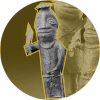
Representations of figures, often the Ọba, with an Ukhurhẹ (Ancestral Staff) in their right hand recur in a number of Emwin Arre (royal treasures), particularly those carved in wood as Agba (royal stools), cast in brass as part of Osogan (Osun staffs) and Ikẹgobọ (altars to the hand), and carved in ivory as Aken'ni Elao (carved tusks).

Ukhurhẹ are rattle staffs, usually made from wood, although brass examples are believed to have been owned by the Ọba. Ukhurhẹ were, and continue to be, commissioned when the paternal head of a family passes away as a way of commemorating them. Following a ceremony in which they are installed on the family’s ancestral altar, Ukhurhẹ are typically lined up against the back of the altar and are used to communicate with ancestors and the spirit world. When depicted on the Emwin Arre, Ukhurhẹ are usually held in the right hand of the Ọba, while an Ughavan (celts) is carried in his left hand.

1 annotation
Ukhurhẹ

Provenance

4 events
Production
unknown to February 22, 1897 (day approximate)
Production of Agba in Benin
Loot
February 19, 1897 (day approximate) to June 1899 (month approximate)
Looting of the Emwin Arre - Inalienable Cultural Artefacts - during the Invasion of the Benin Kingdom in February 1897 and until the end of overt military activity in June 1899
Auction
July 17, 1919
Sale at Puttick, Simpson & Neale, July 17th, 1919
Gift
1965
Gift of part of the Wellcome collection of Benin objects to the Fowler Museum at UCLA

Institution data

Fowler Museum at UCLA
The data was transferred directly by the institution.
Last updated: 2021-07-30
Language: english
Institution fieldValue
Object ID
object id
X65.1625
description
description
Materials
material
WOOD
Dimensions
dimensions
L: 59.70 cm, H: 38.10 cm, D: 31.80 cm
Object Name
object type
STOOL
Date
date made
7/17/19
Geographical area
production place
BENIN KINGDOM, SOUTH NIGERIA
Party
prior source
Phillips, Son & Neale, Wellcome Trust
Evidence 1
provenance
Evidence 2
provenance
Country Culture
ethnic attribution
Culture Group
ethnic attribution
Party Notes
notes
"Five carved Indian spears and a stick, 3 ditto stools, 5 swords, and a walking-stick"
summary of curatorial notes archival research thus far summer 2021
notes
status
legal status
Old Numbers
object id
R2552/1938, 19544B
Party Lot Number
256
provenance list known dates
provenance
Sensitive content

Sensitive Content Digital Benin includes colonial material that may contain inaccurate, derogatory or harmful language relating to African and African diasporic communities. Such language may appear in catalogue records, transcriptions, and book, exhibition or museum titles. We recognize that this material may cause distress. Sensitive-content warnings are being implemented across the collection, but this process is ongoing. The language does not reflect Digital Benin’s views; we take an anti-colonial and anti-racist position and are committed to centring the humanity of historically marginalised communities.

Read more about our approach