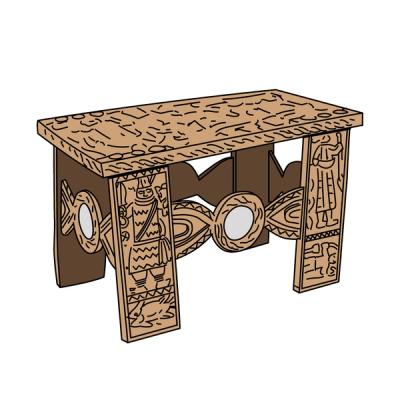
Agba
‘Ogiso ma m’ẹmwẹn ẹ fian agba’ (When the Ogiso does not have a case to judge, he will not ask for Agba to be made)
The Agba is regarded as the stool of judgement, and according to oral tradition, it originated during the Ogiso dynasty. In Benin Kingdom, there are two kinds of stools with ceremonial and ritual functions: the Agba and the Ẹrhẹ. The Agba is rectangular in shape, with a carved panel forming the seat and four carved interconnected panels that serve as the legs. Agba may be used by the Ọba, chiefs and some priests, and it is believed they were carved by members of the Emada (Hess, 1983, p.41 ). The Erhe has a circular seat and base with a central supporting column and can be cast in brass or carved in wood. Although a third kind of stool, the Ekete, has been identified in literature (e.g. Ezra 1992, p.263 ), our own research indicates that the word means ‘throne’ and can be used to describe any kind of stool the Ọba may sit upon, thus both the Agba and Erhe could be Ekete as well. (Hess, 1983, p.41 ).
Educational Material
Digital Benin collates digital material from institutions, and some of this material is inherently colonial and contains words, terms and phrases that are inaccurate, derogatory and harmful towards African and African diasporic communities. Catalogue transcriptions, book titles, exhibition titles and museum titles may contain harmful terms. We recognise the potential for the material to cause physical and mental distress as well as evoke strong emotions. Owing to the scale of the collection’s data, a process to implement sensitive-content warnings in the displayed data is still incomplete. The material within the catalogue does not represent Digital Benin’s views. Digital Benin maintains a strong anti-colonial, anti-racist position and affirms its support for centring the humanity of historically marginalised and disenfranchised communities. Read more about the background of this statement here