Loading...
Object Number
A230
Institution
Barnes Foundation Edo designations

English designations
Categories
Institution Location
2025 Benjamin Franklin Pkwy, Philadelphia, PA 19130, United States
Object Number
A230
Institution
Barnes Foundation Edo designations
English designations
Ewua Messenger Figure
Categories
Altar & Shrine Objects
Figures
Institution Location
2025 Benjamin Franklin Pkwy, Philadelphia, PA 19130, United States
Iconographies
6
annotations
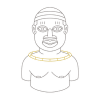
Ikele
Coral bead circlet
1 annotation


Uman-ague
Equal-armed cross
1 annotation


Ẹrhu
Headwear
1 annotation


Ukpọn
Wrapper
1 annotation


Itakpa
Cat's whiskers facial markings
1 annotation


Ubanu'hi
Inifinity Symbol
1 annotation

Provenance
4
events
Institution data
Barnes Foundation
The data was transferred directly by the institution.
Last updated: 2021-09-14
Language: english
| Institution field | Value |
|---|---|
Object Number object id | A230 |
Title designation | Standing Male Figure |
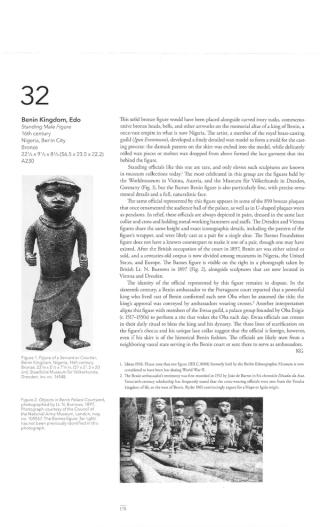
Description description | A sculpture of a standing man. He wears a decorated skirt, helmet, and a cross around his neck. He holds part of a sword in his left hand; his right hand is clasped, but does not hold an object. |
Medium material | Copper alloy |
Dimensions dimensions | Overall: 22 1/4 x 9 1/4 x 8 3/4 in. (56.5 x 23.5 x 22.2 cm) |
Classification object type | Sculptures |
Object Name object type | Figurines |
Mark(s) inscriptions | |
Dated date made | 16th century |
Place made production place | Benin City, Nigeria, Africa |
Provenance prior source | |
Culture ethnic attribution | Benin Kingdom, Edo |
Department department and institution | Gallery |
Curatorial Remarks notes | This cast copper alloy figure dates to the 16th century. It was made by an artist working for the king (Oba) of Benin, an empire that flourished in present-day Nigeria from around 1400 until 1897, when it was sacked by British punitive forces. Works of cast copper alloy, like this example, documented life at court and glorified the power and wealth of the Oba. The figure may represent either a priest or messenger. The figure's skirt depicts stylized faces, which may represent the Portuguese voyagers who conducted extensive trade with Benin beginning in the 15th century. (Dr. Christa Clarke, March 2003) |
Exhibition History exhibition history | Philadelphia Museum of Art, "Great French Paintings from The Barnes Foundation: Impressionist, Post-Impressionist, and Early Modern," January 29–April 9, 1995. |
Bibliography bibliography | Clarke, Christa. African Art in the Barnes Foundation: The Triumph of L'Art redacted e and the Harlem Renaissance. New York: Skira Rizzoli, 2015, 178-179. Clarke, Christa. "Defining African Art." African Arts 36, no. 1 (2003): 49, fig. 16. Dolkart, Judith F., Martha Lucy, and Derek Gillman. The Barnes Foundation: Masterworks. New York: Skira Rizzoli, 2012: 348, 349. Plankensteiner, Barbara, ed. Benin Kings and Rituals: Court Arts from Nigeria. Kunsthistorisches Museum, Vienna. Ghent: Snoeck Publishers, 2007: 28, 103, 105, 333-334. Wattenmaker, Richard J. and Anne Distel. Great French Paintings from The Barnes Foundation: Impressionist, Post-Impressionist, and Early Modern. New York: Alfred A. Knopf in association with Lincoln University Press, 1993, 23, fig. 9. |
Published References bibliography | |
Attribution producer | Unidentified artist |
Barnes Foundation
The data was transferred directly by the institution.
Last updated: 2022-06-01
Language: english
| Institution field | Value |
|---|---|
Accession Number object id | A230 |
Title designation | Ewua (Messenger Figure) |
Long Description description | This solid bronze figure would have been placed alongside carved ivory tusks, commemorative bronze heads, bells, and other artworks on the memorial altar of a king of Benin, a once-vast empire in what is now Nigeria. The artist, a member of the royal brass-casting guild (Igun Eronmwon), developed a finely detailed wax model to form a mold for the casting process: the damask pattern on the skirt was etched into the model, while delicately rolled wax pieces or molten wax dropped from above formed the lace garment that ties behind the figure. Standing officials like this one are rare, and only eleven such sculptures are known in museum collections today. The identity of the official represented by this figure remains in dispute. The three lines of scarification on the figure's cheeks and his unique lace collar suggest that the official is foreign, even if his skirt is of the historical Benin fashion. The officials are likely men from a neighboring vassal state serving in the Benin court or sent there to serve as ambassadors. Kathryn Gunsch in Christa Clarke, African Art in the Barnes Foundation: The Triumph of L'Art redacted e and the Harlem Renaissance (New York: Skira Rizzoli, 2015), 178. |
Sort Description description | This figure dates to the 16th century. It was made by an artist working for the king (Oba) of Benin, an empire that flourished in present-day Nigeria from around 1400 until 1897, when it was sacked by British forces. Works of cast copper alloy, like this example, documented life at court and glorified the power and wealth of the Oba. The figure may represent either a priest or messenger. Research commissioned by the Barnes Foundation has revealed that Standing Male Figure was looted by British forces during the 1897 punitive expedition . The Barnes has since joined the Digital Benin Project and is exploring ethical ways to move forward regarding this work. |
Medium material | Copper alloy |
Dimensions dimensions | Overall: 22 1/4 x 9 1/4 x 8 3/4 in. (56.5 x 23.5 x 22.2 cm) |
Year date made | 16th century |
Artist producer | Unidentified artist |
Culture ethnic attribution | Benin Kingdom, Edo |
Exhibition History exhibition history | Philadelphia Museum of Art, "Great French Paintings from The Barnes Foundation: Impressionist, Post-Impressionist, and Early Modern," January 29–April 9, 1995. Barnes Foundation, Philadelphia, "Isaac Julien: Once Again . . . (Statues Never Die)," June 19 – September 4, 2022. |
Location display status | Second Floor Balcony South (Room 24), South Wall |
Viewing Status display status | Currently on view |
Bibliography bibliography | The Barnes Foundation Handbook. Philadelphia: The Barnes Foundation, 2021, 135. Clarke, Christa. African Art in the Barnes Foundation: The Triumph of L'Art redacted e and the Harlem Renaissance. New York: Skira Rizzoli, 2015, 178-179. Clarke, Christa. "Defining African Art." African Arts 36, no. 1 (2003): 49, fig. 16. Dolkart, Judith F., Martha Lucy, and Derek Gillman. The Barnes Foundation: Masterworks. New York: Skira Rizzoli, 2012: 348, 349. Plankensteiner, Barbara, ed. Benin Kings and Rituals: Court Arts from Nigeria. Kunsthistorisches Museum, Vienna. Ghent: Snoeck Publishers, 2007: 28, 103, 105, 333-334. Wattenmaker, Richard J. and Anne Distel. Great French Paintings from The Barnes Foundation: Impressionist, Post-Impressionist, and Early Modern. New York: Alfred A. Knopf in association with Lincoln University Press, 1993, 23, fig. 9. |
Copyright Status license | Copyright Undetermined |
Provenance prior source | Purchased by Albert C. Barnes from Ernst Ascher through Galerie Bernheim-Jeune, November 19, 1930, 40,000 francs [1] [1] A handwritten notation gives the name Ascher, presumably Ernst Ascher; Bernheim Jeune et Cie. to Albert C. Barnes, November 19, 1930, Albert C. Barnes Correspondence, Barnes Foundation Archives |
Sections
About
Other
Sensitive content
Sensitive Content Digital Benin includes colonial material that may contain inaccurate, derogatory or harmful language relating to African and African diasporic communities. Such language may appear in catalogue records, transcriptions, and book, exhibition or museum titles. We recognize that this material may cause distress. Sensitive-content warnings are being implemented across the collection, but this process is ongoing. The language does not reflect Digital Benin’s views; we take an anti-colonial and anti-racist position and are committed to centring the humanity of historically marginalised communities.