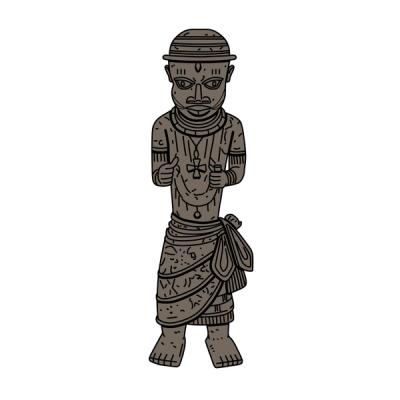
Ewua
Ewua is the title of a priest belonging to the Holy Aruosa Church, also referred to as the church of the Ọba of Benin. The church was first established by Portuguese missionaries in the fifteenth century. Each morning, noon and evening, the Ewua priest goes to the Ọba to lead prayers or devotion (this is an indication of the Catholic culture of the Angelus at 6:00 am, noon and 6:00 pm). The bronze casters today say that the figure holds an Avan, a small axe, in their left hand, though European literature refers to it as a hammer. He is also depicted wearing the equal-armed or Maltese cross on his chest.
Ewua messenger figures refer to cast sculptures of men with cross-shaped pendants worn around their necks and so-called cat’s whiskers scarification on both cheeks, which is thought to denote ‘foreigners’ or non-Edo peoples, and the round-topped cap or hat with open areas.
Educational Material
Digital Benin collates digital material from institutions, and some of this material is inherently colonial and contains words, terms and phrases that are inaccurate, derogatory and harmful towards African and African diasporic communities. Catalogue transcriptions, book titles, exhibition titles and museum titles may contain harmful terms. We recognise the potential for the material to cause physical and mental distress as well as evoke strong emotions. Owing to the scale of the collection’s data, a process to implement sensitive-content warnings in the displayed data is still incomplete. The material within the catalogue does not represent Digital Benin’s views. Digital Benin maintains a strong anti-colonial, anti-racist position and affirms its support for centring the humanity of historically marginalised and disenfranchised communities. Read more about the background of this statement here