Loading...
Object Number
1991.17.32
Edo designations
English designations
Categories
Institution Location
1000 5th Ave, New York, NY 10028, United States
Object Number
1991.17.32
Edo designations
English designations
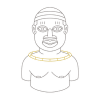
Ewua Messenger Figure
Categories
Altar & Shrine Objects
Figures
Institution Location
1000 5th Ave, New York, NY 10028, United States

Iconographies

7 annotations

Equal-armed cross
Uman-ague
Equal-armed cross

Uman-ague is a badge in the form of an equal-armed cross. The cross with straight-sided arms is known as the “Greek cross,” while the type with V-shaped arms, narrowing toward the centre, is known as the “Maltese cross.”

Uman-ague is usually worn around the neck by members of the Ewua or by the Ohensa. The equal-armed cross has various meanings: as a symbol of cosmic order, it represents the number four and references the “four cardinal points established by the High God Osanobua when he created the world” (Girshick Ben-Amos 1999, p. 64), as well as the “crossroads or junction that serves as the point of connection between the natural and spiritual worlds”. Paula Girshick Ben-Amos also argues that when used on the Aken'ni Elao (altar tusk), the cross, together with the Ivie okpagbaru (royal bead), constitutes an “emblematic reference” to Ọba Ẹsigie.

The cross also references the Portuguese missionaries who brought Christianity to the Kingdom during the reign of Ọba Ẹsigie, although the symbol was already in use before the arrival of Europeans. The Maltese cross is thought to have been introduced by Ọba Eresonyẹn as part of his efforts to encourage the worship of the High God Osanobua during his reign. Regardless, Uman-ague is often associated with Ọba Ẹsigie.

2 annotations
Uman-ague
Uman-ague
Round Neck Bead
Ikele
Coral bead circlet

Ikele is a single stiff string or circlet of coral beads. It is worn by chiefs, such as senior chiefs who have been made Enigie (Inneh 2007, p.107), and is a sign of nobility and rank. The Ikele may only be worn once the Ọba has conferred a person with the right to wear the beads, and the Ikele must always be worn when appearing before the Ọba. According to Ekhaguosa Aisien when a chief is wearing the Ikele, they may not eat nor drink in public, and they “constitute an embassy of the Benin Palace wherever he might be.”

2 annotations
Ikele
Ikele
Forehead markings
Ikharo
Forehead markings

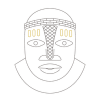
Ikharo are linear keloid markings depicted on the forehead of Uhunmwu-Elao (commemorative heads) in groups of three or four above each eye. The exact meaning of Ikharo is debated; some have argued that they relate to the gender or tribal identification of the person on whom they are depicted. For example, Gabriel Ọbazee has argued that they were worn only by men; however, their use in depictions is not consistent with this, and the Iy’Ọba are also shown wearing them. Flora Kaplan argued that they are instead a stylistic feature employed by artists that varied over time.

The naming of these markings differs between publications. For example, Ekhaguosa Aisien and Joseph Nevadomsky describe these markings as “agbaguda n'ehae”, which they write translates literally as “blades of the forehead”. However, Aisien later went on to call these “ikharo”, as used here. Kate Ezra referred to these forehead markings as ikharo, meaning “tribal mark [of eye]”.

1 annotation
Ikharo
Headwear
Ẹrhu
Headwear

Many different kinds of Ẹrhu (headwear) are worn by the various figures depicted in the imagery of Benin royal artefacts. Through comparisons with ceremonial regalia still worn by chiefs and members of the royal court, including the Ọba himself, some Ẹrhu have been used to identify the different figures depicted. For example, the conical hat worn by high-ranking town chiefs as part of the pangolin regalia, still worn at ceremonies, is also visible on figures on some Ama-Ẹrọnmwọn (bronze relief plaques). Other examples include the distinctive bell-shaped helmet associated with the Iyasẹ. Figures who wear a shallow-brimmed hat and a cross have been identified as Ewua or Ohensa priests.

Different kinds of helmets and headwear were worn by warriors, reflecting the many different ranks and roles in the army at any given time, as well as developing trends that were in turn represented on Emwin Arhe created at different points in time. Warrior figures wearing helmets covered in cowrie shells were carved on the Aken'ni Elao (carved tusks) (Blackmun 1984, p. 330), yet on the brass Ama, warriors are sometimes depicted wearing helmets made from crocodile hide or horsehair with a front plate (Osadolor in Plankensteiner 2007, cat. no. 238, p. 457). Helmets made from horsehair with a front plate are one of the more common types represented on the Ama-Ẹrọnmwọn, and the demand for black horse tails was noted by both Portuguese and British traders during the late 17th and 18th centuries (Osadolor in Plankensteiner 2007, cat. no. 238, p. 457). Other warriors depicted on Ama-Ẹrọnmwọn wear helmets with a rounded top, chinstrap, and sometimes also a feather tucked into the left side. These types of headwear are known as Ẹrhu Iyokuo.

Attire worn for battle also differed from that worn for ceremonial occasions, such as the pointed headwear worn in combination with an ornate leopard-head tunic by war chiefs. Depictions of figures wearing this attire on brass Ama-Ẹrọnmwọn (bronze relief plaques) have been interpreted as representing the war chiefs’ participation in the war-ritual Isiokuo festival (Osadolor in Plankensteiner 2007, cat. no. 238, p. 457).

Another distinctive form of headwear is that worn by figures identified as leopard hunters on the brass Ama-Ẹrọnmwọn (relief plaques). These large helmets cover almost all of the leopard hunters’ faces except for their noses, eyes, and upper lips, and are made of an unusual material that remains unidentifiable (Plankensteiner 2007, cat. nos. 68–69, p. 322).

European figures are also portrayed with distinctive hats, such as Portuguese three-cornered hats. These depictions reflect the artists’ keen observation and highlight the impact of European trade and military assistance (Ezra 1992).

1 annotation
Ẹrhu
Portuguese Head
Uhunmwu Ikpotoki
Portuguese Head

These motifs are known as Uhunmwu Ikpotoki in Edo, which translates as ‘Portuguese head’ in English. Portraits of Portuguese men, featuring only their heads and sometimes their shoulders, were used by artists as motifs on the Emwin Arre (royal treasures), in particular on the Ama-Ẹrọnmwọn (bronze relief plaques) and Aken'ni Elao (carved altar tusks). Also included here are a series of two or three conjoined spirals, which are interpreted as abstract forms of this motif.

One of the earliest suggestions that many of the European figures depicted on objects were Portuguese was made two years after the 1897 British Colonial Military Campaign on Benin City by the British Museum curators Charles Hercules Read and Ormonde Maddock Dalton, based on testimony from seven chiefs in the aftermath of the military campaign. The long, straight hair, beards, and domed hats together led to the identification of these representations as Europeans.

When included within the visual imagery of the Emwin Arhe, the Portuguese are associated with the new Atlantic trade and the consequent wealth that emerged following first contact with the Portuguese in the late 15th century. For this reason, Portuguese heads are also often associated with the sea deity Olokun. Eisenhofer argued that the Portuguese figures and heads as motifs on the royal treasures are symbols of the king’s power: “these depictions of foreigners helped to build and strengthen the king’s image.”

When incorporated into the design of the Ama-Ẹrọnmwọn (bronze relief plaques), Curnow instead argued that these motifs could in fact indicate events that took place during Ọba Esigie’s reign. Ọba Esigie is associated with the Portuguese, as they became increasingly important during his reign, assisting with battles against the Igala from Idah, bringing Catholicism to Benin, and introducing weaponry such as guns and cannons, which were instrumental in the expansion of the kingdom.

1 annotation
Uhunmwu Ikpotoki

Provenance

6 events
Production
unknown to February 22, 1897 (day approximate)
Production of Ewua by the Igun-Ẹrọnmwọn in Benin City
Loot
February 19, 1897 (day approximate) to June 1899 (month approximate)
Looting of the Emwin Arre - Inalienable Cultural Artefacts - during the Invasion of the Benin Kingdom in February 1897 and until the end of overt military activity in June 1899
Collection
February 20, 1897 to 1900
The object was part of the collection of Richard Alfred Poer O’Shee.
Auction
March 8, 1957
Sale at Sotheby's, London, March 8th, 1957
Auction
November 18, 1986
Sale at Sotheby's, New York, November 18th, 1986
Gift
1991
Gift of the Perls collection of Benin objects to the Metropolitan Museum of Art, 1991

Institution data

Metropolitan Museum of Art
The data was transferred directly by the institution.
Last updated: 2021-07-30
Language: english
Institution fieldValue
Object Number
object id
1991.17.32
Object Sort Number
object id
1991 17 32
Primary Rendition No
object id
DT1232
Title
designation
object type
Male Figure: Court Official
Medium
material
Brass
Dimensions
dimensions
H. 24 3/4 in. × W. 7 1/8 in. × D. 7 in. (62.9 × 18.1 × 17.8 cm)
Classification
object type
Metal-Sculpture
Date
date made
16th–17th century
Geo: City
production place
Court of Benin
Geo: Country
production place
Nigeria
Credit Line
prior source
Gift of Mr. and Mrs. Klaus G. Perls, 1991
Provenance
provenance
Court of Benin, taken from the Royal Palace in 1897 during the British military occupation of Benin; Col. Le-Poer-O'Shea, Royal Engineers Boundary Commission, 1897–1900; (Sotheby's, London, March 8, 1957, no. 197); [Julius Carlebach Gallery, New York, from 1957]; a private collector, until 1986; (Sotheby's, New York, Nov. 18, 1986, no. 96); Mr. and Mrs. Klaus G. Perls, New York, 1986–1991Court of Benin Objects in the Michael C. Rockefeller Wing, Metropolitan Museum of Art
Dynasty
reign associated name
Oranmiyan
Culture
ethnic attribution
Edo peoples
ExhibitionHistory
exhibition history
Royal Art of Benin from the Perls Collection The Metropolitan Museum of Art, January 16, 1992–September 13,1992 Treasures From an African Kingdom: The Royal Art of Benin from thePerls Collection at the Metropolitan Museum of Art The Frick Art & Historical Center, June 24, 1993–August 29,1993 Kimbell Art Museum, October 30, 1993–January 2,1994 High Museum of Art, January 25, 1994–April 24,1994 Cincinnati Art Museum, May 21, 1994–August 7,1994 Denver Art Museum, September 6, 1994–November 28,1994
Bibliography
bibliography
Ben‑Amos Paula. The Art of Benin. New York: Thames and Hudson, 1980, p. 40. Blackmun, Barbara. "From Trader to Priest in Two Hundred Years: The Transformation of a Foreign Figure on Benin Ivories." Art Journal vol. 27, no. 2, pp. 131–132. Dark, Philip J.C. An Illustrated Catalogue of Benin Art. Boston: G. K. Hall & Co., 1982, Y8/61. Eyo, Ekpo and Frank Willett. Treasures of Ancient Nigeria. New York: Knopf, 1980, p. 133. Ezra, Kate. The Metropolitan Museum of Art Bulletin, Recent Acquisitions (Fall 1991), p. 83. Ezra, Kate. Royal Art of Benin: The Perls Collection in the Metropolitan Museum of Art. New York: The Metropolitan Museum of Art, 1992, p. 66–67, no. 15. Lehuard, Raoul. "Les Ventes." Arts d' vol. 61 (1987), pp. 47–48. Sotheby & Co. Oriental and European Rugs and Carpets: Textiles and Tapestries; English and Continental Clocks; Fine French and English Furniture. London: , March 8, 1957, no. 157. Sotheby's. Important Art. New York: , November 18, 1986, no. 96.
Published References
bibliography
Oriental and European Rugs and Carpets: Textiles and Tapestries; English and Continental Clocks; Fine French and English Furniture (sale cat.), Sotheby's, London, March 8, 1957, lot 197. Dark, P. 1982. An Illustrated Catalogue of Benin Art. Boston: Y8/61. Important Art (sale cat.), Sotheby's, New York, November 18, 1986, lot 96. Lehuard, R. 1987. "Les Ventes." Arts d' 61: 47- 48; 47. Ezra, K. 1991. The Metropolitan Museum of Art Bulletin, Recent Acquisitions, New York, Fall: 83. "ROYAL ART OF BENIN. The Perls Collection in The Metropolitan Museum of Art." Kate Ezra. The Metropolitan Museum of Art and Harry N. Abrams Inc., New York 1992 Fig. 15
Sensitive content

Sensitive Content Digital Benin includes colonial material that may contain inaccurate, derogatory or harmful language relating to African and African diasporic communities. Such language may appear in catalogue records, transcriptions, and book, exhibition or museum titles. We recognize that this material may cause distress. Sensitive-content warnings are being implemented across the collection, but this process is ongoing. The language does not reflect Digital Benin’s views; we take an anti-colonial and anti-racist position and are committed to centring the humanity of historically marginalised communities.

Read more about our approach