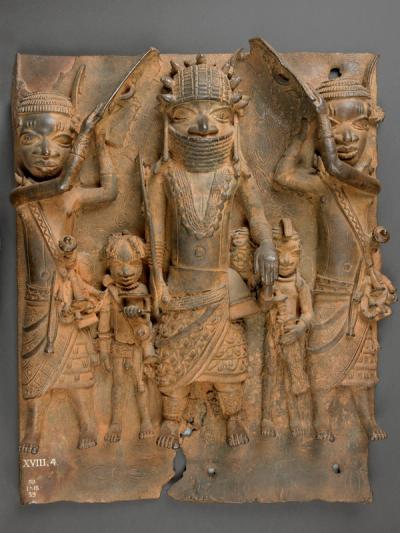
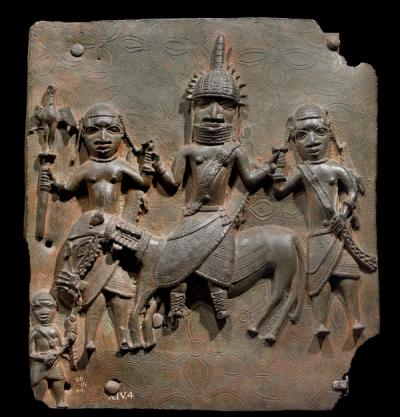
Ọba Ẹsigie (reigned c. 1504–1550) was, like his father and grandfather before him, a powerful warrior king. He is particularly remembered for suppressing his brother Aruanran, ruler of Udo, and for his victories against the Kingdom of Idah (c. 1515–1517), achieved with the support of his mother, Idia, and Portuguese mercenaries. Relations with the Portuguese intensified during Ẹsigie’s reign, resulting in increased imports of brass into the Benin Kingdom and contributing to a flourishing of brass casting.
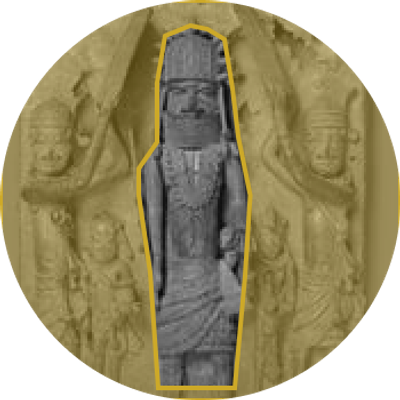
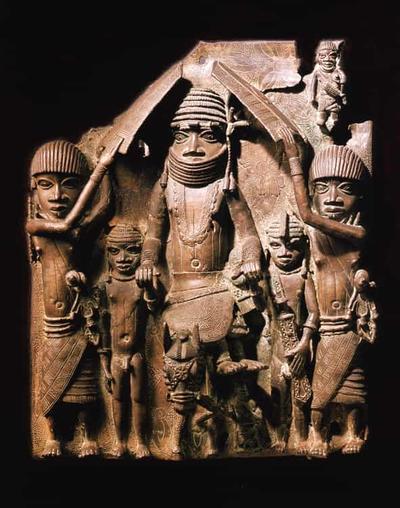
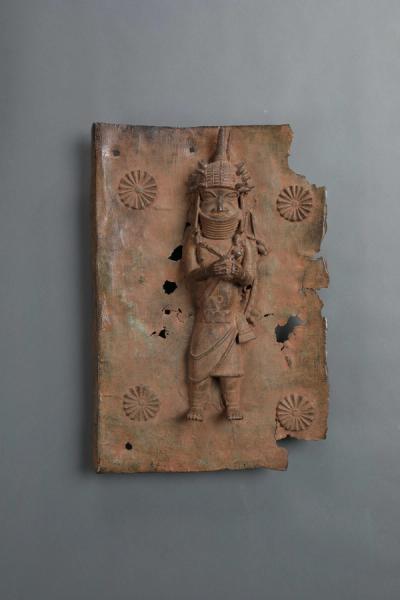
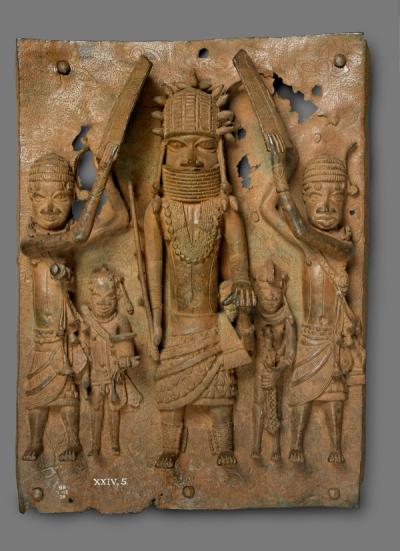
Casters and carvers from the Igun-Ẹrọnmwọn and Igbesamwan represented Ọba Ẹsigie in a variety of ways. He is typically shown wearing the beaded swag over the right hip associated with Ọbas, U-shaped beaded hanging necklaces, heavy beaded anklets, and a richly textured and fringed wrapper ( ).
As a warrior, Ẹsigie was frequently depicted in battle, including in some of the so-called ‘Battle Scene’ Ama-Ẹrọnmwọn (bronze relief plaques). He is also sometimes described as the ‘ruler on horseback’. It is recorded that King Manuel I of Portugal sent him a horse caparisoned with silks, linens, beads and other costly materials. A number of representations show Ẹsigie riding side-saddle, most likely commemorating his military successes.
Ẹsigie was also represented in religious and ceremonial contexts. He appears holding sacred objects such as the Ahianmwe Oro (Bird of Prophecy Clapper) during festivals, the Unwẹnrhiẹnọtan (ceremonial switch) during sacrifices, or a small netted sphere. Some carvings even depict him as a youth holding hands with a Portuguese figure, reflecting his close relationship with the Portuguese; Ẹsigie was baptised and his son was subsequently educated in Portugal.
Art associated with Ẹsigie also frequently incorporates motifs connected with Olokun, deity of the sea, including fish and snakes, alongside Portuguese imagery. These motifs reflect the importance of maritime trade, diplomacy and the kingdom’s relationships with the Portuguese during his reign.
Sensitive Content Digital Benin includes colonial material that may contain inaccurate, derogatory or harmful language relating to African and African diasporic communities. Such language may appear in catalogue records, transcriptions, and book, exhibition or museum titles. We recognize that this material may cause distress. Sensitive-content warnings are being implemented across the collection, but this process is ongoing. The language does not reflect Digital Benin’s views; we take an anti-colonial and anti-racist position and are committed to centring the humanity of historically marginalised communities.