Loading...
Relief Plaque
Relief Plaque
Relief Plaque
Relief Plaque
Relief Plaque
Relief Plaque
Relief Plaque
Registration number
Af1898,0115.38
Institution
British Museum
Edo designations
English designations
Categories
Institution Location
Great Russell St, Bloomsbury, London WC1B 3DG, United Kingdom
Registration number
Af1898,0115.38
Institution
British Museum
Edo designations
English designations
Relief Plaque
Categories
Palace Architecture & Ornamentation
Institution Location
Great Russell St, Bloomsbury, London WC1B 3DG, United Kingdom

Iconographies

22 annotations

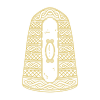
Colar Bead
Odigba
Coral beaded collar

Odigba (beaded collar) is a rigid neck collar made of beads, worn as part of ceremonial attire only by senior princes who have been made Enigie. Although Ibafe (2007, p. 43) argued that the Odigba was introduced during the Ogiso period (c. 900–c. 1170 AD) by Ogiso Ere, along with other symbolically important Emwin Arre, such as the Ada (ceremonial sword) and the Ebẹn (ceremonial sword). The Odigba was initially made of beads, while coral was incorporated only later, following its introduction through trade with Portuguese merchants in the late fifteenth century.

1 annotation
Odigba
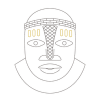
Forehead markings
Ikharo
Forehead markings

Ikharo are linear keloid markings depicted on the forehead of Uhunmwu-Elao (commemorative heads) in groups of three or four above each eye. The exact meaning of Ikharo is debated; some have argued that they relate to the gender or tribal identification of the person on whom they are depicted. For example, Gabriel Ọbazee has argued that they were worn only by men; however, their use in depictions is not consistent with this, and the Iy’Ọba are also shown wearing them. Flora Kaplan argued that they are instead a stylistic feature employed by artists that varied over time.

The naming of these markings differs between publications. For example, Ekhaguosa Aisien and Joseph Nevadomsky describe these markings as “agbaguda n'ehae”, which they write translates literally as “blades of the forehead”. However, Aisien later went on to call these “ikharo”, as used here. Kate Ezra referred to these forehead markings as ikharo, meaning “tribal mark [of eye]”.

2 annotations
Ikharo
Ikharo
Water fern
Ebe Amẹ
Water Fern

Ebe Amẹ refers to a wide variety of plants, particularly the leaves of the water fern or river leaf, found in riverine areas of southern Nigeria. Artists from the Igun-Ẹrọnmwọn used these as a decorative motif in the background of most Ama-Ẹrọnmwọn (bronze relief plaques). The petals of the Ebe Amẹ, like the points of the ἀghàdàgháda (crossroads), represent the four cardinal directions: north, east, south, and west. The number four plays a foundational role in the Edo calendar, which is structured around four market days.

1 annotation
Ebe Amẹ
Attendant
Ibierugha
Attendant

Figures of young men and women, often depicted nude except for waist beads, occur frequently throughout the visual language of Emwin Arre (royal artefacts), particularly on Ama-Ẹrọnmwọn (bronze relief plaques), Urhotọ (altar tableaux), and Aken'ni Elao (carved tusks). These figures are typically shown attending or supporting high-status individuals such as the Ọba, Iy’Ọba, or warrior chiefs. Their smaller scale visually reinforces their subordinate status.

Attendants may carry symbols of state, such as the Ada and Ẹbẹn (ceremonial swords), on behalf of the Ọba; Ẹzuzu (fans), used to cool the Ọba and Iy’Ọba and to waft away evil spirits; or Asa (shields), held over the heads of higher-status figures to protect them from malevolent forces.Kaplan 2007, p. 149 Other attendants are shown carrying offerings, sometimes contained in specialised vessels such as Ẹkpoki (cylindrical boxes) or Orhiẹvbẹ (kola-nut bowls).

Ibierugha (male attendant figures) are distinguished by a characteristic crest-like hairstyle with a braided lock of hair falling over the left ear. The Ọba was typically attended by young men, while the Iy’Ọba was attended by young women. Attendants of both genders were usually provided with clothing by the Ọba or Iy’Ọba once they reached maturity, at which point the royal household would also arrange suitable marriage partners for them.

2 annotations
Ibierugha
Ibierugha
Shield
Asa
Shield

Asa (shields) are a crucial attribute of warriors and warrior chiefs, forming part of their ceremonial and battle attire as represented on the Emwin Arre (royal treasures). Asa were usually made from elephant or crocodile skin and used by warriors for protection during hand-to-hand combat. Interestingly, the form of Asa depicted on historic royal artefacts differs from those found in museum collections today, reflecting changes in shield shapes and designs over time.

2 annotations
Asa
Asa
Portuguese Head
Uhunmwu Ikpotoki
Portuguese Head

These motifs are known as Uhunmwu Ikpotoki in Edo, which translates as ‘Portuguese head’ in English. Portraits of Portuguese men, featuring only their heads and sometimes their shoulders, were used by artists as motifs on the Emwin Arre (royal treasures), in particular on the Ama-Ẹrọnmwọn (bronze relief plaques) and Aken'ni Elao (carved altar tusks). Also included here are a series of two or three conjoined spirals, which are interpreted as abstract forms of this motif.

One of the earliest suggestions that many of the European figures depicted on objects were Portuguese was made two years after the 1897 British Colonial Military Campaign on Benin City by the British Museum curators Charles Hercules Read and Ormonde Maddock Dalton, based on testimony from seven chiefs in the aftermath of the military campaign. The long, straight hair, beards, and domed hats together led to the identification of these representations as Europeans.

When included within the visual imagery of the Emwin Arhe, the Portuguese are associated with the new Atlantic trade and the consequent wealth that emerged following first contact with the Portuguese in the late 15th century. For this reason, Portuguese heads are also often associated with the sea deity Olokun. Eisenhofer argued that the Portuguese figures and heads as motifs on the royal treasures are symbols of the king’s power: “these depictions of foreigners helped to build and strengthen the king’s image.”

When incorporated into the design of the Ama-Ẹrọnmwọn (bronze relief plaques), Curnow instead argued that these motifs could in fact indicate events that took place during Ọba Esigie’s reign. Ọba Esigie is associated with the Portuguese, as they became increasingly important during his reign, assisting with battles against the Igala from Idah, bringing Catholicism to Benin, and introducing weaponry such as guns and cannons, which were instrumental in the expansion of the kingdom.

1 annotation
Uhunmwu Ikpotoki
Switch
Unwẹnrhiẹnọtan
Switch

The Unwẹnrhiẹnọtan (switch) is made from branches of a tall shrub and is held by the Ọba and certain chiefs, such as the Osuan and Ooton, during sacrificial rituals and ceremonies, particularly Ugie Erha Ọba. Figures carrying Unwẹnrhiẹnọtan are depicted in brass on the Ama-Ẹrọnmwọn (bronze relief plaques) and also carved in ivory on the Aken'ni Elao (altar tusk).

According to Barbara Blackmun, the Unwẹnrhiẹnọtan “is required whenever the sacrifice of a living creature takes place within the Ọba’s palace complex, to drive away intrusive spiritual forces. The upright position of this essential implement suggests that the person who holds it is about to preside over a sacrificial ceremony.”

1 annotation
Unwẹnrhiẹnọtan
Sheath
Akuọghọ
Sheath

Akuọghọ are sheaths for swords and bladed weapons. They are usually made from leather or other materials and can be highly decorated with brass sheet and coral beads. The importance of Akuọghọ is indicated by the fact that these are some of the very few inanimate objects that serve as the focal motif on some Ama-Ẹrọnmwọn (bronze relief plaques).

1 annotation
Akuọghọ
tribal marks
Iwu
Facial and Body Markings

Iwu are facial and body markings (scarifications) that were historically worn by Edo men and women. However, since the 1960s, the practice has been nearly extinct. ). In the past, Iwu were used as a way of proving that one was an Edo citizen, and the ceremony of having Iwu completed was an important rite of passage for men and women. The Osiwu, who also practised circumcision and other surgical procedures, would carry out the procedure of adding Iwu. There are different types of Iwu: ‘blades’ worn on the torso (Iwu-eko), and those worn on the face, such as Ikharo (three or four markings above the eyebrows), Irho (two narrow ‘blades’ worn on each cheek), Ovbihue (nasal ‘blades’), Ovbi-agbanmwen (chin ‘blade’), and Igho-okpa/Ukpgho (three forehead ‘blades’).

The number of Iwu also varied depending on the identity of the person wearing them. For example, royal men would wear six ‘blades’ on their torso, whilst men who were not royal would wear seven ‘blades’. Meanwhile, the Ọba’s female children would wear fifteen ‘blades’, and all other women would wear sixteen.

3 annotations
Iwu
Iwu
Iwu
leopard teeth
Akọn Ẹkpen
Leopard Teeth Neck Ornament

Akọn Ẹkpẹn are necklaces or neck ornaments made of strung leopard’s teeth. They are worn by figures to signify their high rank and military prowess, as well as by their leaders, the Ezọmọ or Iyasẹ. They are often worn alongside quadrangular Ẹroro (bells) and Ohian Ẹkpẹn (leopard tunics).

The Akọn Ẹkpẹn is clearly and profoundly related to the symbolism of the Ẹkpẹn (leopard) and its association with the Ọba (king), who is metaphorically referred to as ‘ẹkpẹn ne owa’, the ‘leopard of the home’. On the other hand, the Ẹkpẹn is often referred to as the ‘king of the bush’, embodying ferocity, aggression, strength, and leadership—qualities attributed to the Ọba. This intricate link between the leopard, the monarch, and his military leaders reinforces the complex hierarchy and spiritual authority central to Benin’s courtly art.

2 annotations
Akọn Ẹkpen
Akọn Ẹkpen
Wrapper
Ukpọn
Wrapper

Ukpọn is the Edo term for cloth and is used here to refer to the wrappers or kilts worn by many of the figures depicted on the Emwin Arre (royal treasures). The cloth worn around the waist may be plain, but it is more commonly richly decorated with motifs associated with the monarchy, power, and wealth, such as the Ọba'nui (infinity symbol) and Uhunme Ikpotoki (Portuguese heads).

The Benin Kingdom was renowned for its textile production, both for local use and for trade. Within the royal court, members of the Owina n’Ido produced ukhuen cloth for the Ọba and other members of the court, who wore it as wrappers during festivals and ceremonies.

Alongside locally produced textiles, imported cloth was also an important commodity in the Benin Kingdom’s trade networks. Textiles were exchanged with neighbouring production centres, particularly Ijebu, while European traders brought silks, woollens, linens, and cotton from Europe and Asia from the 15th century onwards.

1 annotation
Ukpọn
King Ẹsigie
Ọba Ẹsigie
King Ẹsigie

Ọba Ẹsigie (reigned c. 1504–1550) was, like his father and grandfather before him, a powerful warrior king. He is particularly remembered for suppressing his brother Aruanran, ruler of Udo, and for his victories against the Kingdom of Idah (c. 1515–1517), achieved with the support of his mother, Idia, and Portuguese mercenaries. Relations with the Portuguese intensified during Ẹsigie’s reign, resulting in increased imports of brass into the Benin Kingdom and contributing to a flourishing of brass casting.

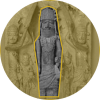
Casters and carvers from the Igun-Ẹrọnmwọn and Igbesamwan represented Ọba Ẹsigie in a variety of ways. He is typically shown wearing the beaded swag over the right hip associated with Ọbas, U-shaped beaded hanging necklaces, heavy beaded anklets, and a richly textured and fringed wrapper ( ).

As a warrior, Ẹsigie was frequently depicted in battle, including in some of the so-called ‘Battle Scene’ Ama-Ẹrọnmwọn (bronze relief plaques). He is also sometimes described as the ‘ruler on horseback’. It is recorded that King Manuel I of Portugal sent him a horse caparisoned with silks, linens, beads and other costly materials. A number of representations show Ẹsigie riding side-saddle, most likely commemorating his military successes.

Ẹsigie was also represented in religious and ceremonial contexts. He appears holding sacred objects such as the Ahianmwe Oro (Bird of Prophecy Clapper) during festivals, the Unwẹnrhiẹnọtan (ceremonial switch) during sacrifices, or a small netted sphere. Some carvings even depict him as a youth holding hands with a Portuguese figure, reflecting his close relationship with the Portuguese; Ẹsigie was baptised and his son was subsequently educated in Portugal.

Art associated with Ẹsigie also frequently incorporates motifs connected with Olokun, deity of the sea, including fish and snakes, alongside Portuguese imagery. These motifs reflect the importance of maritime trade, diplomacy and the kingdom’s relationships with the Portuguese during his reign.

1 annotation
Ọba Ẹsigie
Supporter
Enobare
Supporter

Enobare is the term used for the supporting figures who are typically depicted alongside the Ọba, holding his arms or hands as part of the Royal Triad motif. Their identities are interpreted variously: they may represent the Osa and Osuan, who support the Ọba during certain ceremonial contexts, or, particularly in representations dating to the 18th century, the Edaiken (crown prince) and Ezọmọ.

2 annotations
Enobare
Enobare
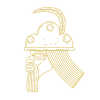
Beaded Crown
Ẹde
Beaded Crown

Although many other members of the Benin royal court wore a variety of hats and forms of headwear, only the Ọba may wear the Ẹde (beaded crown). The Ọba must never be seen bare-headed, and successive Ọba introduced different styles and types of crowns.

Across different media and objects, Ọba are depicted wearing various types of crowns, all elaborately crafted from coral beads. Some feature tall projections rising from the crown, known as Oro, while others have curved projections extending from either side of the head, known as the winged cap. The latter was introduced only in the 19th century, most likely by Ọba Osẹmwẹndẹ. Depictions of Ọba Ẹsigie on Ama-Ẹrọnmwọn (bronze relief plaques) show him wearing an elaborate crown decorated with large jasper or coral beads.

1 annotation
Ẹde
Cylindrical Boxes
Ẹkpoki
Cylindrical Boxes

Ẹkpoki are cylindrical boxes made by members of the Isekpokin (guild of leather workers) from leather and bark. In the late 19th century, some were also crafted from brass sheet with rich embossed ornamentation. Members of the Igun Ẹronmwon (guild of brass casters) might have created examples from cast brass, although only a single example of this kind is known today (inventory no. 212729). Ẹkpoki are used by the Ọba to present gifts to chiefs, while chiefs use leather Ẹkpoki to send kola nuts and other traditional items to one another. Ẹkpoki also feature in important rituals such as Iguẹ, during which the Ọba is ceremonially presented with an Ẹkpoki, as well as Ugie-Ewere, during which the Ọba is presented with an Ẹkpoki that symbolically contains a gift from the Ooni of Ife. This refers to an oral tradition that, at the coronation, the Ooni of Ife sent certain regalia. Gifts presented in Ẹkpoki could also have carried symbolic messages.

1 annotation
Ẹkpoki

Provenance

14 events
Production
1504 (approximate) to 1550 (approximate)
Production of the Ama-Ẹrọnmwọn by the Igun-Ẹrọnmwọn guild in Benin City
Loot
February 19, 1897 (day approximate) to June 1899 (month approximate)
Looting of the Emwin Arre - Inalienable Cultural Artefacts - during the Invasion of the Benin Kingdom in February 1897 and until the end of overt military activity in June 1899
Transfer
March 19, 1897 (day approximate)
Transfer of the Ama-Ẹrọnmwọn prize group to the British Foreign Office by Consul General Ralph Moor
Loan
September 7, 1897 to January 1898 (month approximate)
Loan and exhibition of the Foreign Office Ama-Ẹrọnmwọn group to the British Museum, September 1897
Donation
January 15, 1898
Donation of part of the British Foreign Office Ama-Ẹrọnmwọn group to the British Museum, January 15th, 1898
Exhibition
1970 to 1973
'Divine Kingship in Africa', 1970-1973, Museum of Mankind, London.
Exhibition
sometime in 1993 to sometime in 1997
'Great Benin: a West African Kingdom', 1993-1997, Museum of Mankind, London.
Exhibition
October 13, 1997 to May 3, 1998
'The Enduring Image', October 13th, 1997-May 3rd, 1998, India
Exhibition
April 2003 to September 2003
'Museum of the Mind: Art and Memory in World Cultures', April 2003-September 2003, British Museum, London
Exhibition
October 2003
'Art and Memory', October 2003, Setagaya Art Museum, Tokyo
Exhibition
October 18, 2003 to January 31, 2006
'Treasures of the World's Cultures', October 18th, 2003-January 31st, 2006, Japan ; South Korea
Exhibition
March 18, 2006 to July 2012
'Treasures of the World's Cultures', March 18th, 2006-July 2012, China, Taiwan, Hong Kong, Canada, Spain, United Arab Emirates
Exhibition
May 2007 to September 2008
'Benin. Kings and Rituals: Court Arts from Nigeria', May 2007-May 2008, Vienna ; Paris ; Berlin
Exhibition
November 10, 2017 to June 30, 2018
'India and the World: A History in Nine Stories', November 10th, 2017-June 30th, 2018, India

Related archival documents

3 documents
See all
Museum Catalogue
Staatsbibliothek zu Berlin
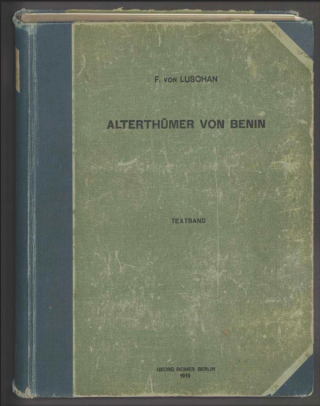
Die Altertümer von Benin
Date
January 1, 1919 at 12:00:00 AM
An archival document representing a Research notes of 1 page(s)
Research notes
British Museum
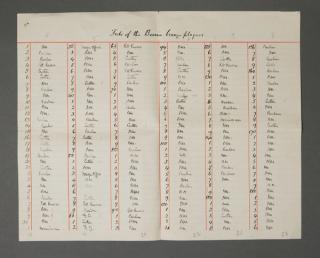
Fate of the Benin bronze plaques
Date
some day in March 1897 to sometime in 1899
An archival document representing a Research notes of 1 page(s)
Research notes
British Museum
Foreign Office plaques retained and dispersed
Date
January 1, 1899

Institution data

British Museum
The data was transferred directly by the institution.
Last updated: 2025-06-10
Language: english
Institution fieldValue
Registration number
object id
Af1898,0115.38
Additional IDs
object id
181 (Foreign Office number)
PRN
object id
EAF14516
Object Type
designation
plaque
Description
description
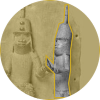
Relief plaque, lost-wax cast in brass. Wide plaque, rectangular in form with side flanges. Background surface decorated with river leaf patterns and stippling. Four nail holes at top, four holes at bottom. Depicts standing figure of Oba (possibly Esigie), facing front, flanked by two standing warrior figures holding shields above his head. Oba wears beaded crown with feather at left, deep beaded collar, multiple beaded necklaces, beaded bracelets and anklets, and patterned wrap-around skirt tied with sash on left hip. Holds ceremonial switch in right hand and places left hand on top of horn held by small attendant at side. Two warriors have tiered hairstyle with single feather and coiled side lock at left side. Wear armlets, leopard's tooth necklace, patterned wrap-around skirts with sash tied over left hip. Both carry swords on left side. Smaller naked emada figures stand on either side of Oba. Figure on right has tiered hairstyle with shaven central section, wears patterned hip ornament tied on left hip and beaded necklace. Carries ekpokin box in left hand. Figure on left has crested haristyle and wears two beaded necklaces. Carries sword in left hand at front of body and holds horn in right hand.
Ethnic name (made by)
ethnic attribution
Edo
Date
date made
16thC-17thC
Production place
production place
Made in: Benin City
Findspot
place collected
Found/Acquired: Benin City
Materials
material
brass
Technique
production technique
lost-wax cast
Dimensions
dimensions
Height: 51.00 cm~Width: 38.00 cm~Depth: 11.00 cm~Weight: 13.50 kg
Curator’s comments
provenance
The relief brass plaques that used to decorate the Oba's (king's) palace are among the most well-known of all the royal arts of Benin. Although frequently described as 'Benin Bronzes' most plaques are made of leaded brass in various compositions. It is widely accepted that they date to the 16th-17th centuries. In the years prior to the British royal influence in Benin was increasingly under threat from rival powers, both internal and external, with a focus on economic power and control of the important trading monopolies. However, the court and palace remained the political and spiritual centre of the Benin Kingdom. Earlier accounts written by Europeans visiting the city describe its size and scale. The palace complex was set up around atrium courtyards; some had galleries with wooden pillars supporting the roof. Brass plaques, probably made in matching pairs, were fixed to these pillars. The Benin brass plaques represent a distinct and unique corpus of work, unparalleled elsewhere on the continent. They are cast using the cire perdue (lost wax) technique and show significant variation in the depth of the relief. Some of the plaques portray historical events or commemorate successful wars, while others are a vivid depiction of Benin court life and ritual. Several groups of plaques show clear stylistic similarities. William B. Fagg suggested that these plaques represent the work of master brass casters. Fagg, William, 1973, 'Nigerian Images', London: Lund Humphries Gunsch, Kathryn, 2018, 'Benin plaques: a 16th century imperial monument', London: Routledge, Taylor and Francis Group ; Direct pair with BM plaque Af1898,0115.39. Oba carries flexible switch, uwenrhien otan, in preparation for sacrificial ceremony. His retainers shield him from the sun, and also from hostile spiritual forces. ; Part of Processional Pillar Set 7. Row 3A. Oba with warriors holding shields aloft (Gunsch, 2018). ; Plankensteiner 2007: These two plaques [with Af1898,0115.39] simultaneously arrived at the British Museum in 1898. Though a little different in size, iconographically and stylistically they are nearly identical. The corresponding features make it all the more likely that they were meant to be a pair. As is known about the old palace buildings at the time of these plaques' manufacturing, this sort of plaque was attached - and demonstrably in symmetrical ordering - onto the pillars of the verandas and entrances. The opulent jewelry of the central figure, identified as Oba Esigie by Barbara Blackmun (1997) based on a comparisson of depictions on carved ivories and plaques, comprises of a high beaded choker, a multirow necklace of agate and coral beads, large agate pendants hanging on the sides of the coral beaded cap, adorned with a feather, arm and foot rings, a precious wrapper, presumably made from imported Indian or Portuguese fabrics, and a luxurious belt-and hip decoration with a mask. In his right hand the king holds a ceremonial switch. His left hand rests on the hand of one of the two small and - except for some jewelry - naked attendants, who also carries a sword. The small attendant figure to the left of the plaque carries a spool-shaped 'ekpokin' box. The two larger figures wear precious clothes. They protect the Oba's head from both sides with raised shields. All attendant figures have an unusual hairdo: a hair lock adorns the left ear of the two shield carrying figures, the hairstyle of both small attendants are reminiscent of those worn by the Ooton priests and the hair crest of the Oduduwa masks. The depicted scene presumably represents a ritual at a palace ceremony, the Igue, for instance, or the Ugie Erha Oba.; This plaque shows an Oba surrounded by his attendants, two of whom are depicted holding up their shields in a formal protective stance. Only the Oba was allowed to be shaded in this way within the city. P. Girshick Ben-Amos, The art of Benin (London, The British Museum Press, 1995); Blurton, 1997 Brass was intimately associated with kingship in the Benin empire and plaques, cast by the lost-wax process, were used to cover the wooden beams that supported the roof in the royal palace, the centre of religious activities that controlled the well-being of the entire empire. Those seen here show scenes of court life and ritual which involve rulers, warriors and officials. Naked figures are royal pages, their nudity contrasting with the splendid cloth and coral-bead costumes of royalty. Depictions of the European adventurers and traders, who sold the metal from which the plaques were cast, also appear and local interest centred on their long hair, hooked noses, dress and weapons. Since they were seen as messengers of the god Olokun, a white-faced deity who sends wealth and children over the sea, their presence in the palace is probably less a celebration of their own wealth and power than those of the Oba (king), who is said to have defeated Olokun in battle, stripping him of his riches and finery.
Bibliographic references
bibliography
Gunsch 2018: p.166 (3A); p.167, fig.6.61; p.174~Read & Dalton 1899: pl XXIV.5~Plankensteiner 2007: 8~Blurton 1997: 288
Exhibition history
exhibition history
Exhibited: 1970-1973, London, Museum of Mankind, Divine Kingship in Africa 1993-1997, London, Museum of Mankind, Great Benin: a West African Kingdom 1997 13 Oct-1998 5 Jan, India, New Delhi, National Museum, The Enduring Image 1998 9 Feb-3 May, India, Mumbai, Sir Caswasjee Jahangir Hall, The Enduring Image 2003, Apr-Sep, BM, 'Museum of the Mind: Art and Memory in World Cultures' 2003 Oct, Japan, Setagaya Art Museum, Art and Memory 2003 18 Oct-14 Dec, Tokyo Metropolitan Art Museum, Treasures of the World's Cultures 2004 17 Jan-28 Mar, Kobe City Museum, Treasures of the World's Cultures 2004 10 Apr-13 Jun, Fukuoka Art Museum, Treasures of the World's Cultures 2004 26 Jun-29 Aug, Niigata Bandaijima Art Museum, Treasures of the World's Cultures 2005 11 Apr-10 Jul, Seoul Arts Centre, Treasures of the World's Cultures 2005 25 Jul-8 Oct, Busan Museum, Treasures of the World's Cultures 2005 27 Oct-2006 31 Jan, Haengso Museum, Keimyung University, Daegu, Treasures of the World's Cultures 2006 18 Mar-4 Jun, Beijing, Capital Museum, Treasures of the World's Cultures 2007 May-Sept, Vienna, Museum für Völkerkunde, Benin. Kings and Rituals: Court Arts from Nigeria 2007-2008 Oct-Jan, Paris, Musée du quai Branly, Benin. Kings and Rituals: Court Arts from Nigeria 2008 Feb-May, Berlin, Staatliche Museen zu Berlin, Ethnologisches Museum, Benin. Kings and Rituals: Court Arts from Nigeria 2008 Jun-Sept, Chicago, The Art Institute of Chicago, Benin. Kings and Rituals: Court Arts from Nigeria 2017-2018, 10 Nov 2017 - 18 Feb 2018, Chhatrapati Shivaji Maharaj Vastu Sangrahalaya (CSMVS), Mumbai, India, India and the World: A History in Nine Stories 2018, 6 May- 30 June, National Museum, New Delhi, India and the World: A History in Nine Stories
Condition
condition
Fair; casting very thin in places. Several holes across top of plaque, edges of metal bent back in places. Repair in centre adjacent to Oba's head. Remains of iron (?) nail close to warrior's elbow on left side. Chip from left corner. Missing sections from bottom corners and along bottom edge.
Subjects
iconography
ruler ~palace/mansion
Associated events
event
Associated Event: British to Benin City - Feb 1897
Acquisition name (acquisition)
provenance
Secretary of State for Foreign Affairs
Acquisition date
accession date
1898
Acquisition notes (excavation)
provenance
This plaque was looted during the British to Benin City in 1897.
Sensitive content

Sensitive Content Digital Benin includes colonial material that may contain inaccurate, derogatory or harmful language relating to African and African diasporic communities. Such language may appear in catalogue records, transcriptions, and book, exhibition or museum titles. We recognize that this material may cause distress. Sensitive-content warnings are being implemented across the collection, but this process is ongoing. The language does not reflect Digital Benin’s views; we take an anti-colonial and anti-racist position and are committed to centring the humanity of historically marginalised communities.

Read more about our approach