Loading...


Registration number
Af1898,0115.39
Institution
British Museum Edo designations

English designations
Categories
Institution Location
Great Russell St, Bloomsbury, London WC1B 3DG, United Kingdom
Registration number
Af1898,0115.39
Institution
British Museum Edo designations
English designations
Relief Plaque
Categories
Palace Architecture & Ornamentation
Institution Location
Great Russell St, Bloomsbury, London WC1B 3DG, United Kingdom
Iconographies
18
annotations
Asa
Shield
2 annotations


Unwẹnrhiẹnọtan
Switch
1 annotation

Iwu
Facial and Body Markings
3 annotations



Akọn Ẹkpen
Leopard Teeth Neck Ornament
2 annotations



Igan
Feather
2 annotations


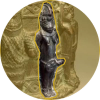
Ibierugha
Attendant
2 annotations



Odigba
Coral beaded collar
1 annotation


Ẹkpoki
Cylindrical Boxes
1 annotation


Akuọghọ
Sheath
1 annotation


Ukpọn
Wrapper
1 annotation

Ẹde
Beaded Crown
1 annotation

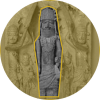
Ọba Ẹsigie
King Ẹsigie
1 annotation

Provenance
7
events
Institution data
British Museum
The data was transferred directly by the institution.
Last updated: 2025-06-10
Language: english
| Institution field | Value |
|---|---|
Registration number object id | Af1898,0115.39 |
Additional IDs object id | 272 (Foreign Office number) |
PRN object id | EAF26495 |
Object Type designation | plaque |
Description description | Relief plaque, lost-wax cast in brass. Wide plaque, rectangular in form with side flanges. Background surface decorated with river leaf patterns and stippling. One nail hole at top, two holes at bottom. Depicts standing figure of Oba (possibly Esigie), facing front, flanked by two standing warrior figures holding shields above his head. Oba wears beaded crown with feather at left, deep beaded collar, multiple beaded necklaces, beaded bracelets and anklets, and patterned wrap-around skirt tied with sash on left hip. Holds ceremonial switch in right hand and places left hand on top of horn held by small attendant at side. Two warriors have tiered hairstyle with single feather and coiled side lock at left side. Wear armlets, leopard's tooth necklace, patterned wrap-around skirts with sash tied over left hip. Both carry swords on left side. Smaller naked emada figures stand on either side of Oba. Figure on right has plaited hairstyle parted at front, wears patterned hip ornament tied on left hip, beaded necklace and bracelets. Carries ekpokin box in left hand. Figure on left has crested hairstyle, wears necklace and bracelets. Carries sword at front of body supported by left hand and holds horn in right hand. |
Ethnic name (made by) ethnic attribution | Edo |
Date date made | 16thC-17thC |
Production place production place | Made in: Benin City |
Findspot place collected | Found/Acquired: Benin City |
Materials material | brass |
Technique production technique | lost-wax cast |
Dimensions dimensions | Height: 48.00 cm~Width: 39.00 cm~Depth: 8.00 cm~Weight: 14.10 kg |
Curator’s comments provenance | The relief brass plaques that used to decorate the Oba's (king's) palace are among the most well-known of all the royal arts of Benin. Although frequently described as 'Benin Bronzes' most plaques are made of leaded brass in various compositions. It is widely accepted that they date to the 16th-17th centuries. In the years prior to the British Expedition royal influence in Benin was increasingly under threat from rival powers, both internal and external, with a focus on economic power and control of the important trading monopolies. However, the court and palace remained the political and spiritual centre of the Benin Kingdom. Earlier accounts written by Europeans visiting the city describe its size and scale. The palace complex was set up around atrium courtyards; some had galleries with wooden pillars supporting the roof. Brass plaques, probably made in matching pairs, were fixed to these pillars. The Benin brass plaques represent a distinct and unique corpus of work, unparalleled elsewhere on the continent. They are cast using the cire perdue (lost wax) technique and show significant variation in the depth of the relief. Some of the plaques portray historical events or commemorate successful wars, while others are a vivid depiction of Benin court life and ritual. Several groups of plaques show clear stylistic similarities. William B. Fagg suggested that these plaques represent the work of master brass casters. Fagg, William, 1973, 'Nigerian Images', London: Lund Humphries Gunsch, Kathryn, 2018, 'Benin plaques: a 16th century imperial monument', London: Routledge, Taylor and Francis Group ; Direct pair with BM plaque Af1898,0115.38. Oba carries flexible switch, uwenrhien otan, in preparation for sacrificial ceremony. His retainers shield him from the sun, and also from hostile spiritual forces. ; Plankensteiner 2007: These two plaques [with Af1898,0115.38] simultaneously arrived at the British Museum in 1898. Though a little different in size, iconographically and stylistically they are nearly identical. The corresponding features make it all the more likely that they were meant to be a pair. As is known about the old palace buildings at the time of these plaques' manufacturing, this sort of plaque was attached - and demonstrably in symmetrical ordering - onto the pillars of the verandas and entrances. The opulent jewelry of the central figure, identified as Oba Esigie by Barbara Blackmun (1997) based on a comparisson of depictions on carved ivories and plaques, comprises of a high beaded choker, a multirow necklace of agate and coral beads, large agate pendants hanging on the sides of the coral beaded cap, adorned with a feather, arm and foot rings, a precious wrapper, presumably made from imported Indian or Portuguese fabrics, and a luxurious belt-and hip decoration with a mask. In his right hand the king holds a ceremonial switch. His left hand rests on the hand of one of the two small and - except for some jewelry - naked attendants, who also carries a sword. The small attendant figure to the left of the plaque carries a spool-shaped 'ekpokin' box. The two larger figures wear precious clothes. They protect the Oba's head from both sides with raised shields. All attendant figures have an unusual hairdo: a hair lock adorns the left ear of the two shield carrying figures, the hairstyle of both small attendants are reminiscent of those worn by the Ooton priests and the hair crest of the Oduduwa masks. The depicted scene presumably represents a ritual at a palace ceremony, the Igue, for instance, or the Ugie Erha Oba.; Read & Dalton 1899: Plaque made of bronze: A Chief with two attendants, and between them two smaller figures... With a bead cap like that of Af1898,0115.15, and holds a wand in the right hand, while the left is supported by a naked boy who holds his sword. The attendants, who are clothed like the figure to the left in Af1898,0115,16 but have the hair dressed in overlapping layers, with a feather and a spiral curl over the left ear, are holding a shield over the chief's head. The second small figure holds in his left hand a small cylindrical drum (compare Af1898,0115,131). All the figures are marked with tribal cicatrices. |
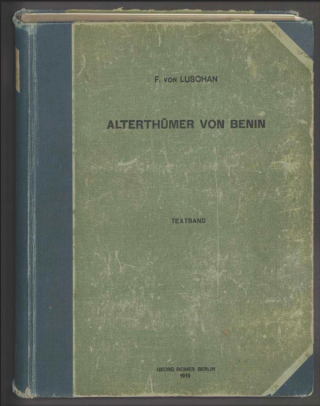
Bibliographic references bibliography | Gunsch 2018: ~Read & Dalton 1899: pl XVIII.4 |
Exhibition history exhibition history | Exhibited: 1970-1973, London, Museum of Mankind, Divine Kingship in Africa 2007 May-Sept, Vienna, Museum für Völkerkunde, Benin. Kings and Rituals: Court Arts from Nigeria 2007-2008 Oct-Jan, Paris, Musée du quai Branly, Benin. Kings and Rituals: Court Arts from Nigeria 2008 Feb-May, Berlin, Staatliche Museen zu Berlin, Ethnologisches Museum, Benin. Kings and Rituals: Court Arts from Nigeria 2008 Jun-Sept, Chicago, The Art Institute of Chicago, Benin. Kings and Rituals: Court Arts from Nigeria |
Condition condition | Fair; top right corner has recent metal repair. Flange missing from left side. Missing and damaged section around bottom centre edge. |
Subjects iconography | ruler ~palace/mansion |
Associated events event | Associated Event: British Expedition to Benin City - Feb 1897 |
Acquisition name (acquisition) provenance | Secretary of State for Foreign Affairs |
Acquisition date accession date | 1898 |
Acquisition notes (excavation) provenance | This plaque was looted during the British Expedition to Benin City in 1897. |
Sections
About
Other
Sensitive content
Sensitive Content Digital Benin includes colonial material that may contain inaccurate, derogatory or harmful language relating to African and African diasporic communities. Such language may appear in catalogue records, transcriptions, and book, exhibition or museum titles. We recognize that this material may cause distress. Sensitive-content warnings are being implemented across the collection, but this process is ongoing. The language does not reflect Digital Benin’s views; we take an anti-colonial and anti-racist position and are committed to centring the humanity of historically marginalised communities.