Loading...
Relief Plaque
Relief Plaque
Reg No.
17973
Edo designations
English designations
Categories
Institution Location
1 Adesogbe (Plymouth) Road, P.M.B. 1115, Benin City , Edo State
Reg No.
17973
Edo designations
English designations
Relief Plaque
Categories
Palace Architecture & Ornamentation
Institution Location
1 Adesogbe (Plymouth) Road, P.M.B. 1115, Benin City , Edo State

Iconographies

13 annotations

Water fern
Ebe Amẹ
Water Fern

Ebe Amẹ refers to a wide variety of plants, particularly the leaves of the water fern or river leaf, found in riverine areas of southern Nigeria. Artists from the Igun-Ẹrọnmwọn used these as a decorative motif in the background of most Ama-Ẹrọnmwọn (bronze relief plaques). The petals of the Ebe Amẹ, like the points of the ἀghàdàgháda (crossroads), represent the four cardinal directions: north, east, south, and west. The number four plays a foundational role in the Edo calendar, which is structured around four market days.

2 annotations
Ebe Amẹ
Ebe Amẹ
Rosette - 'The Sun Never Misses a Day'
Owẹn iba ẹdẹ ku
Rosette - 'The Sun Never Misses a Day'

This rosette design, usually found in the corners of Ama-Ẹrọnmwọn (bronze relief plaques), is one of two motifs representing the sun and one of a number of motifs in Edo art that are also connected with Olokun. The association between the sun and Olokun refers to the way in which the sun descends into the sea each day—hence the proverb ‘the sun never misses a day’—and the sea is where the deity Olokun lives.

2 annotations
Owẹn iba ẹdẹ ku
Owẹn iba ẹdẹ ku
Headdress/crown with single projection
Oro
Headdress/crown with single projection

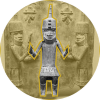
Figures wearing a headdress with a single protrusion from the crown of the head, known as the Oro, are found only among the Ọba and a select category of palace dignitaries whose ancestors originated in ancient Ile Ife. Only the Osa and Osuan, custodians of the Uwen and Ora deities, as well as members of the Emuru, who are responsible for the care of Iru vessels, may wear a headdress with the Oro. The identification of different figures is therefore interpreted based on the combination of the Oro with other items of regalia. Artists in the Igun-Ẹrọnmwọn and Igbesamwan depicted figures with the Oro on Ama-Ẹrọnmwọn (bronze relief plaques) and Aken'ni Elao (carved tusks), respectively. The Oro would either be made of coral beads as part of the crown or headdress, or be woven from itoto fibre.

2 annotations
Oro
Oro
Feather
Igan
Feather

Igan (feathers) are commonly depicted tucked into the headdresses and hats of chiefs represented on Emwin Arre (royal treasures). These feathers are from the Oɛɣohɔ (vulturine fish eagle) and symbolise respected old age and proper chieftaincy.

1 annotation
Igan
Beaded Crown
Ẹde
Beaded Crown

Although many other members of the Benin royal court wore a variety of hats and forms of headwear, only the Ọba may wear the Ẹde (beaded crown). The Ọba must never be seen bare-headed, and successive Ọba introduced different styles and types of crowns.

Across different media and objects, Ọba are depicted wearing various types of crowns, all elaborately crafted from coral beads. Some feature tall projections rising from the crown, known as Oro, while others have curved projections extending from either side of the head, known as the winged cap. The latter was introduced only in the 19th century, most likely by Ọba Osẹmwẹndẹ. Depictions of Ọba Ẹsigie on Ama-Ẹrọnmwọn (bronze relief plaques) show him wearing an elaborate crown decorated with large jasper or coral beads.

1 annotation
Ẹde
Colar Bead
Odigba
Coral beaded collar

Odigba (beaded collar) is a rigid neck collar made of beads, worn as part of ceremonial attire only by senior princes who have been made Enigie. Although Ibafe (2007, p. 43) argued that the Odigba was introduced during the Ogiso period (c. 900–c. 1170 AD) by Ogiso Ere, along with other symbolically important Emwin Arre, such as the Ada (ceremonial sword) and the Ebẹn (ceremonial sword). The Odigba was initially made of beads, while coral was incorporated only later, following its introduction through trade with Portuguese merchants in the late fifteenth century.

2 annotations
Odigba
Odigba
King Ẹsigie
Ọba Ẹsigie
King Ẹsigie

Ọba Ẹsigie (reigned c. 1504–1550) was, like his father and grandfather before him, a powerful warrior king. He is particularly remembered for suppressing his brother Aruanran, ruler of Udo, and for his victories against the Kingdom of Idah (c. 1515–1517), achieved with the support of his mother, Idia, and Portuguese mercenaries. Relations with the Portuguese intensified during Ẹsigie’s reign, resulting in increased imports of brass into the Benin Kingdom and contributing to a flourishing of brass casting.

Casters and carvers from the Igun-Ẹrọnmwọn and Igbesamwan represented Ọba Ẹsigie in a variety of ways. He is typically shown wearing the beaded swag over the right hip associated with Ọbas, U-shaped beaded hanging necklaces, heavy beaded anklets, and a richly textured and fringed wrapper ( ).

As a warrior, Ẹsigie was frequently depicted in battle, including in some of the so-called ‘Battle Scene’ Ama-Ẹrọnmwọn (bronze relief plaques). He is also sometimes described as the ‘ruler on horseback’. It is recorded that King Manuel I of Portugal sent him a horse caparisoned with silks, linens, beads and other costly materials. A number of representations show Ẹsigie riding side-saddle, most likely commemorating his military successes.

Ẹsigie was also represented in religious and ceremonial contexts. He appears holding sacred objects such as the Ahianmwe Oro (Bird of Prophecy Clapper) during festivals, the Unwẹnrhiẹnọtan (ceremonial switch) during sacrifices, or a small netted sphere. Some carvings even depict him as a youth holding hands with a Portuguese figure, reflecting his close relationship with the Portuguese; Ẹsigie was baptised and his son was subsequently educated in Portugal.

Art associated with Ẹsigie also frequently incorporates motifs connected with Olokun, deity of the sea, including fish and snakes, alongside Portuguese imagery. These motifs reflect the importance of maritime trade, diplomacy and the kingdom’s relationships with the Portuguese during his reign.

1 annotation
Ọba Ẹsigie
Wrapper
Ukpọn
Wrapper

Ukpọn is the Edo term for cloth and is used here to refer to the wrappers or kilts worn by many of the figures depicted on the Emwin Arre (royal treasures). The cloth worn around the waist may be plain, but it is more commonly richly decorated with motifs associated with the monarchy, power, and wealth, such as the Ọba'nui (infinity symbol) and Uhunme Ikpotoki (Portuguese heads).

The Benin Kingdom was renowned for its textile production, both for local use and for trade. Within the royal court, members of the Owina n’Ido produced ukhuen cloth for the Ọba and other members of the court, who wore it as wrappers during festivals and ceremonies.

Alongside locally produced textiles, imported cloth was also an important commodity in the Benin Kingdom’s trade networks. Textiles were exchanged with neighbouring production centres, particularly Ijebu, while European traders brought silks, woollens, linens, and cotton from Europe and Asia from the 15th century onwards.

1 annotation
Ukpọn
King
Ọba
King

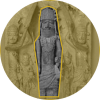
The Ọba is the monarch of the Edo people and Kingdom. The current reigning monarch, Ọba Ẹwuare II, is the fortieth Ọba of the current dynasty, which is traditionally understood to have begun around 1170 AD. Over the centuries, the role and conception of the monarch have shifted, and the Emwin Arre (royal treasures) and the visual language they carry provide important evidence for understanding these developments. Although Emwin Arhe served a variety of functions within court life and ritual, “their primary purpose was to glorify the godlike king and the history of the powerful empire”.Plankensteiner 2007, p. 25 Representations of the Ọba are therefore ubiquitous across Benin court arts and frequently occupy a central position within their visual language.

Representations of the Ọba can be recognised through a combination of characteristics, including his size, as he is usually depicted larger than other figures, and his position within compositions, where he may appear in front of or be supported by other figures, as in the Royal Triad motif. The Ọba is also distinguished by particular items of regalia, including the Oro projection from his crown, the distinctive beaded swag extending from his right hip, the Ewu ivie (coral-beaded shirt), and Ukpan obọ eva (crossed coral-beaded baldrics).

Since the early 20th century, scholars have sought to identify individual Ọbas represented on Emwin Arhe by analysing the regalia and other attributes of figures identified as monarchs, as well as the combinations of motifs and figures appearing on particular objects. Oral traditions and historical accounts, alongside European archival sources, have also played an important role in determining the identities of specific Ọba. Just as the institution of the monarchy developed and changed over time, so too did the ways in which Ọbas were represented by artists working within the royal guilds, including the Igun-Ẹrọnmwọn and Igbesamwan.

1 annotation
Ọba

Provenance

5 events
Production
1504 (approximate) to 1550 (approximate)
Production of the Ama-Ẹrọnmwọn by the Igun-Ẹrọnmwọn guild in Benin City
Loot
February 19, 1897 (day approximate) to June 1899 (month approximate)
Looting of the Emwin Arre - Inalienable Cultural Artefacts - during the Invasion of the Benin Kingdom in February 1897 and until the end of overt military activity in June 1899
Unknown
November 17, 1905
The object is known to have come into contact with the MARKK Museum am Rothenbaum Kulturen und Künste der Welt.
Donation
September 3, 1906
The object was donated by the MARKK Museum am Rothenbaum Kulturen und Künste der Welt to the Rautenstrauch-Joest-Museum.
Restitution
December 8, 2022
Transfer of ownership of 92 Emwin Arre from the Rautenstrauch-Joest Museum to Omo n'Oba n'Edo Uku Akpolokpolo, Ọba of Benin, and the National Commission for Museums and Monuments, Nigeria, 15 December 2022

Institution data

Rautenstrauch-Joest-Museum
The data was transferred directly by the institution.
Last updated: 2022-07-27
Language: english
Institution fieldValue
Additional Ids
object id
190612
Additional Ids / bundle
object id
RJM 1906/12
Other numbers
object id
Reg No.
object id
17973
Reg. No / Inventory number
object id
RJM 17973
Object name
designation
object type
relief plaque
Object name / Title
designation
Relief Plaque
materials
material
copper alloy
Dimension/s
dimensions
H.54.50cm W.36.50cm X. 12cm
previous owner/collector
prior source
Theodor Rautenstrauch
provenance
provenance
03.09.1906, Rautenstrauch-Joest Museum (donation); 17.11.1905, MARKK, Hamburg
Institution
department and institution
Rautenstrauch-Joest Museum - Cultures of the World, Cologne
Institution acquisition date
accession date
9/3/06
Acquisition details
accession method
donation
comments
notes
Permanent exhibition RJM
Copyright
license
© Museumsgesellschaft RJM Köln, Foto Uli Grohs
notes concerning "other numbers"
Sensitive content

Sensitive Content Digital Benin includes colonial material that may contain inaccurate, derogatory or harmful language relating to African and African diasporic communities. Such language may appear in catalogue records, transcriptions, and book, exhibition or museum titles. We recognize that this material may cause distress. Sensitive-content warnings are being implemented across the collection, but this process is ongoing. The language does not reflect Digital Benin’s views; we take an anti-colonial and anti-racist position and are committed to centring the humanity of historically marginalised communities.

Read more about our approach