Loading...
Ewua Messenger Figure
ObjectNumber_Original
VO_64747
Institution
Weltmuseum Wien
Edo designations
English designations
Categories
Institution Location
Heldenplatz, 1010 Wien, Austria
ObjectNumber_Original
VO_64747
Institution
Weltmuseum Wien
Edo designations
English designations
Ewua Messenger Figure
Categories
Altar & Shrine Objects
Figures
Institution Location
Heldenplatz, 1010 Wien, Austria

Iconographies

3 annotations

Portuguese Head
Uhunmwu Ikpotoki
Portuguese Head

These motifs are known as Uhunmwu Ikpotoki in Edo, which translates as ‘Portuguese head’ in English. Portraits of Portuguese men, featuring only their heads and sometimes their shoulders, were used by artists as motifs on the Emwin Arre (royal treasures), in particular on the Ama-Ẹrọnmwọn (bronze relief plaques) and Aken'ni Elao (carved altar tusks). Also included here are a series of two or three conjoined spirals, which are interpreted as abstract forms of this motif.

One of the earliest suggestions that many of the European figures depicted on objects were Portuguese was made two years after the 1897 British Colonial Military Campaign on Benin City by the British Museum curators Charles Hercules Read and Ormonde Maddock Dalton, based on testimony from seven chiefs in the aftermath of the military campaign. The long, straight hair, beards, and domed hats together led to the identification of these representations as Europeans.

When included within the visual imagery of the Emwin Arhe, the Portuguese are associated with the new Atlantic trade and the consequent wealth that emerged following first contact with the Portuguese in the late 15th century. For this reason, Portuguese heads are also often associated with the sea deity Olokun. Eisenhofer argued that the Portuguese figures and heads as motifs on the royal treasures are symbols of the king’s power: “these depictions of foreigners helped to build and strengthen the king’s image.”

When incorporated into the design of the Ama-Ẹrọnmwọn (bronze relief plaques), Curnow instead argued that these motifs could in fact indicate events that took place during Ọba Esigie’s reign. Ọba Esigie is associated with the Portuguese, as they became increasingly important during his reign, assisting with battles against the Igala from Idah, bringing Catholicism to Benin, and introducing weaponry such as guns and cannons, which were instrumental in the expansion of the kingdom.

1 annotation
Uhunmwu Ikpotoki
Wrapper
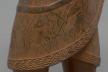
Ukpọn
Wrapper

Ukpọn is the Edo term for cloth and is used here to refer to the wrappers or kilts worn by many of the figures depicted on the Emwin Arre (royal treasures). The cloth worn around the waist may be plain, but it is more commonly richly decorated with motifs associated with the monarchy, power, and wealth, such as the Ọba'nui (infinity symbol) and Uhunme Ikpotoki (Portuguese heads).

The Benin Kingdom was renowned for its textile production, both for local use and for trade. Within the royal court, members of the Owina n’Ido produced ukhuen cloth for the Ọba and other members of the court, who wore it as wrappers during festivals and ceremonies.

Alongside locally produced textiles, imported cloth was also an important commodity in the Benin Kingdom’s trade networks. Textiles were exchanged with neighbouring production centres, particularly Ijebu, while European traders brought silks, woollens, linens, and cotton from Europe and Asia from the 15th century onwards.

1 annotation
Ukpọn
Equal-armed cross
Uman-ague
Equal-armed cross

Uman-ague is a badge in the form of an equal-armed cross. The cross with straight-sided arms is known as the “Greek cross,” while the type with V-shaped arms, narrowing toward the centre, is known as the “Maltese cross.”

Uman-ague is usually worn around the neck by members of the Ewua or by the Ohensa. The equal-armed cross has various meanings: as a symbol of cosmic order, it represents the number four and references the “four cardinal points established by the High God Osanobua when he created the world” (Girshick Ben-Amos 1999, p. 64), as well as the “crossroads or junction that serves as the point of connection between the natural and spiritual worlds”. Paula Girshick Ben-Amos also argues that when used on the Aken'ni Elao (altar tusk), the cross, together with the Ivie okpagbaru (royal bead), constitutes an “emblematic reference” to Ọba Ẹsigie.

The cross also references the Portuguese missionaries who brought Christianity to the Kingdom during the reign of Ọba Ẹsigie, although the symbol was already in use before the arrival of Europeans. The Maltese cross is thought to have been introduced by Ọba Eresonyẹn as part of his efforts to encourage the worship of the High God Osanobua during his reign. Regardless, Uman-ague is often associated with Ọba Ẹsigie.

1 annotation
Uman-ague

Provenance

5 events
Production
unknown to February 22, 1897 (day approximate)
Production of Ewua by the Igun-Ẹrọnmwọn in Benin City
Loot
February 19, 1897 (day approximate) to June 1899 (month approximate)
Looting of the Emwin Arre - Inalienable Cultural Artefacts - during the Invasion of the Benin Kingdom in February 1897 and until the end of overt military activity in June 1899
Unknown
February 22, 1897 (day approximate) to 1899
Acquisition of a collection of Benin objects by W. A. Maschmann
Transfer
February 22, 1897 (day approximate) to 1898
Transfer of the Maschmann collection to Hamburg, c. 1898
Purchase
1899
Purchase of the Maschmann collection by the Weltmuseum Wien, 1899

Related archival documents

1 documents
See all
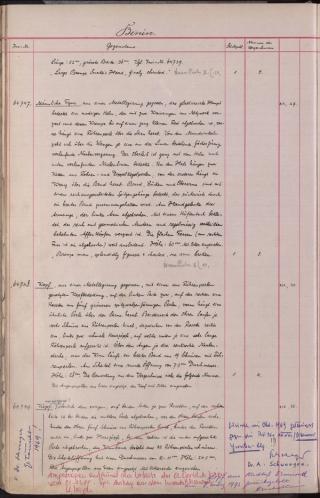
An archival document representing a Inventories of 1 page(s)
InventoryAccession Record
Weltmuseum Wien
Inventory book - objects

Institution data

Weltmuseum Wien
The data was transferred directly by the institution.
Last updated: 2022-05-24
Languages: german, english
Institution fieldValue
ObjectNumber_Original
object id
VO_64747
NativeTitle
edo designation
TextEntry
description
Medium
material
Gelbguss
Medium_en
material
Brass
ObjectName
object type
Figur eines Ewua-Priesters
ObjectName_en
object type
Figure of an Ewua Priest
DateBegin
date made
1500
DateEnd
date made
1700
Dated
date made
16./17. Jahrhundert
Dated_en
date made
16th/17th century
Period
date made
Term
production place
Afrika südlich der Sahara
Term2
production place
West-Afrika
Term3
production place
Nigeria
Term4
production place
Benin
Thesaurus
production place
Afrika südlich der Sahara/West-Afrika/Nigeria/Benin
Provenance
provenance
Role_person
provenance
Sammlung-Collection-Wilhelm Albert Maschmann|
Culture
ethnic attribution
Edo, Benin Königreich
Culture_en
ethnic attribution
Edo, Benin Kingdom
CreditLine
department and institution
Weltmuseum Wien
Department
department and institution
MVK Objekte - Afrika südlich der Sahara
Zugangsdatum
accession date
1899
LocationString
display status
Raum Me.40
FileName
images
VO_64747_3.jpg|VO_64747_neu_2.jpg|
PrimaryImage
images
VO_64747_3.jpg
Classification
||
DepartmentID
35
Department_cut
department and institution
Afrika südlich der Sahara
DisplayOrder
|
Last_Modified
2021-12-06 08:15:34
LocationID
75091
ObjectID
object id
441026
ObjectNumber
object id
64747
PublicAccess
1
SortNumber
VO 64747
TextDate_en
|
TextEntryHTML
description
TextEntryHTML_en
description
This Figure of an Ewua Priest is part of the historical collections from the Benin Kingdom, in present-day Nigeria. In 1897, the kingdom was conquered and Oba (king) Ovonramwen banned into exile. The loot from the royal palace was then sold through the ar
TextEntry_en
description
This Figure of an Ewua Priest is part of the historical collections from the Benin Kingdom, in present-day Nigeria. In 1897, the kingdom was conquered and Oba (king) Ovonramwen banned into exile. The loot from the royal palace was then sold through the ar
cxrDisplayOrder
1|
Sensitive content

Sensitive Content Digital Benin includes colonial material that may contain inaccurate, derogatory or harmful language relating to African and African diasporic communities. Such language may appear in catalogue records, transcriptions, and book, exhibition or museum titles. We recognize that this material may cause distress. Sensitive-content warnings are being implemented across the collection, but this process is ongoing. The language does not reflect Digital Benin’s views; we take an anti-colonial and anti-racist position and are committed to centring the humanity of historically marginalised communities.

Read more about our approach