Loading...
Object Number
1979.206.265
Edo designations
English designations
Categories
Institution Location
1000 5th Ave, New York, NY 10028, United States
Object Number
1979.206.265
Edo designations
English designations
Altar Tusk
Categories
Altar & Shrine Objects
Institution Location
1000 5th Ave, New York, NY 10028, United States

Iconographies

14 annotations

Mudfish
Ewi
Mudfish

Depictions of Ewi (mudfish) are among the most frequent motifs in the Emwin Arre (royal treasures). Mudfish hold an important place in Edo belief, both as representations of the god Olokun and as symbols of royalty, as well as of “prosperity, peace, well-being and fertility”. Mudfish are also particularly common animals for sacrifice, and mudfish-shaped Orhiẹvbẹ (kola-nut boxes) were used to make offerings or store kola nuts.

Yet, the appearance of Ewi across the Emwin Arhe is not consistent, and it has been argued that different species of mudfish were depicted by Edo artists, each with different qualities and capabilities. For example, the electric shock of Malapterurus electricus resembles the fierceness of the Ọba, while the liminal qualities of the Synodontis clarias mudfish, which lives both on land and in water, similarly reflect the Ọba’s rule over land and sea.Gallagher 1983, p. 93 With these different qualities in mind, the mudfish is an important symbol of Benin kingship and royalty.

Sometimes the Ọba was depicted by artists with mudfish rather than legs (see Ọba with Mudfish Legs).

1 annotation
Ewi
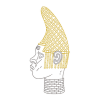
Curved conical hairstyle worn by Iy'Ọba
Ukpẹ ọkhọkhọ
Curved conical hairstyle worn by Iy'Ọba

The Ukpẹ ọkhọkhọ is a distinctive hairstyle and coral-beaded headdress worn by the Iy’Ọba. The headdress includes a projection called the ‘ede Iy’Ọba’, which indicates that “her spiritual potentialities are closer in quality to those of her ruling son than they are to the powers of the nobles”. The Iy’Ọba’s hairstyle and headdress are meant to resemble ukpe-okhue, or the curved parrot’s beak.

Barbara Blackmun argued that “Benin art is multivocal, and any depiction of the Iye Ọba [sic] is a reference to Idia. Every woman who holds the office of lye Ọba plays the part of Idia, the ideal model of an Ọba’s mother.” Wearing the Ukpẹ ọkhọkhọ is one of the ways the Iy’Ọba plays the role of Idia.

1 annotation
Ukpẹ ọkhọkhọ
Ubanu'hi / Obanu'hi
Ubanu'hi
Inifinity Symbol

The Ubanu'hi (infinity symbol) is a kind of guilloche or interlaced strapwork motif that can be angular or rounded. It was used by Edo artists in the decoration of many Emwin Arhe (royal treasures) and is ubiquitous in Benin royal arts. Ubanu'hi is a shortened form of “uba no Ọba ya de agbon ke ehimwin yi”, which means “the rope with which the Ọba ties the heaven and earth together” (pers. comm. Chief John Igbineweka Inneh n’Igbesawman, 2022). Similarly, Paula Ben-Amos Girshick described this as “Ọba n’iri agbon”, or the “rope of the world” pattern.

According to Ọbabanmu Ineh, the use of this motif indicates that objects were carved by members of the Igbesanmwan. However, the motif is found on all types of Emwin Arhe (royal treasures), not only those made of ivory or wood. On the flanges of the Ama-Ẹrọnmwọn (relief plaques) alone, Kathryn Gunsch identified three different versions of the Ubanu'hi and, through her analysis of over 850 plaques, found that these different Ubanu'hi forms align with other characteristics, such as dimensions, the prevalence of ornamental motifs, and stylistic qualities. Together, these provide evidence, she argues, of different production groups among the plaque makers.

Kate Ezra went on to argue that the use of these motifs indicates that certain objects were used in a “royal context” and were associated with “royal patronage”.

Ubanu’hi can also be spelt Obanu'hi, indicating different intonations in the pronunciation of the words.

1 annotation
Ubanu'hi
Crossed Beaded Baldrics
Ukpan obọ eva
Crossed Beaded Baldrics

The Ukpan obọ eva (coral-bead crossed baldrics) were worn as part of the ehaingbehia, the full ceremonial regalia, by only high-ranking members of the palace, including the Ọba himself, the Iy’Ọba, the Edaiken, and the Ezọmọ.

2 annotations
Ukpan obọ eva
Ukpan obọ eva
Iconography image
Ẹkpẹn
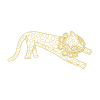
Leopard

The Ẹkpẹn (leopard) is an animal that appears most often among the motifs decorating the Emwin Arhe (royal treasures). The Ẹkpẹn symbolises the valour and strength of the Ọba, as well as his political authority. The Benin people eulogise the Ọba as the ‘ẹkpẹn n'owa’ (leopard of the home).

When a hunter kills a leopard, he must say “ẹkpẹn n'oha” (I killed a bush leopard), as it is taboo to say that a hunter killed a leopard without specifying that it is a bush leopard, as otherwise this would “be tantamount to symbolically killing the king” (Nevadomsky 1988, p. 81). For this reason, leopards of the bush are called Atalakpa to distinguish them from those that represent the Ọba.

1 annotation
Ẹkpẹn
Portuguese Figure
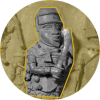
Ikpotoki
Portuguese Figure

Ikpotoki figures (Portuguese figures) are easily distinguished by their European-style clothing, including hats and helmets, as well as by their facial features, particularly their thin, straight noses and straight hair. The objects Ikpotoki figures are shown wearing or holding provide further indications of their relationship with the Benin Kingdom. When they hold or are positioned alongside Ugianran (manillas), for example, they indicate trade, commerce, and wealth, while weaponry such as firearms, swords, or spears indicates their role as mercenaries in the service of the Ọba. In 1515, Ọba Ẹsigie went to war against the Attah of Idah, the ruler of a neighbouring kingdom. Portuguese mercenaries and weapons assisted the Edo in winning the battle, enabling the further expansion of the Kingdom. Ẹsigie’s reign was particularly important for strengthening ties between the Benin Kingdom and the Portuguese Empire, and he is believed to have spoken fluent Portuguese. With Ẹsigie’s encouragement, Portuguese missionaries established churches in the Benin Kingdom, while Portuguese trading factories were also established. Ọba Ẹsigie allowed his son to be baptised and sent him to Portugal to be educated; following his return, he became Ọba Orhogbua.

1 annotation
Ikpotoki
Crossbow
Ekpede
Crossbow

In addition to the Uhanbọ, the Ekpede was also used by warriors in Benin and is likewise said to have been created by Ake, the deity of archery. Because the Ekpede could fire heavier arrows, it was an important weapon in warfare before the introduction of firearms by Portuguese traders. However, this interpretation has been disputed, with some scholars arguing that the crossbow was instead copied by the Edo from Portuguese examples. Furthermore, in depictions on the Emwin Arre (royal treasures), Edo warriors and hunters are shown using the Uhanbọ, while only Portuguese soldiers are depicted with the Ekpede.

1 annotation
Ekpede
alligator
Ẹghughu
Crocodile

In the riverine area surrounding Benin City, there are two types of crocodile. The Ẹghughu, known in English as the dwarf or bush crocodile, is believed to be more docile. The second type is the Àgbákà, the aggressive Nile crocodile.

Crocodiles are one of the important animals represented in the historical Emwin Arre, and they are known as Olokun’s guards or the “policemen” of the waters. The powerful and ferocious qualities of these animals might explain why warrior figures are often depicted wearing Uhunmwu-Ẹkuẹ (pendant masks) in the shape of crocodile heads on Ama-Ẹrọnmwọn (bronze relief plaques). Olokun devotees use crocodiles as sacrificial animals in offerings during the worship of Olokun.

1 annotation
Ẹghughu
Horse
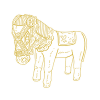
Ọyanyan
Horse

Ọyanyan (horses), along with their riders, are significant motifs in the visual language of the Emwin Arre (royal treasures), appearing across various media and periods. Although the Benin Kingdom lies in the tropical region of West Africa affected by the tsetse fly, according to oral tradition, a small, stocky breed of horses introduced via trade routes from Nupe and Hausa was known in the kingdom from the 13th century.

In 1505, King Manuel of Portugal sent a horse, alongside other luxurious gifts such as satin and Indian silk, to one of the Ọbas, most likely Ẹsigie, as a gift. An account believed to have been written by the Dutch traveller Dierick Ruiters in 1602 described how he travelled from the port of Ughoton to Benin City on horseback. In the same account, Ruiters also described how the Ọba and his courtiers rode on horseback as part of ceremonial processions. A scene of this kind is also featured in the view of the city of Benin in Olfert Dapper’s Description of Africa.

Ọyanyan therefore embody themes relating to military power, foreign interaction, and royal authority, as well as “dignity and achievement”.

1 annotation
Ọyanyan
Spears
Asoro
Spears

Asoro (spears) were used as weapons in battle and for hunting. According to Osadolor, there were two types: long and short. Figures holding Asoro are often depicted on Ama-Ẹrọnmwọn (bronze relief plaques), sometimes in battle scenes and at ceremonies and festivals.

1 annotation
Asoro
Shield
Asa
Shield

Asa (shields) are a crucial attribute of warriors and warrior chiefs, forming part of their ceremonial and battle attire as represented on the Emwin Arre (royal treasures). Asa were usually made from elephant or crocodile skin and used by warriors for protection during hand-to-hand combat. Interestingly, the form of Asa depicted on historic royal artefacts differs from those found in museum collections today, reflecting changes in shield shapes and designs over time.

1 annotation
Asa
leopard teeth
Akọn Ẹkpen
Leopard Teeth Neck Ornament

Akọn Ẹkpẹn are necklaces or neck ornaments made of strung leopard’s teeth. They are worn by figures to signify their high rank and military prowess, as well as by their leaders, the Ezọmọ or Iyasẹ. They are often worn alongside quadrangular Ẹroro (bells) and Ohian Ẹkpẹn (leopard tunics).

The Akọn Ẹkpẹn is clearly and profoundly related to the symbolism of the Ẹkpẹn (leopard) and its association with the Ọba (king), who is metaphorically referred to as ‘ẹkpẹn ne owa’, the ‘leopard of the home’. On the other hand, the Ẹkpẹn is often referred to as the ‘king of the bush’, embodying ferocity, aggression, strength, and leadership—qualities attributed to the Ọba. This intricate link between the leopard, the monarch, and his military leaders reinforces the complex hierarchy and spiritual authority central to Benin’s courtly art.

1 annotation
Akọn Ẹkpen
Warrior
Ọkhọn Okuo
Warrior

The frequency with which Ọkhọn Okuo (Benin warriors) are depicted in Emwin Arre (royal treasures) reflects the importance of the army and military to the Kingdom, as well as the role of royal art as an archive in which artists from the palace guilds recorded important people, events, and institutions. The army was organised into a number of regiments, with soldiers grouped according to the weapons they used, including archers, swordsmen, crossbowmen, and spearmen.

Warrior figures are frequently shown carrying weapons such as Asa (shields), Asoro (spears), warfare swords such as the Umozo or Ọhọ (executioners’ or warfare swords), Uhanbọ (bows), Ẹkpẹde (crossbows), and Ifẹnmwẹ (arrows), which were sometimes poisoned, as well as Osisi (firearms). Their dress also provides important indications of their military role. On both the Aken'ni Elao (carved tusks) and Ama-Ẹrọnmwọn (bronze relief plaques), warriors are depicted in a relatively standardised form, typically wearing an Ohian Ẹkpẹn (leopard tunic), Akọn Ẹkpen (leopard’s tooth neck ornament), an Ẹroro pendant around the neck, and the Uko ugbo-ohamwen (fortified chest band).

Differences are particularly apparent in the warriors’ headwear, both between individual figures and between representations on Aken'ni Elao and Ama-Ẹrọnmwọn. On the Ama - Eronmwon, the most common forms of headwear are crocodile-hide helmets and horsetail helmets with a front plate. On the Aken'ni Elao, some warriors wear double-horned helmets, while others wear simple rounded hats or helmets. The most frequently represented warrior type on the tusks, however, wears a helmet with cowries sewn onto a front panel.

1 annotation
Ọkhọn Okuo

Provenance

6 events
Production
1750 (year uncertain/approximate) to February 22, 1897 (day approximate)
Production of the Aken'ni Elao by the Igbesamwan guild in Benin City
Loot
February 19, 1897 (day approximate) to June 1899 (month approximate)
Looting of the Emwin Arre - Inalienable Cultural Artefacts - during the Invasion of the Benin Kingdom in February 1897 and until the end of overt military activity in June 1899
Unknown
1939 to 1951
The object is known to have come into contact with Julius Carlebach.
Purchase
1951
The object was purchased by Nelson Aldrich Rockefeller from Julius Carlebach and Julius Carlebach Gallery.
Loan
1963 to 1978
The object was loaned by Nelson Aldrich Rockefeller to New York Museum of Primitive Arts.
Bequest
1979
N. A. Rockefeller bequest to the Metropolitan Museum of Art, 1979

Institution data

Metropolitan Museum of Art
The data was transferred directly by the institution.
Last updated: 2021-07-30
Language: english
Institution fieldValue
Object Number
object id
1979.206.265
Object Sort Number
object id
1979 206 265
Primary Rendition No
object id
vs1979_206_265-d
Title
designation
object type
Altar Tusk
Medium
material
Ivory
Dimensions
dimensions
H. 74 × W. 6 × D. 56 in. (188 × 15.2 × 142.2 cm)
Classification
object type
Bone/Ivory-Sculpture
Date
date made
18th century
Geo: City
production place
Court of Benin
Geo: Country
production place
Nigeria
Credit Line
prior source
The Michael C. Rockefeller Memorial Collection, Bequest of Nelson A. Rockefeller, 1979
Provenance
provenance
[Julius Carlebach Gallery, New York, until 1951]; Nelson A. Rockefeller, New York,1951, on loan to The Museum of Art, New York, 1963–1978
Dynasty
reign associated name
Oranmiyan
Culture
ethnic attribution
Edo peoples
ExhibitionHistory
exhibition history
Art of Oceania, Africa and the Americas from The Museum of Art The Metropolitan Museum of Art, May 10, 1969–August 17,1969
Bibliography
bibliography
The Metropolitan Museum of Art. Art of Oceania, Africa, and the Americas from the Museum of Art. New York: The Metropolitan Museum of Art, 1969, no. 380. Ross, Doran H. Elephant: The Animal and Its Ivory in African Culture. Los Angeles: Fowler Museum of Cultural History, 1992, p. 180, no. 8–20.
Published References
bibliography
Sensitive content

Sensitive Content Digital Benin includes colonial material that may contain inaccurate, derogatory or harmful language relating to African and African diasporic communities. Such language may appear in catalogue records, transcriptions, and book, exhibition or museum titles. We recognize that this material may cause distress. Sensitive-content warnings are being implemented across the collection, but this process is ongoing. The language does not reflect Digital Benin’s views; we take an anti-colonial and anti-racist position and are committed to centring the humanity of historically marginalised communities.

Read more about our approach