Ewua
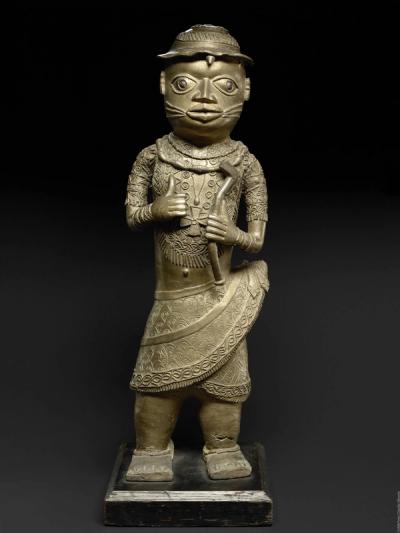
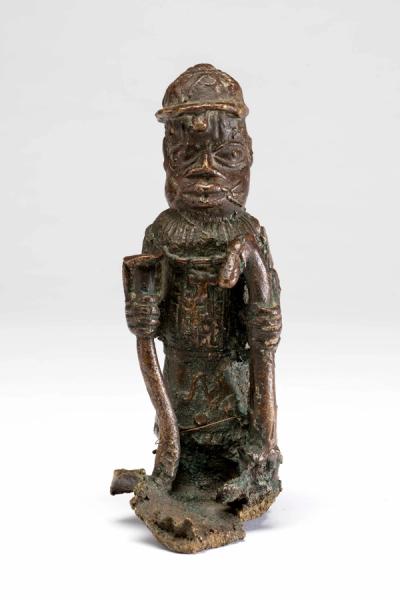
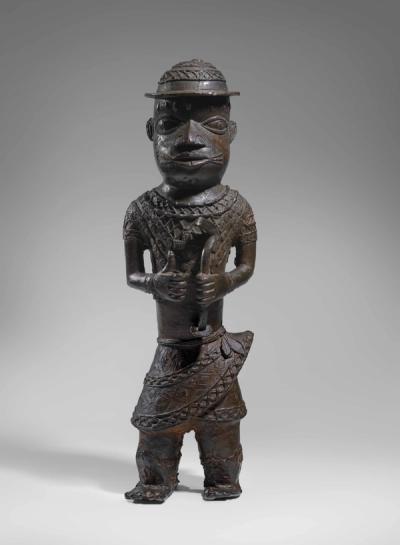
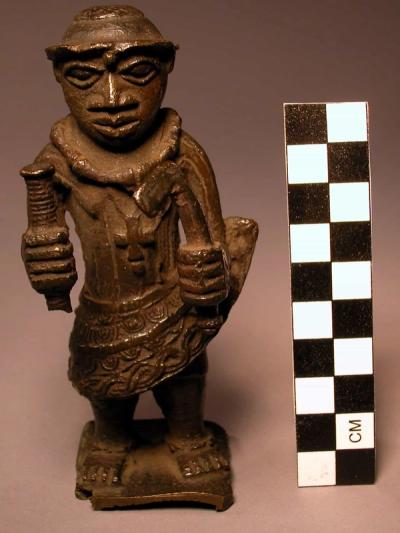
Figures bearing an equal-armed cross on the chest have been interpreted variously as messengers from Ife ( ), or, more likely, as either Ẹwua officials or Ohensa priests ( ; ). These differing interpretations highlight the ambiguity of the visual language of Emwin Arre (royal treasures), in which the meaning and identity of a figure may depend on the type of object on which it appears, the period in which the object was made, and the combination of motifs surrounding it.
The Ẹwua guild was established by Ọba Ẹsigie, and its members were responsible for waking the Ọba each morning ( ). In 1959, Ọba Akẹnzua II identified the cross-bearing figure specifically as an Ẹwua official (in Bradbury 1959, B.S. 207/2). Alternatively, the figure has been identified as an Ohensa, a priest of the High God Osanobua, whose worship also became closely associated with Christianity following the arrival of Portuguese missionaries during the reign of Ọba Ẹsigie.
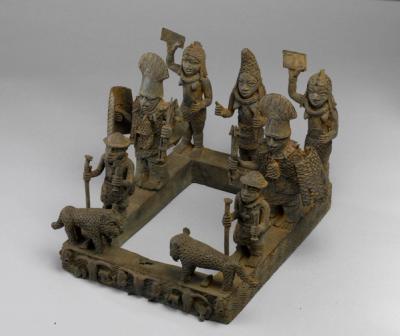
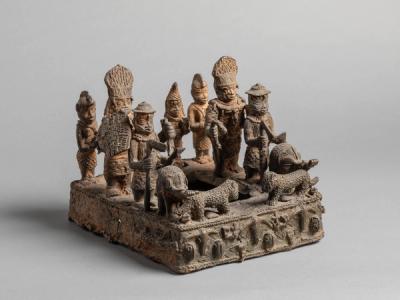
These figures were cast in brass and bronze both as freestanding figures and as elements within the compositions of Ama-Ẹrọnmwọn (bronze relief plaques), as well as being carved on 18th- and 19th-century Aken'ni Elao (carved tusks). They are typically identifiable by their rounded, bowler-like hats with narrow brims and the equal-armed cross pendants worn on their chests. In their left hand they hold an L-shaped hammer known as Umọmọ, while in their right hand they sometimes carry a tall, straight staff ( ).
Digital Benin collates digital material from institutions, and some of this material is inherently colonial and contains words, terms and phrases that are inaccurate, derogatory and harmful towards African and African diasporic communities. Catalogue transcriptions, book titles, exhibition titles and museum titles may contain harmful terms. We recognise the potential for the material to cause physical and mental distress as well as evoke strong emotions. Owing to the scale of the collection’s data, a process to implement sensitive-content warnings in the displayed data is still incomplete. The material within the catalogue does not represent Digital Benin’s views. Digital Benin maintains a strong anti-colonial, anti-racist position and affirms its support for centring the humanity of historically marginalised and disenfranchised communities. Read more about the background of this statement here