Loading...
Object Number
16-43-50/B1488
Edo designations
English designations
Categories
Institution Location
11 Divinity Ave, Cambridge, MA 02138, United States
Object Number
16-43-50/B1488
Edo designations
English designations
Altar Tableau
Fragment
Categories
Altar & Shrine Objects
Institution Location
11 Divinity Ave, Cambridge, MA 02138, United States

Iconographies

3 annotations

Equal-armed cross
Uman-ague
Equal-armed cross

Uman-ague is a badge in the form of an equal-armed cross. The cross with straight-sided arms is known as the “Greek cross,” while the type with V-shaped arms, narrowing toward the centre, is known as the “Maltese cross.”

Uman-ague is usually worn around the neck by members of the Ewua or by the Ohensa. The equal-armed cross has various meanings: as a symbol of cosmic order, it represents the number four and references the “four cardinal points established by the High God Osanobua when he created the world” (Girshick Ben-Amos 1999, p. 64), as well as the “crossroads or junction that serves as the point of connection between the natural and spiritual worlds”. Paula Girshick Ben-Amos also argues that when used on the Aken'ni Elao (altar tusk), the cross, together with the Ivie okpagbaru (royal bead), constitutes an “emblematic reference” to Ọba Ẹsigie.

The cross also references the Portuguese missionaries who brought Christianity to the Kingdom during the reign of Ọba Ẹsigie, although the symbol was already in use before the arrival of Europeans. The Maltese cross is thought to have been introduced by Ọba Eresonyẹn as part of his efforts to encourage the worship of the High God Osanobua during his reign. Regardless, Uman-ague is often associated with Ọba Ẹsigie.

1 annotation
Uman-ague
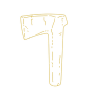
Hammer
Umọmọ
Hammer

The Umọmọ is an L-shaped hammer made of iron that holds profound importance, symbolising power, transformation, and spiritual efficacy. The hammer is fundamentally associated with Ogun, the god of iron, embodying “the force inherent in metal, [with] a mystical power with the potential to create or destroy”. This dual aspect of the hammer—its capacity for both shaping and destruction—mirrors the formidable power of the Ọba. The L-shaped hammer is often associated specifically with Ọba Eresonyẹn, as it most commonly appears within the visual language of Emwin Arhe (royal treasures) that he commissioned, for example, held by Ewua figures and on one ornate cast Ẹrhẹ, thought to have been Ọba Eresonyẹn’s throne (id. no. 209779).

The hammer is notably held by figures identified as Ewua palace officials or Ohensa priests, who also wear a cross pendant on their chests. The consistent portrayal of these figures holding the Umọmọ underscores its connection to the origins of the Benin dynasty and the spiritual authority of the Ọba. Ọba Esigie, the powerful 16th-century “warrior king”, is credited with encouraging ironworking, further solidifying the hammer’s link to royal martial strength and divine kingship.

Appearing on Aken'ni Elao (carved ivory tusks), Ama-Ẹrọnmwọn (bronze relief plaques), and even as a charm, the hammer symbolises the Ọba’s ability to “mold and transform” events, to overcome challenges, and to provide spiritual protection. Its presence thus reinforces the complex interplay of hierarchy, spiritual authority, and military might within the Benin Kingdom, consistent with other potent symbols such as the Akọn Ẹkpẹn (leopard’s tooth neck ornament). The Umọmọ often appears on Emwin Arhe (royal treasures) believed to have been commissioned during the reign of Ọba Eresonyẹn.

Other terms for hammer in Edo are Avan or Avalaka, which are used interchangeably with Umọmọ by members of the Igun-Ẹrọnmwọn.

1 annotation
Umọmọ
Ẹwua officials or Ohensa priest
Ewua
Ẹwua officials or Ohensa priest

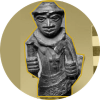
Figures bearing an equal-armed cross on the chest have been interpreted variously as messengers from Ife, or, more likely, as either Ẹwua officials or Ohensa priests. These differing interpretations highlight the ambiguity of the visual language of Emwin Arre (royal treasures), in which the meaning and identity of a figure may depend on the type of object on which it appears, the period in which the object was made, and the combination of motifs surrounding it.

The Ẹwua guild was established by Ọba Ẹsigie, and its members were responsible for waking the Ọba each morning. In 1959, Ọba Akẹnzua II identified the cross-bearing figure specifically as an Ẹwua official (in Bradbury 1959, B.S. 207/2). Alternatively, the figure has been identified as an Ohensa, a priest of the High God Osanobua, whose worship also became closely associated with Christianity following the arrival of Portuguese missionaries during the reign of Ọba Ẹsigie.

These figures were cast in brass and bronze both as freestanding figures and as elements within the compositions of Ama-Ẹrọnmwọn (bronze relief plaques), as well as being carved on 18th- and 19th-century Aken'ni Elao (carved tusks). They are typically identifiable by their rounded, bowler-like hats with narrow brims and the equal-armed cross pendants worn on their chests. In their left hand they hold an L-shaped hammer known as Umọmọ, while in their right hand they sometimes carry a tall, straight staff.

1 annotation
Ewua

Provenance

5 events
Production
unknown to February 22, 1897 (day approximate)
Production of Urhotọ in Benin City
Loot
February 19, 1897 (day approximate) to June 1899 (month approximate)
Looting of the Emwin Arre - Inalienable Cultural Artefacts - during the Invasion of the Benin Kingdom in February 1897 and until the end of overt military activity in June 1899
Unknown
1902 (approximate) to 1916
The object is known to have come into contact with William Ockelford Oldman.
Purchase
1902 (approximate) to 1916
The object was purchased by Oric Bates from William Ockelford Oldman.
Gift
1916
The object was given as a gift by Oric Bates to the Peabody Museum of Archaeology and Ethnology at Harvard University.

Institution data

Peabody Museum of Archaeology and Ethnology at Harvard University
The data was transferred directly by the institution.
Last updated: 2021-09-10
Language: english
Institution fieldValue
Object Number
object id
16-43-50/B1488
Display Title
designation
Bronze figure of messenger
Inventory Description
description
object type
Bronze figurine, standing human, holding tools in both hands
Object Description
description
Bronze figure of messinger. Additional descriptive notes in Conservation.
Materials
material
Bronze, Copper alloy
Dimensions
dimensions
Overall: 12.6 x 5.7 x 5.1 cm (4 15/16 x 2 1/4 x 2 in.)
Classication
object type
Figurine
Quantity
object count
1
Date
date made
GeoLocale
production place
West Africa
Geography/Provenience
production place
Africa\Nigeria
Credit Line
prior source
Gift of Oric Bates, 1916
Provenance: Collector
prior source
provenance
Collector: British Punitive Force; Dealer: William O. Oldman
Provenance: Acquisition
provenance
Donor: Mr. Oric Bates
Culture/Period
ethnic attribution
Benin
Department
department and institution
Ethnographic
Image Credit Line Reproduction
license
Gift of Oric Bates, 1916. Image © President and Fellows of Harvard College, Peabody Museum of Archaeology and Ethnology, 16-43-50/B1488
URL
weblink
https://collections.peabody.harvard.edu/objects/114227
Digital File Number
15670055
Sensitive content

Sensitive Content Digital Benin includes colonial material that may contain inaccurate, derogatory or harmful language relating to African and African diasporic communities. Such language may appear in catalogue records, transcriptions, and book, exhibition or museum titles. We recognize that this material may cause distress. Sensitive-content warnings are being implemented across the collection, but this process is ongoing. The language does not reflect Digital Benin’s views; we take an anti-colonial and anti-racist position and are committed to centring the humanity of historically marginalised communities.

Read more about our approach