Loading...
Object ID
X65.10882
Edo designations
English designations
Categories
Institution Location
308 Charles E Young Dr N, Los Angeles, CA 90024, United States
Object ID
X65.10882
Edo designations
English designations
Carved Wooden Panel
Categories
Palace Architecture & Ornamentation
Institution Location
308 Charles E Young Dr N, Los Angeles, CA 90024, United States

Iconographies

8 annotations
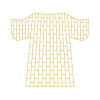
Coral Beaded Shirt
Ewu ivie
Coral Beaded Shirt

The Ewu ivie (coral bead shirt) is made of strings of coral beads. This heavy shirt was part of the ceremonial regalia worn only by a small number of high-ranking members of the palace: the Ọba, the Edaiken, the Iy’Ọba, and the Ezọmọ. The Ewu ivie would be worn along with the Odigba (coral bead collar).

1 annotation
Ewu ivie
Stacked beaded anklet
Iviawẹ
Stacked Beaded Anklet

Ọba gha ye Ivie gie ọwan, ẹ ghi tama rẹn ehe nọ gha bae yi (When the Ọba gifts you a bead, he doesn’t tell you how to wear it) (Daniel Inneh, pers. comm., 27 September 2025).

Iviawẹ (also spelled ĺvîowẹ) are coral-beaded anklets, often worn stacked together. Many of the figures depicted on the Emwin Arre (royal treasures) in brass, bronze, ivory, and wood are shown wearing these. According to Daniel Inneh (pers. comm., 27 September 2025), beads were sent to people whom the Ọba wished to honour, although there was no directive on how to wear them.

Mostly, people who wear Iviawẹ are identified as palace chiefs or priests and priestesses. However, today anyone can wear them as cultural identifiers or fashion pieces.

1 annotation
Iviawẹ
King
Ọba
King

The Ọba is the monarch of the Edo people and Kingdom. The current reigning monarch, Ọba Ẹwuare II, is the fortieth Ọba of the current dynasty, which is traditionally understood to have begun around 1170 AD. Over the centuries, the role and conception of the monarch have shifted, and the Emwin Arre (royal treasures) and the visual language they carry provide important evidence for understanding these developments. Although Emwin Arhe served a variety of functions within court life and ritual, “their primary purpose was to glorify the godlike king and the history of the powerful empire”.Plankensteiner 2007, p. 25 Representations of the Ọba are therefore ubiquitous across Benin court arts and frequently occupy a central position within their visual language.

Representations of the Ọba can be recognised through a combination of characteristics, including his size, as he is usually depicted larger than other figures, and his position within compositions, where he may appear in front of or be supported by other figures, as in the Royal Triad motif. The Ọba is also distinguished by particular items of regalia, including the Oro projection from his crown, the distinctive beaded swag extending from his right hip, the Ewu ivie (coral-beaded shirt), and Ukpan obọ eva (crossed coral-beaded baldrics).

Since the early 20th century, scholars have sought to identify individual Ọbas represented on Emwin Arhe by analysing the regalia and other attributes of figures identified as monarchs, as well as the combinations of motifs and figures appearing on particular objects. Oral traditions and historical accounts, alongside European archival sources, have also played an important role in determining the identities of specific Ọba. Just as the institution of the monarchy developed and changed over time, so too did the ways in which Ọbas were represented by artists working within the royal guilds, including the Igun-Ẹrọnmwọn and Igbesamwan.

1 annotation
Ọba
Colar Bead
Odigba
Coral beaded collar

Odigba (beaded collar) is a rigid neck collar made of beads, worn as part of ceremonial attire only by senior princes who have been made Enigie. Although Ibafe (2007, p. 43) argued that the Odigba was introduced during the Ogiso period (c. 900–c. 1170 AD) by Ogiso Ere, along with other symbolically important Emwin Arre, such as the Ada (ceremonial sword) and the Ebẹn (ceremonial sword). The Odigba was initially made of beads, while coral was incorporated only later, following its introduction through trade with Portuguese merchants in the late fifteenth century.

1 annotation
Odigba
Round Neck Bead
Ikele
Coral bead circlet

Ikele is a single stiff string or circlet of coral beads. It is worn by chiefs, such as senior chiefs who have been made Enigie (Inneh 2007, p.107), and is a sign of nobility and rank. The Ikele may only be worn once the Ọba has conferred a person with the right to wear the beads, and the Ikele must always be worn when appearing before the Ọba. According to Ekhaguosa Aisien when a chief is wearing the Ikele, they may not eat nor drink in public, and they “constitute an embassy of the Benin Palace wherever he might be.”

1 annotation
Ikele
Feather
Igan
Feather

Igan (feathers) are commonly depicted tucked into the headdresses and hats of chiefs represented on Emwin Arre (royal treasures). These feathers are from the Oɛɣohɔ (vulturine fish eagle) and symbolise respected old age and proper chieftaincy.

1 annotation
Igan
Beaded Crown
Ẹde
Beaded Crown

Although many other members of the Benin royal court wore a variety of hats and forms of headwear, only the Ọba may wear the Ẹde (beaded crown). The Ọba must never be seen bare-headed, and successive Ọba introduced different styles and types of crowns.

Across different media and objects, Ọba are depicted wearing various types of crowns, all elaborately crafted from coral beads. Some feature tall projections rising from the crown, known as Oro, while others have curved projections extending from either side of the head, known as the winged cap. The latter was introduced only in the 19th century, most likely by Ọba Osẹmwẹndẹ. Depictions of Ọba Ẹsigie on Ama-Ẹrọnmwọn (bronze relief plaques) show him wearing an elaborate crown decorated with large jasper or coral beads.

1 annotation
Ẹde
Iconography image
Ẹbẹn
Ceremonial Sword

Ẹbẹn are a type of ceremonial sword of significant importance in the Benin Kingdom. During ceremonies, titled chiefs would hold them or toss them during dances, thereby paying homage to the Ọba at these public events, particularly when a chief receives a certain status. It is forbidden for Ẹbẹn to touch the ground, so the chief must take extra precautions to avoid dropping the Ẹbẹn during the dance. Therefore, the Okae-Odionmwan (head of executioners) dances with the Umozo (warfare or executioner’s sword) behind the dancing chief.

There are two central ceremonial swords used in the royal court of the Benin Kingdom, one of which is the Ẹbẹn, along with the Ada (ceremonial swords). They are distinguished by their blades: the Ẹbẹn blade reflects the shape of a leaf or an oar. Sometimes, it is decorated with openwork designs and/or brass inlays, most commonly shaped as small Ẹbẹn and Ẹkpẹn (leopards). The handle of the Ẹbẹn also has an unusual ring-shaped form, which further differentiates it from the Ada.

1 annotation
Ẹbẹn

Provenance

4 events
Production
unknown to February 22, 1897 (day approximate)
Production of Ama-Erhan by members of the Emada
Loot
February 19, 1897 (day approximate) to June 1899 (month approximate)
Looting of the Emwin Arre - Inalienable Cultural Artefacts - during the Invasion of the Benin Kingdom in February 1897 and until the end of overt military activity in June 1899
Auction
November 23, 1930
Sale at Stevens Auction Rooms, November 23rd, 1930
Gift
1965
Gift of part of the Wellcome collection of Benin objects to the Fowler Museum at UCLA

Institution data

Fowler Museum at UCLA
The data was transferred directly by the institution.
Last updated: 2021-07-30
Language: english
Institution fieldValue
Object ID
object id
X65.10882
description
description
Materials
material
WOOD, METAL
Dimensions
dimensions
L: 103.51 cm, W: 31.75 cm
Object Name
object type
PANEL
Date
date made
11/23/30
Geographical area
production place
BENIN CITY, NIGERIA
Party
prior source
Stevens' Auction Rooms Ltd., Sir Henry Wellcome, Wellcome Trust
Evidence 1
provenance
Evidence 2
provenance
Country Culture
ethnic attribution
Culture Group
ethnic attribution
Party Notes
notes
summary of curatorial notes archival research thus far summer 2021
notes
status
legal status
Old Numbers
object id
R760/1937, 182183A
Party Lot Number
226
provenance list known dates
provenance
Sensitive content

Sensitive Content Digital Benin includes colonial material that may contain inaccurate, derogatory or harmful language relating to African and African diasporic communities. Such language may appear in catalogue records, transcriptions, and book, exhibition or museum titles. We recognize that this material may cause distress. Sensitive-content warnings are being implemented across the collection, but this process is ongoing. The language does not reflect Digital Benin’s views; we take an anti-colonial and anti-racist position and are committed to centring the humanity of historically marginalised communities.

Read more about our approach