Loading...


Registration number
Af1898,0115.47
Institution
British Museum Edo designations

English designations
Categories
Institution Location
Great Russell St, Bloomsbury, London WC1B 3DG, United Kingdom
Registration number
Af1898,0115.47
Institution
British Museum Edo designations
English designations
Relief Plaque
Categories
Palace Architecture & Ornamentation
Institution Location
Great Russell St, Bloomsbury, London WC1B 3DG, United Kingdom
Iconographies
11
annotations

Ebe Amẹ
Water Fern
1 annotation


Ẹroro
Bell
1 annotation


Ohian Ẹkpẹn
Leopard tunic
1 annotation


Ọyanyan
Horse
1 annotation


Akọn Ẹkpen
Leopard Teeth Neck Ornament
1 annotation

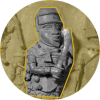
Ọkhọn Okuo
Warrior
2 annotations



Ẹrhu
Headwear
2 annotations



Asoro
Spears
1 annotation


Itakpa
Cat's whiskers facial markings
1 annotation

Provenance
7
events
Institution data
British Museum
The data was transferred directly by the institution.
Last updated: 2025-06-10
Language: english
| Institution field | Value |
|---|---|
Registration number object id | Af1898,0115.47 |
Additional IDs object id | 187 (Foreign Office number) |
PRN object id | EAF26501 |
Object Type designation | plaque |
Description description | Relief plaque, lost-wax cast in brass. Narrow plaque, rectangular in form without side flanges. Background surface decorated with river leaf patterns and stippling. One nail hole at top, one hole at bottom. Depicts high-ranking warrior in part profile leading captured figure on horseback, facing front. Warrior wears tall headgear with front plate and horsetail hanging behind, leopard's tooth necklace, bracelets, protective armbands, quadrangular bell and patterned wrap-around skirt. Carries sword in right hand. Captive sits astride horse, wears rounded helmet, leopard faced body armour and tunic with ruffled border. Figure has facial scarification. Spear with point facing downwards between two figures. |
Ethnic name (made by) ethnic attribution | Edo |
Date date made | 16thC-17thC |
Production place production place | Made in: Benin City |
Findspot place collected | Found/Acquired: Benin City |
Materials material | brass |
Technique production technique | lost-wax cast |
Dimensions dimensions | Height: 44.00 cm~Width: 21.00 cm~Depth: 9.50 cm~Weight: 6.30 kg |
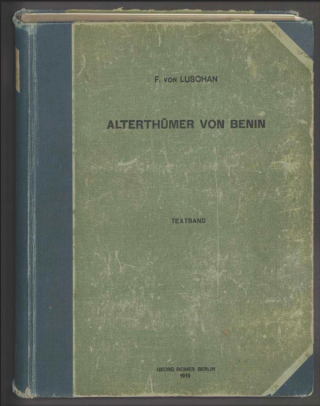
Curator’s comments provenance | The relief brass plaques that used to decorate the Oba's (king's) palace are among the most well-known of all the royal arts of Benin. Although frequently described as 'Benin Bronzes' most plaques are made of leaded brass in various compositions. It is widely accepted that they date to the 16th-17th centuries. In the years prior to the British Expedition royal influence in Benin was increasingly under threat from rival powers, both internal and external, with a focus on economic power and control of the important trading monopolies. However, the court and palace remained the political and spiritual centre of the Benin Kingdom. Earlier accounts written by Europeans visiting the city describe its size and scale. The palace complex was set up around atrium courtyards; some had galleries with wooden pillars supporting the roof. Brass plaques, probably made in matching pairs, were fixed to these pillars. The Benin brass plaques represent a distinct and unique corpus of work, unparalleled elsewhere on the continent. They are cast using the cire perdue (lost wax) technique and show significant variation in the depth of the relief. Some of the plaques portray historical events or commemorate successful wars, while others are a vivid depiction of Benin court life and ritual. Several groups of plaques show clear stylistic similarities. William B. Fagg suggested that these plaques represent the work of master brass casters. Fagg, William, 1973, 'Nigerian Images', London: Lund Humphries Gunsch, Kathryn, 2018, 'Benin plaques: a 16th century imperial monument', London: Routledge, Taylor and Francis Group ; One of six known plaques documenting battles with captured enemies. BM Af1898,0115. 48; BM Af1898,0115.49; Museum für Kunst und Gewerbe, Hamburg: 1899.75, Museum für Völkerkunde, Leipzig: MAf 34549; former PRM collection, (current location unknown), Pitt-Rivers, 1900: pl.2, figs.5-6. ; Plankensteiner 2007: On this relief plaque a Benin warrior seems to lead a captive mounted on horseback on his triumphant return from battle. The plaque is part of a series depicting specific battle scenes from the 16th centuy. The facial scarification of the captive and his use of horses lead to the assumption that it might be a warrior from the north, possibly the Nupe region. It is interesting to note that a Benin warrior on a plaque fragment found in Benin in the 1920s wearing the same attire depicted here, has been identified to Talbot as ‘Iyashere of c.1430’, meaning as Iyase (Talbot 1926, III; fig. 144). The same headgear for warriors though is depicted on many plaques so it seems to have been used by a variety of soldiers. The long straight hear attached to the plate on the forehead could have been a horsetail divided in the middle and hanging down behind (von Luschan 1919: 158-159). Horsetails obviously were such a sought after item of rank, that Portuguese traders specifically included them in their trade goods for Benin (Ryder 1969: 40). A British trader, Randall Shaw, specified in his suggestions for trade in the region in 1582 that black horse tails should be part of the cargoes for Benin (Ryder 1969: 80).; The facial scarification of the captive and his use of horses are thought to indicate that he is a warrior from the north, possibly from the Nupe region.; Read & Dalton 1899: A similar scene [to Af1898,0115.48] but with only the two principal actors. Here the captor wears a head-dress like that in Af1898,0115.20, but with the eyes and mouth of a leopard represented in appliqué instead of bead-work. He has twisted metal armlets on the right arm, and holds his sword by the hilt. At his left side is suspended a circular bell. The prisoner wears a hemispherical hat, on the front of which is a raised trefoil. |
Bibliographic references bibliography | Gunsch 2018: p.59, fig.4.7; p.64~Plankensteiner 2007: 240~Read & Dalton 1899: pl XIX.5 |
Exhibition history exhibition history | Exhibited: 1970-1973, London, Museum of Mankind, Divine Kingship in Africa 2007 May-Sept, Vienna, Museum für Völkerkunde, Benin. Kings and Rituals: Court Arts from Nigeria 2007-2008 Oct-Jan, Paris, Musée du quai Branly, Benin. Kings and Rituals: Court Arts from Nigeria 2008 Feb-May, Berlin, Staatliche Museen zu Berlin, Ethnologisches Museum, Benin. Kings and Rituals: Court Arts from Nigeria |
Condition condition | Fair; missing top lrft corner, section from rigth side and bottom right corner. Slight chip from bottom left edge. Holes in centre of plaque in front of warrior's chin, between two figures and below horse. |
Subjects iconography | equestrian ~battle ~palace/mansion |
Associated events event | Associated Event: British Expedition to Benin City - Feb 1897 |
Acquisition name (acquisition) provenance | Secretary of State for Foreign Affairs |
Acquisition date accession date | 1898 |
Acquisition notes (excavation) provenance | This plaque was looted during the British Expedition to Benin City in 1897. |
Sections
About
Other
Sensitive content
Sensitive Content Digital Benin includes colonial material that may contain inaccurate, derogatory or harmful language relating to African and African diasporic communities. Such language may appear in catalogue records, transcriptions, and book, exhibition or museum titles. We recognize that this material may cause distress. Sensitive-content warnings are being implemented across the collection, but this process is ongoing. The language does not reflect Digital Benin’s views; we take an anti-colonial and anti-racist position and are committed to centring the humanity of historically marginalised communities.