

Object ID
316574
Edo designations
English designations
Altar Tusk
Categories
Altar & Shrine Objects
Location
1000 5th Ave, New York, NY 10028, United States
Loading...

Iconographies

22 annotations
Uman-ague
Equal-armed cross

Uman-ague is a badge in the form of an equal-armed cross. The cross with straight-sided arms is known as the “Greek cross,” while the type with V-shaped arms, narrowing toward the centre, is known as the “Maltese cross.”

Uman-ague is usually worn around the neck by members of the Ewua or by the Ohensa ( ). The equal-armed cross has various meanings: as a symbol of cosmic order, it represents the number four and references the “four cardinal points established by the High God Osanobua when he created the world” (Girshick Ben-Amos 1999, p. 64), as well as the “crossroads or junction that serves as the point of connection between the natural and spiritual worlds” ( ). Paula Girshick Ben-Amos ( ) also argues that when used on the Aken'ni Elao (altar tusk), the cross, together with the Ivie okpagbaru (royal bead), constitutes an “emblematic reference” to Ọba Ẹsigie.

The cross also references the Portuguese missionaries who brought Christianity to the Kingdom during the reign of Ọba Ẹsigie, although the symbol was already in use before the arrival of Europeans ( ). The Maltese cross is thought to have been introduced by Ọba Eresonyẹn as part of his efforts to encourage the worship of the High God Osanobua during his reign ( ; ). Regardless, Uman-ague is often associated with Ọba Ẹsigie.

1 annotation
Uman-ague
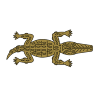
alligator
Ẹghughu
Crocodile

In the riverine area surrounding Benin City, there are two types of crocodile. The Ẹghughu, known in English as the dwarf or bush crocodile, is believed to be more docile ( ; Ọbazee 2025, p. 133). The second type is the Àgbákà, the aggressive Nile crocodile ( ; Ọbazee 2025, p. 11).

Crocodiles are one of the important animals represented in the historical Emwin Arhe, and they are known as Olokun’s guards or the “policemen” of the waters. The powerful and ferocious qualities of these animals might explain why warrior figures are often depicted wearing Uhunmwu-Ẹkuẹ (pendant masks) in the shape of crocodile heads on Ama-Ẹrọnmwọn (bronze relief plaques) ( ). Olokun devotees use crocodiles as sacrificial animals in offerings during the worship of Olokun.

2 annotations
Ẹghughu
Ẹghughu
Ivie okpagbaru/Ivie Ewuare
Royal/Ewuare Bead

This oval-shaped bead with faceted sides is known as the Ivie okpagbaru or Ivie Ewuare (the ‘royal bead’ or ‘Ewuare bead’). The association of Ọba Ewuare with this bead is based on a story in which Ewuare took beads from the deity Olokun, sanctifying his royal position and, in turn, receiving the title ‘Lord of the Land’, in contrast to Olokun’s title ‘Lord of the Sea’ (Omomo of Enisen in Blackmun 1990, p. 65). The Ivie okpagbaru/Ivie Ewuare is a distinctive motif that can be used to identify representations of the Ọba.

Due to the association of beads with Olokun, it is unsurprising that this bead has come to symbolise wealth when used to decorate Emwin Arhe (royal treasures) (Blackmun 1984, p. 59). Paula Ben-Amos (1999, p. 64) associated the bead with a different narrative and the name ‘One Bead Does Not Go around the Neck’. Ben-Amos suggests that the bead is in fact the one that was fought over by Ọba Ẹsigie and his brother Aruanran when they struggled for the right to the throne in the early 16th century.

1 annotation
Ivie okpagbaru/Ivie Ewuare
Ẹroro
Bell

Ẹroro (bells) frequently appear as ornaments worn by figures depicted on the Emwin Arhe, particularly on Ama-Eronmwon (bronze relief plaques) and Aken’ni Elao (carved tusks). These Ẹroro are most commonly quadrangular in form or, less commonly, cylindrical with rounded tops. Quadrangular Ẹroro worn around the neck are often part of the attire that indicates that figures can be interpreted as warriors, alongside the Akọn Ẹkpẹn (leopard tooth neck ornament) and the Ohian Ẹkpẹn (leopard tunics).

1 annotation
Ẹroro
Ẹkpẹn
Leopard

The Ẹkpẹn (leopard) is an animal that appears most often among the motifs decorating the Emwin Arhe (royal treasures). The Ẹkpẹn symbolises the valour and strength of the Ọba, as well as his political authority. The Benin people eulogise the Ọba as the ‘ẹkpẹn n'owa’ (leopard of the home).

When a hunter kills a leopard, he must say “ẹkpẹn n'oha” (I killed a bush leopard), as it is taboo to say that a hunter killed a leopard without specifying that it is a bush leopard, as otherwise this would “be tantamount to symbolically killing the king” (Nevadomsky 1988, p. 81). For this reason, leopards of the bush are called Atalakpa to distinguish them from those that represent the Ọba.

1 annotation
Ẹkpẹn
Ukpan obọ eva
Crossed Beaded Baldrics

The Ukpan obọ eva (coral-bead crossed baldrics) were worn as part of the ehaingbehia, the full ceremonial regalia, by only high-ranking members of the palace, including the Ọba himself, the Iy’Ọba, the Edaiken, and the Ezọmọ (Ben-Amos 1999, pp. 68, 141; Osadolor in Plankensteiner 2007, cat. no. 70, pp. 322–323).

1 annotation
Ukpan obọ eva
Beaded Crown
Ẹde
Beaded Crown

Although many other members of the Benin royal court wore a variety of hats and forms of headwear, only the Ọba may wear the Ẹde (beaded crown). The Ọba must never be seen bare-headed, and successive Ọbas introduced different styles and types of crowns ( ).

Across different media and objects, Ọbas are depicted wearing various types of crowns, all elaborately crafted from coral beads. Some feature tall projections rising from the crown, known as Oro, while others have curved projections extending from either side of the head, known as the winged cap. The latter was introduced only in the 19th century, most likely by Ọba Osẹmwẹndẹ ( ). Depictions of Ọba Esigie on Ama-Ẹrọnmwọn (bronze relief plaques) show him wearing an elaborate crown decorated with large jasper or coral beads ( ).

1 annotation
Ẹde
Uhunmwu-Ẹkuẹ
Pendant Mask

Uhunmwu-Ẹkuẹ (pendant masks) formed part of the ceremonial regalia worn by court dignitaries to indicate their rank or function and are frequently represented among the Emwin Arhe (royal treasures), particularly those made of brass, bronze, or ivory.

Different animals were depicted on Uhunmwu-Ẹkuẹ, particularly the heads of leopards and crocodiles. The most common type features the face or head of an Ọba. Other examples take the form of an elephant head incorporating the trunk-hand motif, a ram’s head, or, in a very small number of cases, the face of a Portuguese man. Different figures appear to have worn Uhunmwu-Ẹkuẹ with different imagery. For example, warrior chiefs are often depicted wearing leopard-head pendant masks, whereas crocodile-head Uhunmwu-Ẹkuẹ are generally shown being worn only by the Ọba and his Enọbare (Blackmun 2007, cat. no. 137, p. 365).

2 annotations
Uhunmwu-Ẹkuẹ
Uhunmwu-Ẹkuẹ
Ewi
Mudfish

Depictions of Ewi (mudfish) are among the most frequent motifs in the Emwin Arhe (royal treasures). Mudfish hold an important place in Edo belief, both as representations of the god Olokun and as symbols of royalty (Plankensteiner 2007, p. 410), as well as of “prosperity, peace, well-being and fertility” (Ben-Amos 1976, p. 245). Mudfish are also particularly common animals for sacrifice, and mudfish-shaped Orhiẹvbẹ (kola-nut boxes) were used to make offerings or store kola nuts.

Yet, the appearance of Ewi across the Emwin Arhe is not consistent, and it has been argued that different species of mudfish were depicted by Edo artists, each with different qualities and capabilities. For example, the electric shock of Malapterurus electricus resembles the fierceness of the Ọba, while the liminal qualities of the Synodontis clarias mudfish, which lives both on land and in water, similarly reflect the Ọba’s rule over land and sea (Gallagher 1983, p. 93). With these different qualities in mind, the mudfish is an important symbol of Benin kingship and royalty.

Sometimes the Ọba was depicted by artists with mudfish rather than legs (see Ọba with Mudfish Legs).

1 annotation
Ewi
Ọba
King

The Ọba is the monarch of the Edo people and Kingdom. The current reigning monarch, Ọba Ẹwuare II, is the fortieth Ọba of the current dynasty, which is traditionally understood to have begun around 1170 AD ( ). Over the centuries, the role and conception of the monarch have shifted, and the Emwin Arre (royal treasures) and the visual language they carry provide important evidence for understanding these developments. Although Emwin Arhe served a variety of functions within court life and ritual, “their primary purpose was to glorify the godlike king and the history of the powerful empire” (Plankensteiner 2007, p. 25). Representations of the Ọba are therefore ubiquitous across Benin court arts and frequently occupy a central position within their visual language.

Representations of the Ọba can be recognised through a combination of characteristics, including his size, as he is usually depicted larger than other figures, and his position within compositions, where he may appear in front of or be supported by other figures, as in the Royal Triad motif. The Ọba is also distinguished by particular items of regalia, including the Oro projection from his crown, the distinctive beaded swag extending from his right hip, the Ewu ivie (coral-beaded shirt), and Ukpan obọ eva (crossed coral-beaded baldrics).

Since the early 20th century, scholars have sought to identify individual Ọbas represented on Emwin Arhe by analysing the regalia and other attributes of figures identified as monarchs, as well as the combinations of motifs and figures appearing on particular objects. Oral traditions and historical accounts, alongside European archival sources, have also played an important role in determining the identities of specific Ọbas (e.g., , ; ). Just as the institution of the monarchy developed and changed over time, so too did the ways in which Ọbas were represented by artists working within the royal guilds, including the Igun-Ẹrọnmwọn and Igbesamwan.

1 annotation
Ọba
Asoro
Spears

Asoro (spears) were used as weapons in battle and for hunting ( ; Ọbazee 2025, p. 37). According to , there were two types: long and short. Figures holding Asoro are often depicted on Ama-Ẹrọnmwọn (bronze relief plaques), sometimes in battle scenes and at ceremonies and festivals.

1 annotation
Asoro
Ẹrhu
Headwear

Many different kinds of Ẹrhu (headwear) are worn by the various figures depicted in the imagery of Benin royal artefacts. Through comparisons with ceremonial regalia still worn by chiefs and members of the royal court, including the Ọba himself, some Ẹrhu have been used to identify the different figures depicted. For example, the conical hat worn by high-ranking town chiefs as part of the pangolin regalia, still worn at ceremonies, is also visible on figures on some Ama-Ẹrọnmwọn (bronze relief plaques) ( ). Other examples include the distinctive bell-shaped helmet associated with the Iyasẹ ( ). Figures who wear a shallow-brimmed hat and a cross have been identified as Ewua or Ohensa priests ( ).

Different kinds of helmets and headwear were worn by warriors, reflecting the many different ranks and roles in the army at any given time, as well as developing trends that were in turn represented on Emwin Arhe created at different points in time. Warrior figures wearing helmets covered in cowrie shells were carved on the Aken'ni Elao (carved tusks) (Blackmun 1984, p. 330), yet on the brass Ama, warriors are sometimes depicted wearing helmets made from crocodile hide or horsehair with a front plate (Osadolor in Plankensteiner 2007, cat. no. 238, p. 457). Helmets made from horsehair with a front plate are one of the more common types represented on the Ama-Ẹrọnmwọn, and the demand for black horse tails was noted by both Portuguese and British traders during the late 17th and 18th centuries (Osadolor in Plankensteiner 2007, cat. no. 238, p. 457). Other warriors depicted on Ama-Ẹrọnmwọn wear helmets with a rounded top, chinstrap, and sometimes also a feather tucked into the left side. These types of headwear are known as Ẹrhu Iyokuo.

Attire worn for battle also differed from that worn for ceremonial occasions, such as the pointed headwear worn in combination with an ornate leopard-head tunic by war chiefs. Depictions of figures wearing this attire on brass Ama-Ẹrọnmwọn (bronze relief plaques) have been interpreted as representing the war chiefs’ participation in the war-ritual Isiokuo festival (Osadolor in Plankensteiner 2007, cat. no. 238, p. 457).

Another distinctive form of headwear is that worn by figures identified as leopard hunters on the brass Ama-Ẹrọnmwọn (relief plaques). These large helmets cover almost all of the leopard hunters’ faces except for their noses, eyes, and upper lips, and are made of an unusual material that remains unidentifiable (Plankensteiner 2007, cat. nos. 68–69, p. 322).

European figures are also portrayed with distinctive hats, such as Portuguese three-cornered hats. These depictions reflect the artists’ keen observation and highlight the impact of European trade and military assistance (Ezra 1992).

3 annotations
Ẹrhu
Ẹrhu
Ẹrhu
Igan
Feather

Igan (feathers) are commonly depicted tucked into the headdresses and hats of chiefs represented on Emwin Arre (royal treasures). These feathers are from the Oɛɣohɔ (vulturine fish eagle) and symbolise respected old age and proper chieftaincy ( ).

1 annotation
Igan
Unwẹnrhiẹnọtan
Switch

The Unwẹnrhiẹnọtan (switch) is made from branches of a tall shrub and is held by the Ọba and certain chiefs, such as the Osuan and Ooton, during sacrificial rituals and ceremonies, particularly Ugie Erha Ọba (B ). Figures carrying Unwẹnrhiẹnọtan are depicted in brass on the Ama-Ẹrọnmwọn (bronze relief plaques) and also carved in ivory on the Aken'ni Elao (altar tusk).

According to Barbara Blackmun ( ), the Unwẹnrhiẹnọtan “is required whenever the sacrifice of a living creature takes place within the Ọba’s palace complex, to drive away intrusive spiritual forces. The upright position of this essential implement suggests that the person who holds it is about to preside over a sacrificial ceremony.”

1 annotation
Unwẹnrhiẹnọtan
Colar Bead
Odigba
Coral beaded collar

Odigba (coral-beaded collar) is a rigid neck collar made of coral beads, worn as part of ceremonial attire only by senior princes who have been made Enigie (Inneh 2007, p. 107). Although Ibafe (2007, p. 43) argued that the Odigba was introduced during the Ogiso period (c. 900–c. 1170 AD) by Ogiso Ere, along with other symbolically important Emwin Arhe, such as the Ada (ceremonial sword) and the Ẹbẹn (ceremonial sword), this seems unlikely, as coral was only introduced in the late 15th century through trade with Portuguese merchants.

1 annotation
Odigba
leopard teeth
Akọn Ẹkpen
Leopard Teeth Neck Ornament

Akọn Ẹkpẹn are necklaces or neck ornaments made of strung leopard’s teeth. They are worn by figures to signify their high rank and military prowess, as well as by their leaders, the Ezọmọ or Iyasẹ. They are often worn alongside quadrangular Ẹroro (bells) and Ohian Ẹkpẹn (leopard tunics).

The Akọn Ẹkpẹn is clearly and profoundly related to the symbolism of the Ẹkpẹn (leopard) and its association with the Ọba (king), who is metaphorically referred to as ‘ẹkpẹn ne owa’, the ‘leopard of the home’. On the other hand, the Ẹkpẹn is often referred to as the ‘king of the bush’, embodying ferocity, aggression, strength, and leadership—qualities attributed to the Ọba (Nevadomsky 1988). This intricate link between the leopard, the monarch, and his military leaders reinforces the complex hierarchy and spiritual authority central to Benin’s courtly art.

1 annotation
Akọn Ẹkpen
Enobare
Supporter

Enobare is the term used for the supporting figures who are typically depicted alongside the Ọba, holding his arms or hands as part of the Royal Triad motif. Their identities are interpreted variously: they may represent the Osa and Osuan, who support the Ọba during certain ceremonial contexts, or, particularly in representations dating to the 18th century, the Edaiken (crown prince) and Ezọmọ ( ).

1 annotation
Enobare
TBC_Royal Triad
Royal Triad

The Royal Triad is a motif composed of three figures, with a central figure supported on either side by two others. The motif has multiple meanings and interpretations. When understood on the human level, the central seated or standing figure is identified as the Ọba, flanked by two Enobare who each support one of his arms. This pose “encapsulates Edo ideals of kingship,” in which “even the most powerful of Benin's divinely ordained rulers cannot stand alone. He must maintain a careful balance between his authority over the Edo people and their acquiescence in his leadership” ( ). The identities of the supporting Enobare are interpreted variously. They have been identified as the Osa and Osuan, who support the Ọba in this manner during the Ugie Oro and Ododua festivals, although it is possible that the Edaiken (crown prince) and Ezọmọ performed these roles during the 18th century ( ).

In some examples, the central figure has mudfish in place of legs. These figures have sometimes been interpreted as representations of the deity Olokun ( ). Barbara Blackmun (1984, pp. 274–275) alternatively suggested that the triad may represent the high god Osanobua, his son and deity Olokun, and Olokun’s child, Ohen, who in turn represents the Ọba.

The number three is considered an “uncanny” number in Edo thought and “is never used lightly” ( ), being associated with the “threat of occult sanctions or forces” ( ).

The Royal Triad appears on almost all Aken'ni Elao (carved tusks), as well as on some Ẹgogo (gongs) and pendant plaques, and less frequently on Ama-Ẹrọnmwọn (bronze relief plaques). The motif is also referred to as the “supporting triad motif” or “linked supporting triad motif” ( ).

1 annotation
TBC_Royal Triad

Provenance

4 events
Production
1750 (year uncertain/approximate) to February 22, 1897 (day approximate)
The object was produced by Unknown member(s) of the Igbesamwan guild in Benin City.
Looted
February 22, 1897 (day approximate) to June 1899 (year approximate)
The object was looted by February 1897 Unknown member of the British colonial military campaign on Benin from Benin Kingdom.
Auction
April 27, 1976
The object was auctioned to Klaus Gunther & Amelia 'Dolly' Perls through Christie's in London.
Gift
1991
The object was given as a gift by Klaus Gunther & Amelia 'Dolly' Perls to the Metropolitan Museum of Art in New York City.

Institution data

Metropolitan Museum of Art
The data was downloaded via a public data access of the institution.
Last updated: 2025-06-02
Language: english
Institution fieldValue
Is Highlight
False
Is Timeline Work
False
Is Public Domain
license
True
Object ID
object id
316574
Department
department and institution
Arts of Africa, Oceania, and the Americas
AccessionYear
accession date
1991
Object Name
object type
Altar tusk
Title
designation
Altar Tusk
Culture
ethnic attribution
Edo peoples
Object Date
date made
1888–97
Object Begin Date
date made
1888
Object End Date
date made
1897
Medium
material
Ivory
Dimensions
dimensions
W. 3 3/4 × D. 29 1/2 in. (9.5 × 74.9 cm) approx.
Credit Line
prior source
Gift of Mr. and Mrs. Klaus G. Perls, 1991
Country
production place
Nigeria
Classification
object type
Bone/Ivory-Sculpture
Link Resource
weblink
http://www.metmuseum.org/art/collection/search/316574
Repository
department and institution
Metropolitan Museum of Art, New York, NY
Tags
iconography
Men
Tags AAT URL
iconography
http://vocab.getty.edu/page/aat/300025928
Tags Wikidata URL
iconography
https://www.wikidata.org/wiki/Q8441
Sensitive Content

Digital Benin collates digital material from institutions, and some of this material is inherently colonial and contains words, terms and phrases that are inaccurate, derogatory and harmful towards African and African diasporic communities. Catalogue transcriptions, book titles, exhibition titles and museum titles may contain harmful terms. We recognise the potential for the material to cause physical and mental distress as well as evoke strong emotions. Owing to the scale of the collection’s data, a process to implement sensitive-content warnings in the displayed data is still incomplete. The material within the catalogue does not represent Digital Benin’s views. Digital Benin maintains a strong anti-colonial, anti-racist position and affirms its support for centring the humanity of historically marginalised and disenfranchised communities. Read more about the background of this statement here