Loading...
Altar Tusk
Altar Tusk
Inventory no. [ObjInventarNrS]
4256
Edo designations
English designations
Categories
Institution Location
Schaumainkai 29-37, 60594 Frankfurt am Main, Germany
Inventory no. [ObjInventarNrS]
4256
Edo designations
English designations
Altar Tusk
Categories
Altar & Shrine Objects
Institution Location
Schaumainkai 29-37, 60594 Frankfurt am Main, Germany

Iconographies

9 annotations
Antelope
Uzo
Antelope

These motifs are sometimes interpreted as Uzo (antelopes) but also as Emila (cows). Both animals share certain characteristics, being regarded as physically beautiful and peaceful creatures. Some Orhiẹvbẹ (kola-nut bowls) take the form of an antelope head with its horns grasped by a pair of hands, a gesture that symbolises the right of humans to sacrifice antelopes and cows with impunity.

Uzo primarily symbolise beauty, docility, and their status as permissible sacrificial animals, reinforcing themes of human control over nature and the rituals that underpin social and spiritual order.

1 annotation
Uzo
Shield
Asa
Shield

Asa (shields) are a crucial attribute of warriors and warrior chiefs, forming part of their ceremonial and battle attire as represented on the Emwin Arre (royal treasures). Asa were usually made from elephant or crocodile skin and used by warriors for protection during hand-to-hand combat. Interestingly, the form of Asa depicted on historic royal artefacts differs from those found in museum collections today, reflecting changes in shield shapes and designs over time.

1 annotation
Asa
Spears
Asoro
Spears

Asoro (spears) were used as weapons in battle and for hunting. According to Osadolor, there were two types: long and short. Figures holding Asoro are often depicted on Ama-Ẹrọnmwọn (bronze relief plaques), sometimes in battle scenes and at ceremonies and festivals.

1 annotation
Asoro
king with mudfish legs
Ọba Ohẹn
King with Mudfish Legs

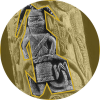
This motif of an Ọba with legs represented as two mudfish is often interpreted as Ọba Ohẹn, who reigned c. 1334–1370. According to oral traditions, Ohẹn suffered from paralysis of the legs and unsuccessfully attempted to conceal his condition from the chiefs and members of the royal court. The Iyasẹ Emuze eventually hid in the Ọba’s chambers to discover his secret. When Ohẹn discovered this, he ordered the Iyasẹ to be executed. However, the people learned of the order and turned against the Ọba. According to the tradition, they plotted to kill him ritually by digging a hole beneath his throne and stoning him with Orhue (white kaolin chalk) when he fell into it.

Not all representations of an Ọba with mudfish legs, however, are understood to refer to Ohẹn. Variations in the objects and animals carried by the figure are thought to indicate different meanings. Members of the Igbesamwan and Igun-Ẹrọnmwọn have emphasised the significance of these accompanying motifs (Blackmun 1984, pp.249–255). When the mudfish-legged Ọba is shown holding aquatic creatures such as crocodiles, for example, the image has been interpreted as a “cosmological image” representing the correspondence between the two monarchs: the Ọba of Benin, ruler of the land, and Olokun, ruler of the waters. By contrast, representations in which the Ọba holds swords or staffs have been interpreted specifically as depictions of Ọba Ohẹn.

1 annotation
Ọba Ohẹn
Iconography image
Ẹkpẹn
Leopard

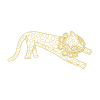
The Ẹkpẹn (leopard) is an animal that appears most often among the motifs decorating the Emwin Arhe (royal treasures). The Ẹkpẹn symbolises the valour and strength of the Ọba, as well as his political authority. The Benin people eulogise the Ọba as the ‘ẹkpẹn n'owa’ (leopard of the home).

When a hunter kills a leopard, he must say “ẹkpẹn n'oha” (I killed a bush leopard), as it is taboo to say that a hunter killed a leopard without specifying that it is a bush leopard, as otherwise this would “be tantamount to symbolically killing the king” (Nevadomsky 1988, p. 81). For this reason, leopards of the bush are called Atalakpa to distinguish them from those that represent the Ọba.

1 annotation
Ẹkpẹn
Crossed Beaded Baldrics
Ukpan obọ eva
Crossed Beaded Baldrics

The Ukpan obọ eva (coral-bead crossed baldrics) were worn as part of the ehaingbehia, the full ceremonial regalia, by only high-ranking members of the palace, including the Ọba himself, the Iy’Ọba, the Edaiken, and the Ezọmọ.

1 annotation
Ukpan obọ eva
Colar Bead
Odigba
Coral beaded collar

Odigba (beaded collar) is a rigid neck collar made of beads, worn as part of ceremonial attire only by senior princes who have been made Enigie. Although Ibafe (2007, p. 43) argued that the Odigba was introduced during the Ogiso period (c. 900–c. 1170 AD) by Ogiso Ere, along with other symbolically important Emwin Arre, such as the Ada (ceremonial sword) and the Ebẹn (ceremonial sword). The Odigba was initially made of beads, while coral was incorporated only later, following its introduction through trade with Portuguese merchants in the late fifteenth century.

1 annotation
Odigba
Mudfish
Ewi
Mudfish

Depictions of Ewi (mudfish) are among the most frequent motifs in the Emwin Arre (royal treasures). Mudfish hold an important place in Edo belief, both as representations of the god Olokun and as symbols of royalty, as well as of “prosperity, peace, well-being and fertility”. Mudfish are also particularly common animals for sacrifice, and mudfish-shaped Orhiẹvbẹ (kola-nut boxes) were used to make offerings or store kola nuts.

Yet, the appearance of Ewi across the Emwin Arhe is not consistent, and it has been argued that different species of mudfish were depicted by Edo artists, each with different qualities and capabilities. For example, the electric shock of Malapterurus electricus resembles the fierceness of the Ọba, while the liminal qualities of the Synodontis clarias mudfish, which lives both on land and in water, similarly reflect the Ọba’s rule over land and sea.Gallagher 1983, p. 93 With these different qualities in mind, the mudfish is an important symbol of Benin kingship and royalty.

Sometimes the Ọba was depicted by artists with mudfish rather than legs (see Ọba with Mudfish Legs).

1 annotation
Ewi
snake
Ẹyẹn
Snake

Ẹyẹn (snakes) are among the most common animals depicted by Edo artists on the Emwin Arre (royal treasures). The varied depictions of these reptiles suggest different snake species, including the Ikpin (python), Arhunmoto (puff adder), and Olose (red-black striped snake); therefore, here we use the generic term for snake: Ẹyẹn.

The identification of snake motifs and depictions as Ikpin, as well as the importance accorded to this species, is a subject of scholarly debate. Paula Ben-Amos argued that the Edo admired the “stature, colouration and crushing power” of the python, which was in turn associated with Olokun. She went on to identify the brass figures of snakes that formerly adorned the roof of the palace, as well as several other snakes, as pythons. Joseph Nevadomsky argued instead that the importance of the Ikpin had been overstated.

Some of these snake representations may in fact be the Arhunmwoto (puff adder). The first to suggest this was the German curator Felix von Luschan in his early research into the Benin royal treasures. Nevadomsky suggested that the large head, narrow neck, and rough scales are indicative of either the puff adder, a symbol of “material wealth, tribute, and gifts,” or the Gaboon viper.

Another kind of snake that may be depicted is the Olose (red-black striped snake). It has the praise name “king of the snakes” in Edo. Olose is also closely connected to the deity Olokun, both because of its attractiveness and because it inhabits wet environments such as forest streams, which in turn flow into rivers and the sea, where Olokun lives. Although the exact meanings of these different snakes vary, they share the characteristic of being spiritually powerful creatures.

1 annotation
Ẹyẹn

Provenance

4 events
Production
1750 (year uncertain/approximate) to February 22, 1897 (day approximate)
Production of the Aken'ni Elao by the Igbesamwan guild in Benin City
Loot
February 19, 1897 (day approximate) to June 1899 (month approximate)
Looting of the Emwin Arre - Inalienable Cultural Artefacts - during the Invasion of the Benin Kingdom in February 1897 and until the end of overt military activity in June 1899
Unknown
1899 to 1904 (approximate)
The object is known to have come into contact with J. F. G. Umlauff and Heinrich Umlauff.
Purchase
1904 (approximate)
The object was purchased by the Weltkulturen Museum Frankfurt am Main from Heinrich Umlauff and J. F. G. Umlauff.

Related archival documents

1 documents
See all
An archival document representing a Accession Records of 1 page(s)
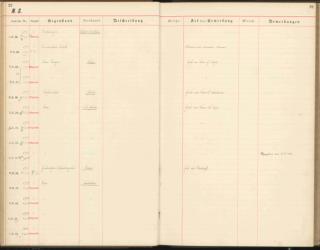
Accession RecordInventory
Weltkulturen Museum Frankfurt am Main
Inventory book WKM FFM

Institution data

Weltkulturen Museum Frankfurt am Main
The data was transferred directly by the institution.
Last updated: 2021-04-20
Language: english
Institution fieldValue
Inventory no. [ObjInventarNrS]
object id
4256
Object designation [ObjTitelOriginalS]
designation
object type
Elephant tusk. Altar decorations
Description [ObjReserve02M]
description
04256. Entirely carved with rows of figures: kings, horsemen, catfish feet, etc. Unrolling: 1975 Mathias Woszcyna. PUBL Frobenius 1933 T, 120 Dark (mit falscher Nummer) Blackmun, Barbara. 1984 II, 466
Mat./Technique [ObjTechMatM]
material
Ivory
Dimensions [ObjMasse1S]
dimensions
L 182
Dating [ObjDatierungS]
date made
1735 - 1750
Year from [ObjJahrVonL]
date made
1735
Year until [ObjJahrBisL]
date made
1750
Geographical reference [ObjGeografieS]
production place
Kingdom of Benin (Africa->West Africa->Nigeria)
Name sorting [KueSortierungS_0]
prior source
Umlauff Johann Friederich Gustav
Name sorting [KueSortierungS_1]
prior source
First Name 2 [KueVorNameS_1]
provenance
First name [KueVorNameS_0]
provenance
Johann Friederich Gustav
Function collector 2 [OkuFunktionS_1]
provenance
Function collector [OkuFunktionS_0]
provenance
Collector
Inventory note [ObjFeld07M]
provenance
Last Name 2 [KueNameS_1]
provenance
Last name [KueNameS_0]
provenance
Umlauff
Date of acquisition[ObjFeld04M]
accession date
c. 1904
Acquisition type [ObjFeld02M]
accession method
Buying
Comemnts[ObjCreditlineM]
notes
Unwinding available
Exhibition
exhibition history
Being Object. Being Art. Meisterwerke aus den Sammlungen des Museums der Weltkulturen Haupthaus (Masterpieces from the collections of the Museum of World Cultures Main Building) MdW 31.10.2009 - 31.10.2010;
Literature
bibliography
Being Object. Being Art. Meisterwerke aus den Sammlungen des Museums der Weltkulturen Frankfurt am Main. hrsg. von Achim Sibeth, Tübingen, Berlin, Ernst Wasmuth Verlag, 2009.
Type [ObjSystematikS]
object type
Rite/Cult
Type of ownership [ObjFeld01M]
accession method
Property
Type of person 2 [KueTypS_1]
Type of person [KueTypS_0]
Person
Sensitive content

Sensitive Content Digital Benin includes colonial material that may contain inaccurate, derogatory or harmful language relating to African and African diasporic communities. Such language may appear in catalogue records, transcriptions, and book, exhibition or museum titles. We recognize that this material may cause distress. Sensitive-content warnings are being implemented across the collection, but this process is ongoing. The language does not reflect Digital Benin’s views; we take an anti-colonial and anti-racist position and are committed to centring the humanity of historically marginalised communities.

Read more about our approach