Loading...
Relief Plaque
Relief Plaque
Relief Plaque
Relief Plaque
Relief Plaque
Relief Plaque
Relief Plaque
Relief Plaque
ID
211218
Edo designations
English designations
Categories
Institution Location
1 Adesogbe (Plymouth) Road, P.M.B. 1115, Benin City , Edo State
ID
211218
Edo designations
English designations
Relief Plaque
Categories
Palace Architecture & Ornamentation
Institution Location
1 Adesogbe (Plymouth) Road, P.M.B. 1115, Benin City , Edo State

Iconographies

15 annotations
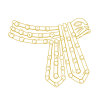
Hand of Wealth
Abuwa
Hand of Wealth

Abuwa ornaments are made from red ododo cloth and are a symbol of wealth. ‘Abuwa’ is understood to translate directly as “hand of wealth”. The Abuwa is worn at the waist by high-ranking chiefs as part of their ‘pangolin skin’ ceremonial regalia and continues to be worn today.

2 annotations
Abuwa
Abuwa
Wrapper
Ukpọn
Wrapper

Ukpọn is the Edo term for cloth and is used here to refer to the wrappers or kilts worn by many of the figures depicted on the Emwin Arre (royal treasures). The cloth worn around the waist may be plain, but it is more commonly richly decorated with motifs associated with the monarchy, power, and wealth, such as the Ọba'nui (infinity symbol) and Uhunme Ikpotoki (Portuguese heads).

The Benin Kingdom was renowned for its textile production, both for local use and for trade. Within the royal court, members of the Owina n’Ido produced ukhuen cloth for the Ọba and other members of the court, who wore it as wrappers during festivals and ceremonies.

Alongside locally produced textiles, imported cloth was also an important commodity in the Benin Kingdom’s trade networks. Textiles were exchanged with neighbouring production centres, particularly Ijebu, while European traders brought silks, woollens, linens, and cotton from Europe and Asia from the 15th century onwards.

2 annotations
Ukpọn
Ukpọn
Stacked beaded anklet
Iviawẹ
Stacked Beaded Anklet

Ọba gha ye Ivie gie ọwan, ẹ ghi tama rẹn ehe nọ gha bae yi (When the Ọba gifts you a bead, he doesn’t tell you how to wear it) (Daniel Inneh, pers. comm., 27 September 2025).

Iviawẹ (also spelled ĺvîowẹ) are coral-beaded anklets, often worn stacked together. Many of the figures depicted on the Emwin Arre (royal treasures) in brass, bronze, ivory, and wood are shown wearing these. According to Daniel Inneh (pers. comm., 27 September 2025), beads were sent to people whom the Ọba wished to honour, although there was no directive on how to wear them.

Mostly, people who wear Iviawẹ are identified as palace chiefs or priests and priestesses. However, today anyone can wear them as cultural identifiers or fashion pieces.

1 annotation
Iviawẹ
Round Neck Bead
Ikele
Coral bead circlet

Ikele is a single stiff string or circlet of coral beads. It is worn by chiefs, such as senior chiefs who have been made Enigie (Inneh 2007, p.107), and is a sign of nobility and rank. The Ikele may only be worn once the Ọba has conferred a person with the right to wear the beads, and the Ikele must always be worn when appearing before the Ọba. According to Ekhaguosa Aisien when a chief is wearing the Ikele, they may not eat nor drink in public, and they “constitute an embassy of the Benin Palace wherever he might be.”

1 annotation
Ikele
Armcuff
Ikoro
Armcuff

Ikoro (armcuffs) are made from different materials using different techniques, including brass sheet, cast bronze, and ivory. They were crafted by different guilds depending on the material used: artists of the Igun-Ẹrọnmwọn cast them in brass or hammered and incised them from brass sheet, whereas artists of the Igbesamwan carved ivory Ikoro. Ikoro were made in different qualities, from rather simple examples with abstract geometric decoration to finely carved ivory examples with brass or copper inlays. Ikoro are worn in pairs on both forearms by chiefs and the Ọba during ceremonies and festivals. Figures depicted on the Emwin Arre (royal treasures) are often shown wearing such pairs.

1 annotation
Ikoro
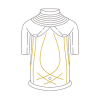
Crossed Beaded Baldrics
Ukpan obọ eva
Crossed Beaded Baldrics

The Ukpan obọ eva (coral-bead crossed baldrics) were worn as part of the ehaingbehia, the full ceremonial regalia, by only high-ranking members of the palace, including the Ọba himself, the Iy’Ọba, the Edaiken, and the Ezọmọ.

1 annotation
Ukpan obọ eva
Water fern
Ebe Amẹ
Water Fern

Ebe Amẹ refers to a wide variety of plants, particularly the leaves of the water fern or river leaf, found in riverine areas of southern Nigeria. Artists from the Igun-Ẹrọnmwọn used these as a decorative motif in the background of most Ama-Ẹrọnmwọn (bronze relief plaques). The petals of the Ebe Amẹ, like the points of the ἀghàdàgháda (crossroads), represent the four cardinal directions: north, east, south, and west. The number four plays a foundational role in the Edo calendar, which is structured around four market days.

1 annotation
Ebe Amẹ
Headwear
Ẹrhu
Headwear

Many different kinds of Ẹrhu (headwear) are worn by the various figures depicted in the imagery of Benin royal artefacts. Through comparisons with ceremonial regalia still worn by chiefs and members of the royal court, including the Ọba himself, some Ẹrhu have been used to identify the different figures depicted. For example, the conical hat worn by high-ranking town chiefs as part of the pangolin regalia, still worn at ceremonies, is also visible on figures on some Ama-Ẹrọnmwọn (bronze relief plaques). Other examples include the distinctive bell-shaped helmet associated with the Iyasẹ. Figures who wear a shallow-brimmed hat and a cross have been identified as Ewua or Ohensa priests.

Different kinds of helmets and headwear were worn by warriors, reflecting the many different ranks and roles in the army at any given time, as well as developing trends that were in turn represented on Emwin Arhe created at different points in time. Warrior figures wearing helmets covered in cowrie shells were carved on the Aken'ni Elao (carved tusks) (Blackmun 1984, p. 330), yet on the brass Ama, warriors are sometimes depicted wearing helmets made from crocodile hide or horsehair with a front plate (Osadolor in Plankensteiner 2007, cat. no. 238, p. 457). Helmets made from horsehair with a front plate are one of the more common types represented on the Ama-Ẹrọnmwọn, and the demand for black horse tails was noted by both Portuguese and British traders during the late 17th and 18th centuries (Osadolor in Plankensteiner 2007, cat. no. 238, p. 457). Other warriors depicted on Ama-Ẹrọnmwọn wear helmets with a rounded top, chinstrap, and sometimes also a feather tucked into the left side. These types of headwear are known as Ẹrhu Iyokuo.

Attire worn for battle also differed from that worn for ceremonial occasions, such as the pointed headwear worn in combination with an ornate leopard-head tunic by war chiefs. Depictions of figures wearing this attire on brass Ama-Ẹrọnmwọn (bronze relief plaques) have been interpreted as representing the war chiefs’ participation in the war-ritual Isiokuo festival (Osadolor in Plankensteiner 2007, cat. no. 238, p. 457).

Another distinctive form of headwear is that worn by figures identified as leopard hunters on the brass Ama-Ẹrọnmwọn (relief plaques). These large helmets cover almost all of the leopard hunters’ faces except for their noses, eyes, and upper lips, and are made of an unusual material that remains unidentifiable (Plankensteiner 2007, cat. nos. 68–69, p. 322).

European figures are also portrayed with distinctive hats, such as Portuguese three-cornered hats. These depictions reflect the artists’ keen observation and highlight the impact of European trade and military assistance (Ezra 1992).

1 annotation
Ẹrhu
Rosette - 'The Sun Never Misses a Day'
Owẹn iba ẹdẹ ku
Rosette - 'The Sun Never Misses a Day'

This rosette design, usually found in the corners of Ama-Ẹrọnmwọn (bronze relief plaques), is one of two motifs representing the sun and one of a number of motifs in Edo art that are also connected with Olokun. The association between the sun and Olokun refers to the way in which the sun descends into the sea each day—hence the proverb ‘the sun never misses a day’—and the sea is where the deity Olokun lives.

1 annotation
Owẹn iba ẹdẹ ku
Switch
Unwẹnrhiẹnọtan
Switch

The Unwẹnrhiẹnọtan (switch) is made from branches of a tall shrub and is held by the Ọba and certain chiefs, such as the Osuan and Ooton, during sacrificial rituals and ceremonies, particularly Ugie Erha Ọba. Figures carrying Unwẹnrhiẹnọtan are depicted in brass on the Ama-Ẹrọnmwọn (bronze relief plaques) and also carved in ivory on the Aken'ni Elao (altar tusk).

According to Barbara Blackmun, the Unwẹnrhiẹnọtan “is required whenever the sacrifice of a living creature takes place within the Ọba’s palace complex, to drive away intrusive spiritual forces. The upright position of this essential implement suggests that the person who holds it is about to preside over a sacrificial ceremony.”

1 annotation
Unwẹnrhiẹnọtan
tribal marks
Iwu
Facial and Body Markings

Iwu are facial and body markings (scarifications) that were historically worn by Edo men and women. However, since the 1960s, the practice has been nearly extinct. ). In the past, Iwu were used as a way of proving that one was an Edo citizen, and the ceremony of having Iwu completed was an important rite of passage for men and women. The Osiwu, who also practised circumcision and other surgical procedures, would carry out the procedure of adding Iwu. There are different types of Iwu: ‘blades’ worn on the torso (Iwu-eko), and those worn on the face, such as Ikharo (three or four markings above the eyebrows), Irho (two narrow ‘blades’ worn on each cheek), Ovbihue (nasal ‘blades’), Ovbi-agbanmwen (chin ‘blade’), and Igho-okpa/Ukpgho (three forehead ‘blades’).

The number of Iwu also varied depending on the identity of the person wearing them. For example, royal men would wear six ‘blades’ on their torso, whilst men who were not royal would wear seven ‘blades’. Meanwhile, the Ọba’s female children would wear fifteen ‘blades’, and all other women would wear sixteen.

1 annotation
Iwu
Warfare Sword
Umozo
Warfare Sword

The Umozo is a type of sword with a short, broad, and curved single-edged blade that was used by warriors during warfare. According to Benson Osadolor, it is remembered in Benin City as one of the oldest kinds of weapons used in warfare and “was better for the attack than defence”.

1 annotation
Umozo
Forehead markings
Ikharo
Forehead markings

Ikharo are linear keloid markings depicted on the forehead of Uhunmwu-Elao (commemorative heads) in groups of three or four above each eye. The exact meaning of Ikharo is debated; some have argued that they relate to the gender or tribal identification of the person on whom they are depicted. For example, Gabriel Ọbazee has argued that they were worn only by men; however, their use in depictions is not consistent with this, and the Iy’Ọba are also shown wearing them. Flora Kaplan argued that they are instead a stylistic feature employed by artists that varied over time.

The naming of these markings differs between publications. For example, Ekhaguosa Aisien and Joseph Nevadomsky describe these markings as “agbaguda n'ehae”, which they write translates literally as “blades of the forehead”. However, Aisien later went on to call these “ikharo”, as used here. Kate Ezra referred to these forehead markings as ikharo, meaning “tribal mark [of eye]”.

1 annotation
Ikharo

Provenance

6 events
Production
1504 (approximate) to 1550 (approximate)
Production of the Ama-Ẹrọnmwọn by the Igun-Ẹrọnmwọn guild in Benin City
Loot
February 19, 1897 (day approximate) to June 1899 (month approximate)
Looting of the Emwin Arre - Inalienable Cultural Artefacts - during the Invasion of the Benin Kingdom in February 1897 and until the end of overt military activity in June 1899
Unknown
January 1898 to July 1898
Acquisition of Benin objects by F. Erdmann in Benin City in 1898
Transfer
July 1898 (year approximate)
Transfer of Benin objects acquired by F. Erdmann from Benin City to Hamburg, 1898
Purchase
1899
Purchase of Benin objects from Bey & Co. by the Berlin Museum für Völkerkunde, 1899
Restitution
August 25, 2022
Transfer of ownership of 512 Emwin Arre from the collection of the Ethnological Museum, State Museums of Berlin to Omo n'Oba n'Edo Uku Akpolokpolo, Ọba of Benin, and the National Commission for Museums and Monuments, Nigeria, 25 August 2022

Related archival documents

1 documents
See all
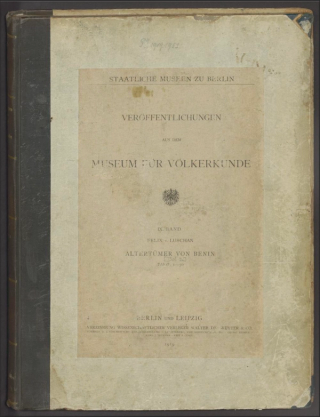
Museum Catalogue
Staatsbibliothek zu Berlin
Die Altertümer von Benin
Date
January 1, 1919 at 12:00:00 AM

Institution data

Ethnologisches Museum, Staatliche Museen zu Berlin
The data was transferred directly by the institution.
Last updated: 2021-06-14
Language: german
Institution fieldValue
ID
object id
211218
Sachbegriff
designation
Sachbegriff: Reliefplatte
Titel
designation
Titel: Osuan mit Ewua-Begleitern
Objektref.
description
E 1151/1898, Erwerbung: I/41/1899: III C 8348-8531, Altertümer (Benin), H. Bey, Hamburg, 1898, Heinrich Bey (1882)
Texte Online
description
Online Beschreibung, Osuan mit Gerte und ada-Schwert begleitet von zwei Mitgliedern der Ewua-Gilde.Der Priester Osuan ist an dem zapfenförmigen Aufsatz der Kopfbedeckung zu erkennen, die außer ihnen nur der König und einige Würdenträger tragen durften. Die lange Gerte, die er in der Hand trägt, dientn der Abwehr böser Mächte bei den Opferhandlungen. Osuan hatte zudem das Privileg, ein ada-Schwert zu tragen. Begleitet wird er von zwei Mitgliedern der Ewua-Gilde begleitet, deren Aufgabe das morgendliche zeremonielle Wecken des Königs war. [Benin_Königreich]
Material / Technik
material
Material: Messing; Material (engl.): copper alloy; Technik: Guss (Wachsausschmelzverfahren); Technik (engl.): casting (lost wax technique); Ausgabe: Messing; Guss; Ausgabe (engl.): Brass; copper alloy; casting
Material / Technik // Alle
material
Messing; Guss, Brass; copper alloy; casting, Messing, copper alloy, Guss (Wachsausschmelzverfahren), casting (lost wax technique)
Maße
dimensions
41,30 x 39,20 x 5,20 cm; 3,00 kg
Objekttyp
object type
Allgemein
Sachbegr. Ausgabe
object type
Reliefplatte (Relief plaque)
Anzahl Teile
object count
1
Datierung
date made
16. Jh.
Geogr. Bezüge
production place
Nigeria ( Land ); Benin ( Königreich )
Geogr. Bezüge // Alle
production place
Nigeria, Benin
Beteiligte
prior source
Heinrich Bey (1882), Sammler
Beteiligte // (Name, Sortierung=kleinste)
prior source
Bey, Heinrich
Veräußerer
prior source
null
Erwerb. Notiz
provenance
Erwerbung von: H. Bey; Notiz: Rückführung Leipzig; Ausgabe: 16. Jh., im Auftrag von Oba Esigie (reg. 1517-1550) oder seines Sohnes Oba Orhogbua (reg. 1550-1570), Königspalast, Benin-Stadt; durch Erbschaft an Oba Ovonramwen (ca. 1857-1914; reg. 1888-97), Königspalast, Benin-Stadt; geplündert im Zusammenhang mit der britischen Eroberung von Benin, 1897; in unbekanntem Besitz nach der Eroberung vom Königreich Benin; gesammelt im Auftrag der Firma Bey & Co., zwischen 1897 und 1898 im Gebiet des späteren kolonialen Nigeria; verkauft an das Königliche Museum für Völkerkunde in Berlin, 1899.
Verw. Institution
department and institution
Ethnologisches Museum, Staatliche Museen zu Berlin
Erwerb. Datum
accession date
1899
Besitzart
accession method
Erwerbungsart
accession method
Ankauf
Digital Assets
images
III C 8371.jpg, Vorlage; III C 8371 -B.JPG, Repro Digitalisat; III C 8371 -C.JPG, Repro Digitalisat; III C 8371 -D.JPG, Repro Digitalisat; III C 8371 -E.JPG, Repro Digitalisat; III C 8371 -F.JPG, Repro Digitalisat; III C 8371 -G.JPG, Repro Digitalisat; III C 8371 -H.JPG, Repro Digitalisat
Erwerb. Nr.
I/41/1899
Ident. Nr.
object id
III C 8371
Ident. Nr. // (Sortiernr.)
object id
0003 C 08371
Obj. Status
vorhanden
Sensitive content

Sensitive Content Digital Benin includes colonial material that may contain inaccurate, derogatory or harmful language relating to African and African diasporic communities. Such language may appear in catalogue records, transcriptions, and book, exhibition or museum titles. We recognize that this material may cause distress. Sensitive-content warnings are being implemented across the collection, but this process is ongoing. The language does not reflect Digital Benin’s views; we take an anti-colonial and anti-racist position and are committed to centring the humanity of historically marginalised communities.

Read more about our approach