Loading...
Queen Mother Figure
Queen Mother Figure
Queen Mother Figure
ID
210808
Edo designations
English designations
Categories
Institution Location
1 Adesogbe (Plymouth) Road, P.M.B. 1115, Benin City , Edo State
ID
210808
Edo designations
English designations
Queen Mother Figure
Categories
Figures
Institution Location
1 Adesogbe (Plymouth) Road, P.M.B. 1115, Benin City , Edo State

Iconographies

5 annotations

Ubanu'hi / Obanu'hi
Ubanu'hi
Inifinity Symbol

The Ubanu'hi (infinity symbol) is a kind of guilloche or interlaced strapwork motif that can be angular or rounded. It was used by Edo artists in the decoration of many Emwin Arhe (royal treasures) and is ubiquitous in Benin royal arts. Ubanu'hi is a shortened form of “uba no Ọba ya de agbon ke ehimwin yi”, which means “the rope with which the Ọba ties the heaven and earth together” (pers. comm. Chief John Igbineweka Inneh n’Igbesawman, 2022). Similarly, Paula Ben-Amos Girshick described this as “Ọba n’iri agbon”, or the “rope of the world” pattern.

According to Ọbabanmu Ineh, the use of this motif indicates that objects were carved by members of the Igbesanmwan. However, the motif is found on all types of Emwin Arhe (royal treasures), not only those made of ivory or wood. On the flanges of the Ama-Ẹrọnmwọn (relief plaques) alone, Kathryn Gunsch identified three different versions of the Ubanu'hi and, through her analysis of over 850 plaques, found that these different Ubanu'hi forms align with other characteristics, such as dimensions, the prevalence of ornamental motifs, and stylistic qualities. Together, these provide evidence, she argues, of different production groups among the plaque makers.

Kate Ezra went on to argue that the use of these motifs indicates that certain objects were used in a “royal context” and were associated with “royal patronage”.

Ubanu’hi can also be spelt Obanu'hi, indicating different intonations in the pronunciation of the words.

1 annotation
Ubanu'hi
Colar Bead
Odigba
Coral beaded collar

Odigba (beaded collar) is a rigid neck collar made of beads, worn as part of ceremonial attire only by senior princes who have been made Enigie. Although Ibafe (2007, p. 43) argued that the Odigba was introduced during the Ogiso period (c. 900–c. 1170 AD) by Ogiso Ere, along with other symbolically important Emwin Arre, such as the Ada (ceremonial sword) and the Ebẹn (ceremonial sword). The Odigba was initially made of beads, while coral was incorporated only later, following its introduction through trade with Portuguese merchants in the late fifteenth century.

1 annotation
Odigba
Fist/Hand
Obọ
Fist/Hand

The fist motif—particularly a clenched fist with an extended thumb—carries significant symbolic weight. It is central to the cult of the hand, a major aspect of Edo religion that focuses on an individual’s ability to achieve success through their own actions, skills, and enterprise. This cult is primarily observed by those who have already attained considerable wealth or status, including hunters, warriors, and craftsmen.

The fist symbolises physical prowess and strength, denoting the individual’s might and accomplishment. The hand is credited with enabling the accumulation of great riches and high status. This is sometimes linked to the idea that wealth results from both personal effort and the favour of Olokun, the god of wealth. On Ukhurhẹ (ancestral staffs), a clenched fist or hand grasping a mudfish signifies royal or chiefly authority. The image of a hand holding a coiled mudfish can also illustrate the Ọba’s formidable power to “cast and then release a curse” or to “set up obstacles and remove them”. The fist is sometimes accompanied by other motifs symbolising strength, chieftaincy, and longevity, such as tools like the hammer and pliers or feathers of the vulturine fish eagle. The fist motif is frequently depicted on Aken'ni Elao (carved tusks), on wooden Ikẹgobọ (altars to the hand), and on Ukhurhẹ.

1 annotation
Obọ
Royal/Ewuare Bead
Ivie okpagbaru/Ivie Ewuare
Royal/Ewuare Bead

This oval-shaped bead with faceted sides is known as the Ivie okpagbaru or Ivie Ẹwuare (the ‘royal bead’ or ‘Ẹwuare bead’). The association of Ọba Ẹwuare with this bead is based on a story in which Ẹwuare took beads from the deity Olokun, sanctifying his royal position and, in turn, receiving the title ‘Lord of the Land’, in contrast to Olokun’s title ‘Lord of the Sea’. The Ivie okpagbaru/Ivie Ẹwuare is a distinctive motif that can be used to identify representations of the Ọba.

Due to the association of beads with Olokun, it is unsurprising that this bead has come to symbolise wealth when used to decorate Emwin Arre (royal treasures). ). Paula Ben-Amos associated the bead with a different narrative and the name ‘One Bead Does Not Go around the Neck’. Ben-Amos suggests that the bead is in fact the one that was fought over by Ọba Ẹsigie and his brother Aruanran when they struggled for the right to the throne in the early 16th century.

1 annotation
Ivie okpagbaru/Ivie Ewuare
Gong
Ẹgogo
Gong

Ẹgogo (gongs) hold significant importance in Benin art and ritual, serving as powerful instruments with both practical and symbolic roles. Ivory gongs, especially “double-bell” types, were highly prized and reserved for the royal court, particularly those made entirely of ivory, which were used exclusively by the Ọba. The whiteness of ivory Ẹgogo symbolises purity and peace and is linked to sacred Orhue (white kaolin chalk) and the deity Olokun.

When depicted in the imagery of the Emwin Arre (royal treasures), Ẹgogo are usually held by figures such as the Ọba or high-ranking chiefs, illustrating their historical and ongoing use as idiophones during ceremonies and festivals. The Ọba dances with an ornately carved ivory Ẹgogo during the Emobo festival, which takes place three days after the Iguẹ festival.

1 annotation
Ẹgogo

Provenance

5 events
Production
unknown to February 22, 1897 (day approximate)
The object was produced by Unknown member(s) of the Igbesamwan guild.
Loot
February 19, 1897 (day approximate) to June 1899 (month approximate)
Looting of the Emwin Arre - Inalienable Cultural Artefacts - during the Invasion of the Benin Kingdom in February 1897 and until the end of overt military activity in June 1899
Unknown
February 22, 1897 (day approximate) to 1898
The object is known to have come into contact with William Downing Webster.
Purchase
1898
The object was purchased by the Ethnologisches Museum, Staatliche Museen zu Berlin from William Downing Webster.
Restitution
August 25, 2022
Transfer of ownership of 512 Emwin Arre from the collection of the Ethnological Museum, State Museums of Berlin to Omo n'Oba n'Edo Uku Akpolokpolo, Ọba of Benin, and the National Commission for Museums and Monuments, Nigeria, 25 August 2022

Related archival documents

1 documents
See all
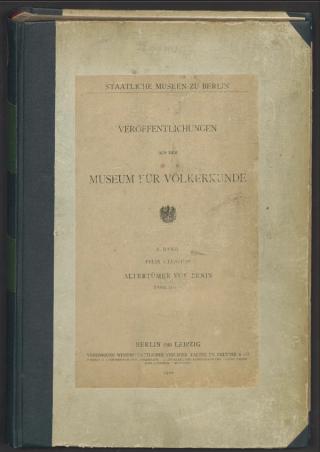
Museum Catalogue
Staatsbibliothek zu Berlin
Die Altertümer von Benin
Date
January 1, 1919 at 12:00:00 AM

Institution data

Ethnologisches Museum, Staatliche Museen zu Berlin
The data was transferred directly by the institution.
Last updated: 2021-06-14
Language: german
Institution fieldValue
ID
object id
210808
Sachbegriff
designation
Sachbegriff: Plastik; Sachbegriff: Skulptur; Sachbegriff: Menschliche Skulptur
Titel
designation
Titel: König von Benin
Objektref.
description
E 534/1898, Erwerbung: I/80/1898: III C 8054-8084, VI 14555-14556, Ethnogr. (Benin; N. Guinea), Webster, 1898, William Downing Webster (1895)
Texte Online
description
Online Beschreibung, [Benin_Königreich]
Material / Technik
material
Material: Elfenbein; Ausgabe: Elfenbein
Material / Technik // Alle
material
Elfenbein, Elfenbein
Maße
dimensions
9,70 cm; 9,50 x 3,00 x 2,50 cm
Objekttyp
object type
Allgemein
Sachbegr. Ausgabe
object type
Plastik (Sculpture)
Anzahl Teile
object count
1
Datierung
date made
19. Jh.
Geogr. Bezüge
production place
Nigeria ( Land ); Benin ( Königreich )
Geogr. Bezüge // Alle
production place
Nigeria, Benin
Beteiligte
prior source
William Downing Webster (1895), Veräußerer
Beteiligte // (Name, Sortierung=kleinste)
prior source
Webster, William Downing
Veräußerer
prior source
null
Erwerb. Notiz
provenance
Erwerbung von: [William Downing] Webster; Notiz: Rückführung Wiesbaden; Ausgabe: 19. Jh., im Auftrag im Königreich Benin gegeben; Besitz vor 1897 derzeit unbekannt; vermutlich geplündert im Zusammenhang mit der britischen Eroberung von Benin, 1897; in unbekanntem Besitz zwischen Feb. 1897 und 1898; erworben vom Museum für Völkerkunde von William D. Webster, 1898.
Verw. Institution
department and institution
Ethnologisches Museum, Staatliche Museen zu Berlin
Erwerb. Datum
accession date
1898
Besitzart
accession method
Eigentum
Erwerbungsart
accession method
Ankauf
Digital Assets
images
Vorlage; Vorlage; Vervielfältigung; III C 8061.JPG, Repro Digitalisat
Erwerb. Nr.
I/80/1898
Ident. Nr.
object id
III C 8061
Ident. Nr. // (Sortiernr.)
object id
0003 C 08061
Obj. Status
vorhanden
object_images/creator
license
Dietmar Gunne
Sensitive content

Sensitive Content Digital Benin includes colonial material that may contain inaccurate, derogatory or harmful language relating to African and African diasporic communities. Such language may appear in catalogue records, transcriptions, and book, exhibition or museum titles. We recognize that this material may cause distress. Sensitive-content warnings are being implemented across the collection, but this process is ongoing. The language does not reflect Digital Benin’s views; we take an anti-colonial and anti-racist position and are committed to centring the humanity of historically marginalised communities.

Read more about our approach