Loading...
OBJEKTE_ID
1709973
Edo designations
English designations
Categories
Institution Location
Johannispl. 5-11, 04103 Leipzig, Germany
OBJEKTE_ID
1709973
Edo designations
English designations
Relief Plaque
Categories
Palace Architecture & Ornamentation
Institution Location
Johannispl. 5-11, 04103 Leipzig, Germany

Iconographies

6 annotations
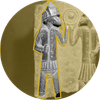
European Figures
Ebo
European Figures

During the late 15th century, European visitors began arriving in Benin City and subsequently played important roles in trade, the military, religion, and belief. Edo artists incorporated a range of figures understood to represent Europeans into the visual language of Emwin Arre (royal treasures). These depictions served in part to communicate the power and reach of the Benin monarchy, making the “greatness of ruler and realm more palpable” and demonstrating that the Ọba’s authority extended beyond his own people to those who came from distant lands.

European visitors came from a number of countries, including the Netherlands, Britain, France, and Italy. Portuguese visitors, however, had the most extensive and enduring influence, which is particularly evident in the visual language of Benin royal arts.

European figures were incorporated into Ama-Ẹrọnmwọn (bronze relief plaques), dating primarily to the 16th and 17th centuries, and Aken'ni Elao (carved tusks), dating from the 17th to the 19th centuries. They are typically depicted with straight, shoulder-length hair and/or beards, rounded cap-like headwear, heavily pleated skirts, and jerkins. These figures often appear alongside other motifs associated with European trade and contact, such as Ugianranran (manillas) and horses, or with warfare, such as firearms. In addition to full-length figures, the Uhunmwu Ikpotoki (Portuguese head) was incorporated into a wide range of objects, most likely as a symbol of power and wealth associated with overseas trade and, by extension, with Olokun, the deity of the sea.

European figures also became part of the visual language developed by the Emada, palace pages whose carving tradition differed from that of the royal guild of wood and ivory carvers, the Igbesamwan. Although the precise origins of the Emada carving tradition are uncertain, it is thought to have developed during the reign of Ọba Adolo, and many surviving examples are therefore dated to the 19th century. Their representations of Europeans differ from the conventions used in earlier depictions understood to represent Portuguese visitors. Rather than wearing pleated skirts and jerkins, these later figures are typically shown in suits, wide-brimmed hats, and smoking pipes, and may carry straighter, sabre-like swords, guns, or umbrellas.

2 annotations
Ebo
Ebo
Neptune
Neptune
Neptune

Neptunes are brass or copper pans that became a highly sought-after import item in Benin during the 18th century, eventually replacing Ugianran (manilla) as a primary exchange commodity. Unlike most of the other bronze and brass objects shown on Digital Benin, these were not produced by artists from the Igun-Ẹrọnmwọn but were made as trade goods in southern Germany. Although they are not among the most frequent motifs, they are symbolically important, representing the wealth brought to the Edo Kingdom through Olokun’s realm—the ocean. Neptunes are usually depicted being held by European figures with long, straight hair.

1 annotation
Neptune
Headwear
Ẹrhu
Headwear

Many different kinds of Ẹrhu (headwear) are worn by the various figures depicted in the imagery of Benin royal artefacts. Through comparisons with ceremonial regalia still worn by chiefs and members of the royal court, including the Ọba himself, some Ẹrhu have been used to identify the different figures depicted. For example, the conical hat worn by high-ranking town chiefs as part of the pangolin regalia, still worn at ceremonies, is also visible on figures on some Ama-Ẹrọnmwọn (bronze relief plaques). Other examples include the distinctive bell-shaped helmet associated with the Iyasẹ. Figures who wear a shallow-brimmed hat and a cross have been identified as Ewua or Ohensa priests.

Different kinds of helmets and headwear were worn by warriors, reflecting the many different ranks and roles in the army at any given time, as well as developing trends that were in turn represented on Emwin Arhe created at different points in time. Warrior figures wearing helmets covered in cowrie shells were carved on the Aken'ni Elao (carved tusks) (Blackmun 1984, p. 330), yet on the brass Ama, warriors are sometimes depicted wearing helmets made from crocodile hide or horsehair with a front plate (Osadolor in Plankensteiner 2007, cat. no. 238, p. 457). Helmets made from horsehair with a front plate are one of the more common types represented on the Ama-Ẹrọnmwọn, and the demand for black horse tails was noted by both Portuguese and British traders during the late 17th and 18th centuries (Osadolor in Plankensteiner 2007, cat. no. 238, p. 457). Other warriors depicted on Ama-Ẹrọnmwọn wear helmets with a rounded top, chinstrap, and sometimes also a feather tucked into the left side. These types of headwear are known as Ẹrhu Iyokuo.

Attire worn for battle also differed from that worn for ceremonial occasions, such as the pointed headwear worn in combination with an ornate leopard-head tunic by war chiefs. Depictions of figures wearing this attire on brass Ama-Ẹrọnmwọn (bronze relief plaques) have been interpreted as representing the war chiefs’ participation in the war-ritual Isiokuo festival (Osadolor in Plankensteiner 2007, cat. no. 238, p. 457).

Another distinctive form of headwear is that worn by figures identified as leopard hunters on the brass Ama-Ẹrọnmwọn (relief plaques). These large helmets cover almost all of the leopard hunters’ faces except for their noses, eyes, and upper lips, and are made of an unusual material that remains unidentifiable (Plankensteiner 2007, cat. nos. 68–69, p. 322).

European figures are also portrayed with distinctive hats, such as Portuguese three-cornered hats. These depictions reflect the artists’ keen observation and highlight the impact of European trade and military assistance (Ezra 1992).

2 annotations
Ẹrhu
Ẹrhu
Crossroads
Aghadaghada
Crossroads

According to Paula Ben-Amos, this motif is known as Aghadaghada, a “play on the word ada,” meaning “crossroads.” The design appears as a background motif on a small number of Ama-Ẹrọnmwọn (bronze relief plaques) and is associated with Olokun and the period of close contact between the Benin Kingdom and the Portuguese Empire during the reigns of Ọba Ọzọlua, Ọba Ẹsigie, and Ọba Orhogbua. At the time of Ben-Amos’s research, the same symbol was drawn in chalk at the centre of Olokun shrine courtyards in Benin City. William Fagg described the design more literally as a “circled cross” and suggested that the Ama-Eronmwon bearing this background motif may have been cast by a particular ‘master’ or member of the Igun-Ẹrọnmwọn.

More broadly, the cross, with its four points, references the number four, which has significance in Edo belief: the Edo week consists of four days, and each day is divided into four parts ( ). Other cross forms are treated as distinct motifs and are discussed separately under Uman-Ague (equal-armed cross).

1 annotation
Aghadaghada

Provenance

5 events
Production
1504 (approximate) to 1550 (approximate)
Production of the Ama-Ẹrọnmwọn by the Igun-Ẹrọnmwọn guild in Benin City
Loot
February 19, 1897 (day approximate) to June 1899 (month approximate)
Looting of the Emwin Arre - Inalienable Cultural Artefacts - during the Invasion of the Benin Kingdom in February 1897 and until the end of overt military activity in June 1899
Unknown
February 22, 1897 (day approximate) to 1902
The object is known to have come into contact with William Downing Webster.
Purchase
1902
The object was purchased by Arthur Baessler from William Downing Webster.
Donation
1902
Donation of Benin objects purchased and collected by A. Baessler to the Dresden Museum für Völkerkunde, 1902

Related archival documents

3 documents
See all
Museum Catalogue
Staatsbibliothek zu Berlin
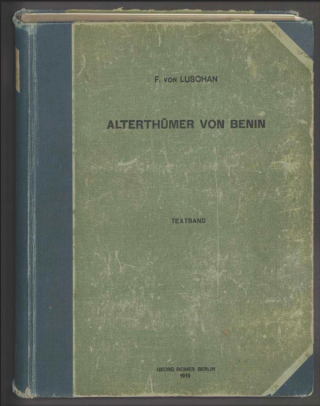
Die Altertümer von Benin
Date
January 1, 1919 at 12:00:00 AM
An archival document representing a Inventories of 257 page(s)
Inventory
Museum of New Zealand Te Papa Tongarewa
Stock books
Date
March 24, 1900 to December 31, 1903
An archival document representing a Sales Catalogs of 48 page(s)
Sales Catalogue
Wellcome Collection
Catalogue of ethnological specimens : European and Eastern arms & armour, Prehistoric and other curiosities / W.D. Webster, Oxford House, Bicester, Oxon., England.
Date
January 1, 1901 to December 31, 1901

Institution data

Staatliche Ethnographische Sammlungen Sachsen und Staatliche Kunstsammlungen Dresden
The data was transferred directly by the institution.
Last updated: 2021-09-28
Language: german
Institution fieldValue
INV_NR
object id
13597
OBJEKTE_ID
object id
1709973
KURZTITEL
designation
Reliefplatte Portugiesen
Object-name-and-materials
designation
material
Reliefplatte mit zwei Portugiesen Gelbguss
TITEL
designation
Reliefplatte mit zwei Portugiesen
INTERNETKOMMENTAR
description
notes
Die Portugiesen-Figuren wurden in Anlehnung an Kleidungsformen des 16. Jh. dargestellt. Die Platte mit zwei Portugiesen gehört vermutlich zu den sehr früh hergestellten Stücken, worauf das kreuzförmige Plattengrundmotiv hinweist. Das von den Männern gehaltene fremdartige Objekt könnte ein Metallring oder eine Metallplatte sein, ebenfalls begehrte Handelsgüter am Königshof in Benin. (MVD, S. D.)
KATALOGTEXT
description
MATERIAL
material
Metall;Bronze
MASSEBEMERKUNG
dimensions
31 x 18 x 2,5 cm; 2500 g|L: 31 cm B: 18 cm T: 2,5 cm, Gewicht: 2500 g
MASSETABANGABE
dimensions
Gesamt
MASSETABBEMERKUNG
dimensions
MASSETABBREITE
dimensions
18
MASSETABDURCHMESSER
dimensions
MASSETABEINHEITLAENGE
dimensions
cm
MASSETABEINHEITLAENGE_IDS
dimensions
1
MASSETABHOEHE
dimensions
31
MASSETABTIEFE
dimensions
2,5
Dimensions_weight
weight
H: 31 cm W: 18 cm X: 2,5 cm M: 2500 g
MASSETABEINHEITGEWICHT
weight
g
MASSETABEINHEITGEWICHT_ID
weight
8
MASSETABGEWICHT
weight
2500
OBJEKTBEZ
object type
Plastik
KONVOLUT
provenance
object count
Sammlung Arthur Baessler; SES Benin-Objekte; William D. Webster, London; SES Dossier Benin-Objekte, Überlieferung an die Kontaktstelle für Sammlungsgut aus kolonialen Kontexten
ORT_DATUM_BIS
date made
1897;1902
ORT_DATUM_KONKRET
date made
';'
ORT_DATUM_VON
date made
;
MATTECHBEMERKUNG
production technique
Gelbguss
TECHNIK
production technique
gegossen
ORTE
production place
Federal Republic of Nigeria;Benin City
ORTZEITBEMERKUNG
production place
Königreich Benin, vor 1897
Ort_Zeit-Bemerkung
production place
Königreich Benin, vor 1897
REGIONEN
production place
Benin
Collector/Previous-owner
prior source
Arthur Baessler, Berlin, purchased from William D. Webster, London, in March 1902
ERWERBUNG
prior source
Schenkung 1902 von Arthur Baessler, Berlin
PERSON
prior source
unbekannt;Baessler, Arthur;Webster, William Downing
Acquisition-Details
provenance
Donated by Arthur Baessler, Berlin
EIGENTUEMER
provenance
SES/Freistaat Sachsen
PROVENIENZ
provenance
William D. Webster, London (bis 1902); Arthur Baessler, Berlin (erworben März 1902 von William D. Webster, bis 1902)
PROVENIENZSTATUS
provenance
SKD-Eigentum
EREIGNISSE
event
Herstellung;Provenienz;Provenienz
ETHNIEN
ethnic attribution
Institution
department and institution
Staatliche Ethnographische Sammlungen Sachsen - Museum für Völkerkunde Dresden
MUSEUM
department and institution
MVD
Institutional-acquisition-date
accession date
1902
Comments
notes
Arthur Baessler, 1857-1907, German Ethnologist and Athropologist; William Downing Webster, 1868-1913, English Dealer and Collector of Ethnographica
PRAESENZ
display status
nicht ausgestellt
BIBLIOGRAPHIE
bibliography
'- Menut, Nicolas: Premiers contacts. in: Fondation Pierre Arnaud [Hrsg.]: Homme Blanc, Homme Noir. Impressions d’Afrique [Ausst.Kat.]. Lausanne, 2015|- Silvia Dolz: Schätze aus Afrika: Benin. Die Schenkung Baessler [Ausst.Kat.]. Dresden, 2006|- Wolf, Sieg
ERWAEHNTIN
bibliography
1) Menut, 2015, S. 51 u. Abb. 32|2) MVD, 2006, S. 23 u. Abb. 47|3) Wolf, 1972, Taf. 1 u. S. 33|4) Wolf, 1965. S. 111-164, Tafel 1 + 2
LITERATUR
bibliography
Gunsch, K.W.: The Benin Plaques: A Singular Monument. in: Art. N° 88 Summer 2018. S. 98-113|
LIT_LITERATUR
bibliography
Deimel 2006 [Schätze aus Afrika, ...];Wolf 1965;Wolf 1965
BILDUNTERSCHRIFT
images
Übernahme Altdaten|Region original: Großregion => Westafrika; Land => Nigeria; Gebiet => Benin|Ethnie original: kein Eintrag|Region bei Datenübergabe: Afrika>Westafrika>Nigeria>Benin
ALTINVENTARE
AUTHENTIZITAETSZUSATZ
;;
AUTHZUSAETZE_IDS
;;
Additional-IDs
object id
11610 (original number)
Dokumentname
13597_1
EREIGNISSE_IDS
12;15;15
ETHNIEN_IDS
ETH_AUTHZUSAETZE
ETH_AUTHZUSAETZE_IDS
ETH_EREIGNISSE
ETH_EREIGNIS_IDS
FERTIG
1
FLAG
EXP
FOTOFELD
Neg.Tasche Nr. 326/49,50
FUNKTION
Hersteller;Schenker;Händler
GEAENDERT_AM
14.06.2021
GLEICHRANGIG
GND_ID_OBEZ
22955
GND_ID_SCHLAGWORT
243875;77042;186934;102167;22955;22976;24148;33597
GRUNDDATEN
1
INTERNETFREIGABE
1
INVENTURDATUM
INVNR_MERKMALE_IDS
581
KONVOLUTE_IDS
582;959;1409;1191
KOORDINATEN
(10 8);(6,33504 5,62749)
LEIHVERKEHR
exhibition history
LIT_ABBILDUNG
47;1;2 (Rückansicht)
LIT_BAND_SEITE
Seite 47;Bd. 24 / Taf.;Bd. 24 / Taf.
LIT_BEMERKUNG
farbig;schwarz-weiss;schwarz-weiss
LIT_LITERATUR_IDS
821;1968;1968
LIT_NUMMERE
;;
LIT_STA_INETFREIGABE
1;1;1
MAND_ID
1
MATERIALIEN_IDS
1233;1116
MERKMAL
Originalnummer
MUSEEN_ID
35
ORTE_IDS
2328926;2347283
ORT_AUTHZUSAETZE
;
ORT_AUTHZUSAETZE_IDS
;
ORT_BEZUG
;
ORT_EREIGNISSE
Herstellung;Erwerbung
ORT_EREIGNISSE_IDS
12;9
PND_BEZUG
;;
PND_FUNKTIONEN_IDS
-2;133;645
PND_INETFREIGABE
1;0;1
PND_PERSONEN_IDS
12797488;12106249;12821279
PRAESENZEN_WERT_ID
-67
PROVSTATUS_WERT_ID
-43
REGIONEN_IDS
612
REG_EREIGNISSE
Sammelereignis
REG_EREIGNIS_IDS
17
SAMMLUNG
Afrika
SAMMLUNGEN_ID
535
SCHLAGWORT
Europäer <Motiv>;Helm;Kolonialgeschichte;Konquistador;Plastik;Platte;Relief;Rüstung
TECHNIKEN_IDS
75
UNTERGEORDNET
VORLAGEN
WEITERE_NUMMERN
object id
11610
WISSENSCHAFT
1
XRAY
###
Sensitive content

Sensitive Content Digital Benin includes colonial material that may contain inaccurate, derogatory or harmful language relating to African and African diasporic communities. Such language may appear in catalogue records, transcriptions, and book, exhibition or museum titles. We recognize that this material may cause distress. Sensitive-content warnings are being implemented across the collection, but this process is ongoing. The language does not reflect Digital Benin’s views; we take an anti-colonial and anti-racist position and are committed to centring the humanity of historically marginalised communities.

Read more about our approach