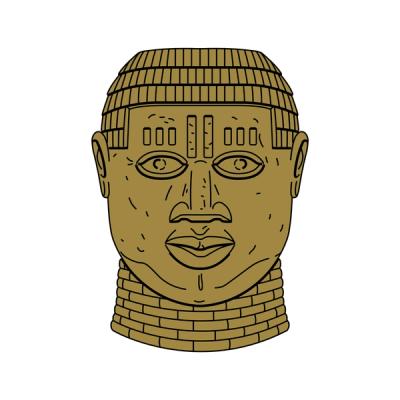
Ivbiotọ
Ivbiotọ (trophy heads) are thought to represent decapitated heads of former Benin vassals who rebelled against the Ọba. When a rebel vassal was defeated, his head was removed and brought to Benin in an Ẹkpoki. The Ọba sent it to the Igun Ẹronmwon, where they made bronze replicas. The three Udari, or suborbital markings, show that the image is that of a non-Benin male.
Based on a conversation with Chief Ihama in 1976, Ben-Amos (1995 ) argued that these represent the decapitated heads of conquered kings. The Ọba kept one of the cast heads in the palace, while the other was sent to the son of the rebel vassal to constantly remind him of what happened to his father in case he chose to rebel against the Ọba. According to Chief Inneh, such heads were placed on the shrines of the ancestors, whereas Nevadomsky (1986 ) suggested they were placed on the shrine of war, the Aro-Okuo.
Educational Material
Digital Benin collates digital material from institutions, and some of this material is inherently colonial and contains words, terms and phrases that are inaccurate, derogatory and harmful towards African and African diasporic communities. Catalogue transcriptions, book titles, exhibition titles and museum titles may contain harmful terms. We recognise the potential for the material to cause physical and mental distress as well as evoke strong emotions. Owing to the scale of the collection’s data, a process to implement sensitive-content warnings in the displayed data is still incomplete. The material within the catalogue does not represent Digital Benin’s views. Digital Benin maintains a strong anti-colonial, anti-racist position and affirms its support for centring the humanity of historically marginalised and disenfranchised communities. Read more about the background of this statement here