Loading...
ObjectID
291942
Institution
musée du quai Branly - Jacques Chirac Edo designations

English designations
Categories
Institution Location
37 Quai Branly, 75007 Paris, France
ObjectID
291942
Institution
musée du quai Branly - Jacques Chirac Edo designations
English designations
Trophy Head
Categories
Altar & Shrine Objects
Heads
Institution Location
37 Quai Branly, 75007 Paris, France
Iconographies
4
annotations

Odigba
Coral beaded collar
1 annotation

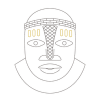
Ikharo
Forehead markings
2 annotations



Eto
hairstyles
1 annotation

Provenance
7
events
Institution data
musée du quai Branly - Jacques Chirac
The data was transferred directly by the institution.
Last updated: 2022-09-27
Language: french
| Institution field | Value |
|---|---|
Numéro d'objet object id | 73.1997.14.1 |
ObjectID object id | 291942 |
Tri titres designation | Tête anthropomorphe |
Description description | Tête d'ennemi ou de reine. Cette tête modelée aux traits du visage naturalistes (les yeux, les oreilles, le nez, la bouche), porte une coiffure constituée de fines tresses étagées; elle est dotée du cou jusqu'au menton d'un collier qui représente des perles de corail ; elle affiche quatre scarifications chéloïdes à l'emplacement des sourcils et deux autres scarification verticales sur le front. |
Matériaux et techniques material production technique | Alliage cuivreux Fonte à cire perdue |
Dimensions dimensions | 21 x 15,5 x 13,5 cm |
Date date made | fin 15e - début 16e siècle |
Toponyme production place | Afrique > Afrique occidentale > Nigéria |
Unité patrimoniale production place | Afrique |
Provenance historique provenance | Autres numéros : 1011.121 : Barbier-Mueller - Collection, A 97-14-1 : MNAAO - Inventaire. Ancienne collection R. Mosse; ancienne collection F. Wolffe-Knize; ancienne collection P. Schnell. |
Culture ethnic attribution | Royaume de Bénin |
Ethnonyme ethnic attribution | Edo |
Date d'entrée dans les collections nationales accession date | 1997-10-17 00:00:00 |
Mode d'entrée accession method | Achat |
Statut de l'objet display status | Inscription à l'inventaire |
Bibliographie bibliography | |
Références publiées bibliography | - Kerchache J. (sous la direction de) : Sculptures Afrique, Asie, Océanie, Amériques, 2000, Paris, RMN, Musée du quai Branly, pp 128-130. -Sculptures Afrique, Asie, Océanie, Amériques : l'album de l'exposition, 2000, p 23. - |
Crédits photographiques license | musée du quai Branly - Jacques Chirac, photo Claude Germain |
Donateur prior owner | |
Usage | P. Ben Amos a suggéré que les têtes confectionnées à la première période (fin XIVe début XVIe ) représentent non pas des ancêtres mais des trophés de guerre. Cette tête serait donc le portrait d'un enemi défait identifiable grâce aux scarifications qu'il porte sur le front. On retrouve cependant ces même scarifications sur les portraits de mère du roi ( Iyoba). |
Sections
About
Other
Sensitive content
Sensitive Content Digital Benin includes colonial material that may contain inaccurate, derogatory or harmful language relating to African and African diasporic communities. Such language may appear in catalogue records, transcriptions, and book, exhibition or museum titles. We recognize that this material may cause distress. Sensitive-content warnings are being implemented across the collection, but this process is ongoing. The language does not reflect Digital Benin’s views; we take an anti-colonial and anti-racist position and are committed to centring the humanity of historically marginalised communities.