Aza

Aza

Description

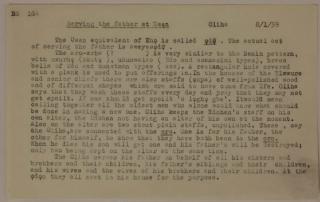
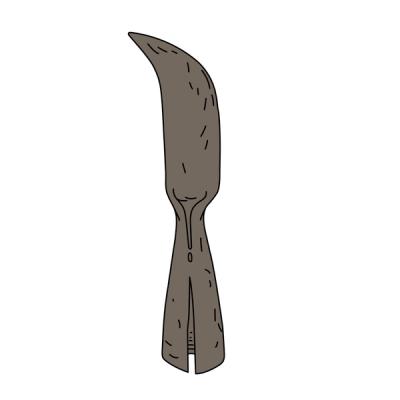
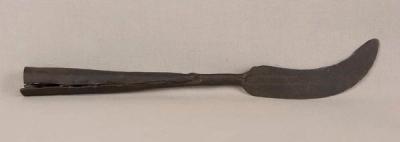
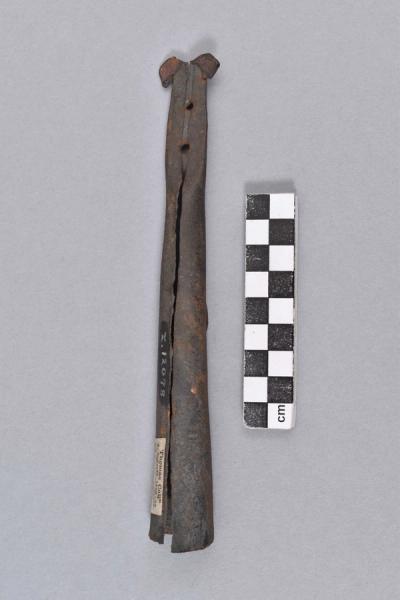
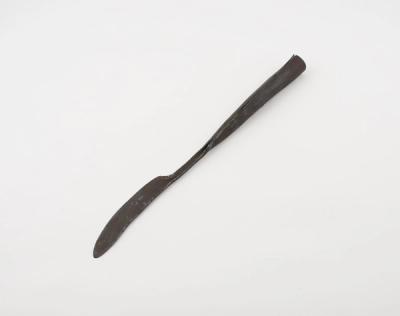
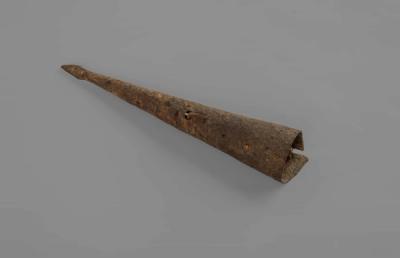
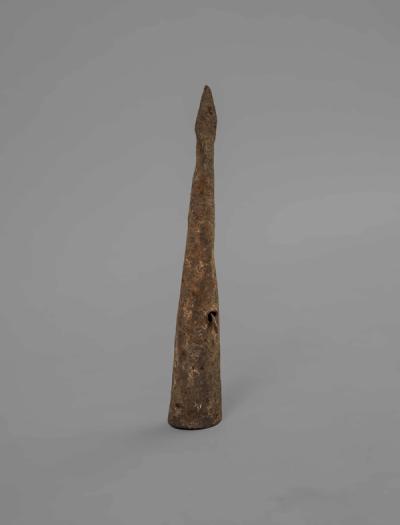
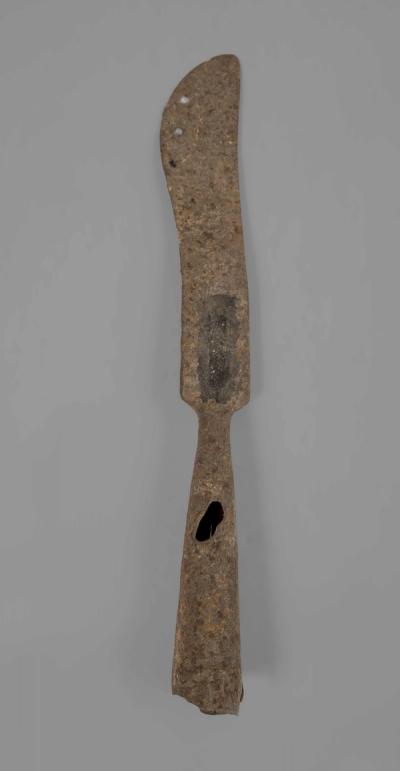
This knife with a bell-like handle would be used at oranmila shrine to summon spirits and ancestors. The Aza are not frequently mentioned in works on Edo culture, which is likely because they are used on fewer occasions compared to the other clapper bells.

In English, the term bell is used to describe objects designated in Edo as Aza and Ẹroro. Whereas most Ẹroro are made from brass and some even from ivory, Aza are made from iron. The form of Aza differs as well: rather than sharing the quadrangular form of most Ẹroro, Aza are conical and have pointed protrusions at the top, sometimes in the form of a knife. Unlike Ẹroro, Aza are not featured on other objects such as relief plaques, and they are not written about much in literature on material culture from Benin.

Objects defined as Aza

17 objects
See all
Bell
Institution
Fowler Museum at UCLA
Object ID
X65.9014
Edo designations
Aza
Bell
Institution
Museum of Archaeology and Anthropology, University of Cambridge
idno
Z 12078
Edo designations
Aza
Bell
Institution
Science Museum
Object Number
A59086
Edo designations
Aza
Bell
Institution
Omo n'Oba n'Edo Uku Akpolokpolo, Ọba of Benin & National Commission for Museums and Monuments, Nigeria
Catalogue No
63B:1:6
Edo designations
Aza
Bell
Institution
Omo n'Oba n'Edo Uku Akpolokpolo, Ọba of Benin & National Commission for Museums and Monuments, Nigeria
Catalogue No
63B:1:7
Edo designations
Aza
Knife and Dagger
Institution
Omo n'Oba n'Edo Uku Akpolokpolo, Ọba of Benin & National Commission for Museums and Monuments, Nigeria
Catalogue No
72B:G:1
Edo designations
Aza

Objects defined as Aza

17
Bell
Institution
Fowler Museum at UCLA
Object ID
X65.9014
Edo designations
Aza
Bell
Institution
Museum of Archaeology and Anthropology, University of Cambridge
idno
Z 12078
Edo designations
Aza
Bell
Institution
Science Museum
Object Number
A59086
Edo designations
Aza
Bell
Institution
Omo n'Oba n'Edo Uku Akpolokpolo, Ọba of Benin & National Commission for Museums and Monuments, Nigeria
Catalogue No
63B:1:6
Edo designations
Aza
Bell
Institution
Omo n'Oba n'Edo Uku Akpolokpolo, Ọba of Benin & National Commission for Museums and Monuments, Nigeria
Catalogue No
63B:1:7
Edo designations
Aza
Knife and Dagger
Institution
Omo n'Oba n'Edo Uku Akpolokpolo, Ọba of Benin & National Commission for Museums and Monuments, Nigeria
Catalogue No
72B:G:1
Edo designations
Aza

Oral histories related to Aza

3 interviews
See all
Interview cover
Functions of Ewua N'ogbelaka in Benin Kingdom
Chief Palmer Enabulele, Chief Ẹfesọba, Chief Aibuẹdẹfe, Chief Idoluwayi, the Enekighidi
00:41:59
Interview cover
Origin of Olokun and the Different Types of Beads and Their Uses
Ohẹn-Olokun Aigbokhaevbo
00:17:41
Interview cover
Igun n'Ugboha Guild, the Iron Smelters of Benin
Chief Emwinmaruamwa Aigbe Obasogie, Prince Henry Obasogie
00:50:21

Oral histories related to Aza

3
Interview cover
Functions of Ewua N'ogbelaka in Benin Kingdom
Chief Palmer Enabulele, Chief Ẹfesọba, Chief Aibuẹdẹfe, Chief Idoluwayi, the Enekighidi
00:41:59
Interview cover
Origin of Olokun and the Different Types of Beads and Their Uses
Ohẹn-Olokun Aigbokhaevbo
00:17:41
Interview cover
Igun n'Ugboha Guild, the Iron Smelters of Benin
Chief Emwinmaruamwa Aigbe Obasogie, Prince Henry Obasogie
00:50:21

Archival documents related to Aza

1 documents
See all
An archival document representing a Research notes of 2 page(s)
Research notes
Cadbury Research Library, University of Birmingham
Papers of Robert Elwyn Bradbury
Date
January 8, 1959

Archival documents related to Aza

1
An archival document representing a Research notes of 2 page(s)
Research notes
Cadbury Research Library, University of Birmingham
Papers of Robert Elwyn Bradbury
Date
January 8, 1959
Sensitive content

Sensitive Content Digital Benin includes colonial material that may contain inaccurate, derogatory or harmful language relating to African and African diasporic communities. Such language may appear in catalogue records, transcriptions, and book, exhibition or museum titles. We recognize that this material may cause distress. Sensitive-content warnings are being implemented across the collection, but this process is ongoing. The language does not reflect Digital Benin’s views; we take an anti-colonial and anti-racist position and are committed to centring the humanity of historically marginalised communities.

Read more about our approach