


Registration number
Af1898,0630.2
Institution
British Museum
Edo designations
English designations
Stool
Categories
Ceremonial Objects
Location
Great Russell St, Bloomsbury, London WC1B 3DG, United Kingdom
Loading...
Stool
Stool
Stool
Stool
Stool
Stool
Stool
Stool
Stool

Iconographies

18 annotations
Colar Bead
Odigba
Coral beaded collar

Odigba (coral-beaded collar) is a rigid neck collar made of coral beads, worn as part of ceremonial attire only by senior princes who have been made Enigie (Inneh 2007, p. 107). Although Ibafe (2007, p. 43) argued that the Odigba was introduced during the Ogiso period (c. 900–c. 1170 AD) by Ogiso Ere, along with other symbolically important Emwin Arhe, such as the Ada (ceremonial sword) and the Ẹbẹn (ceremonial sword), this seems unlikely, as coral was only introduced in the late 15th century through trade with Portuguese merchants.

2 annotations
Odigba
Odigba
Ubanu'hi / Obanu'hi
Ubanu'hi / Obanu'hi
Inifinity Symbol

The Ubanu'hi (infinity symbol) is a kind of guilloche or interlaced strapwork motif that can be angular or rounded. It was used by Edo artists in the decoration of many Emwin Arhe (royal treasures) and is ubiquitous in Benin royal arts. Ubanu'hi is a shortened form of “uba no Ọba ya de agbon ke ehimwin yi”, which means “the rope with which the Ọba ties the heaven and earth together” (pers. comm. Chief John Igbineweka Inneh n’Igbesawman, 2022). Similarly, Paula Ben-Amos Girshick (in Plankensteiner 2007, pp. 339, 341) described this as “Ọba n’iri agbon”, or the “rope of the world” pattern.

According to Ọbabanmu Ineh (in Blackmun 1984, p. 51), the use of this motif indicates that objects were carved by members of the Igbesanmwan. However, the motif is found on all types of Emwin Arhe (royal treasures), not only those made of ivory or wood. On the flanges of the Ama (relief plaques) alone, Kathryn Gunsch (2018, pp. 75–77) identified three different versions of the Ubanu'hi and, through her analysis of over 850 plaques, found that these different Ubanu'hi forms align with other characteristics, such as dimensions, the prevalence of ornamental motifs, and stylistic qualities. Together, these provide evidence, she argues, of different production groups among the plaque makers .

Kate Ezra (1992, pp. 209, 264) went on to argue that the use of these motifs indicates that certain objects were used in a “royal context” and were associated with “royal patronage”.

2 annotations
Ubanu'hi / Obanu'hi
Ubanu'hi / Obanu'hi
Iviawẹ
Stacked Beaded Anklet

Ọba gha ye Ivie gie ọwan, ẹ ghi tama rẹn ehe nọ gha bae yi (When the Ọba gifts you a bead, he doesn’t tell you how to wear it) (Daniel Inneh, pers. comm., 27 September 2025).

Iviawẹ (also spelled ĺvîowẹ) are coral-beaded anklets, often worn stacked together (Aigbe 1985, p. 28; Okpokunu, Agbontaen-Eghafona & Ojo 2005, p. 162; Ọbazee 2025, p. 279). Many of the figures depicted on the Emwin Arhe (royal treasures) in brass, bronze, ivory, and wood are shown wearing these. According to Daniel Inneh (pers. comm., 27 September 2025), beads were sent to people whom the Ọba wished to honour, although there was no directive on how to wear them.

Mostly, people who wear Iviawẹ are identified as palace chiefs or priests and priestesses. However, today anyone can wear them as cultural identifiers or fashion pieces.

1 annotation
Iviawẹ
Ehẹn
Fish

Ehẹn is a general term used to describe various types of fish (Ọbazee 2025, p. 90; ). Although mudfish are one of the most common motifs in Benin art, other kinds of fish are also represented. According to Blackmun ( ), a greater variety of fish are represented on the Aken'ni Elao (carved tusks) than on other types of royal artefacts. According to Kathy Curnow ( ), fish appear on 70 Ama-Ẹrọnmwọn (bronze relief plaques), making them the most commonly represented animal. Despite their prevalence, the precise species of fish are not easy to identify due to their “generic renderings”, possibly indicating that artists did not always distinguish between specific varieties ( ). Fish are represented on the Ama-Ẹrọnmwọn both in profile and from above.

1 annotation
Ehẹn
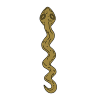
snake
Ẹyẹn
Snake

Ẹyẹn (snakes) are among the most common animals depicted by Edo artists on the Emwin Arhe (royal treasures). The varied depictions of these reptiles suggest different snake species, including the Ikpin (python), Arhunmoto (puff adder), and Olose (red-black striped snake); therefore, here we use the generic term for snake: Ẹyẹn.

The identification of snake motifs and depictions as Ikpin, as well as the importance accorded to this species, is a subject of scholarly debate. Paula Ben-Amos (1976, p. 247) argued that the Edo admired the “stature, colouration and crushing power” of the python, which was in turn associated with Olokun. She went on to identify the brass figures of snakes that formerly adorned the roof of the palace, as well as several other snakes, as pythons. Joseph Nevadomsky (1988, p. 77) argued instead that the importance of the Ikpin had been overstated.

Some of these snake representations may in fact be the Arhunmwoto (puff adder). The first to suggest this was the German curator Felix von Luschan (1919) in his early research into the Benin royal treasures. Nevadomsky (1988, pp. 79–80) suggested that the large head, narrow neck, and rough scales are indicative of either the puff adder, a symbol of “material wealth, tribute, and gifts,” or the Gaboon viper.

Another kind of snake that may be depicted is the Olose (red-black striped snake). It has the praise name “king of the snakes” in Edo. Olose is also closely connected to the deity Olokun, both because of its attractiveness and because it inhabits wet environments such as forest streams, which in turn flow into rivers and the sea, where Olokun lives (Nevadomsky 1988, pp. 76–77). Although the exact meanings of these different snakes vary, they share the characteristic of being spiritually powerful creatures.

2 annotations
Ẹyẹn
Ẹyẹn
Ẹbẹn
Ceremonial Sword

Ẹbẹn are a type of ceremonial sword of significant importance in the Benin Kingdom. During ceremonies, titled chiefs would hold them or toss them during dances, thereby paying homage to the Ọba at these public events, particularly when a chief receives a certain status. It is forbidden for Ẹbẹn to touch the ground, so the chief must take extra precautions to avoid dropping the Ẹbẹn during the dance. Therefore, the Okae-Odionmwan (head of executioners) dances with the Umozo (warfare or executioner’s sword) behind the dancing chief.

There are two central ceremonial swords used in the royal court of the Benin Kingdom, one of which is the Ẹbẹn, along with the Ada (ceremonial swords). They are distinguished by their blades: the Ẹbẹn blade reflects the shape of a leaf or an oar. Sometimes, it is decorated with openwork designs and/or brass inlays, most commonly shaped as small Ẹbẹn and Ẹkpẹn (leopards). The handle of the Ẹbẹn also has an unusual ring-shaped form, which further differentiates it from the Ada.

2 annotations
Ẹbẹn
Ẹbẹn
Ukpan obọ ọkpa
Single Beaded Baldric

Ukpan obọ ọkpa is a single baldric worn diagonally across the torso, from the left shoulder to the right hip. Barbara Blackmun described these baldrics as an “Ẹkpẹn band,” worn by figures as “a sign of distinction” ( ).

1 annotation
Ukpan obọ ọkpa
Beaded Crown
Ẹde
Beaded Crown

Although many other members of the Benin royal court wore a variety of hats and forms of headwear, only the Ọba may wear the Ẹde (beaded crown). The Ọba must never be seen bare-headed, and successive Ọbas introduced different styles and types of crowns ( ).

Across different media and objects, Ọbas are depicted wearing various types of crowns, all elaborately crafted from coral beads. Some feature tall projections rising from the crown, known as Oro, while others have curved projections extending from either side of the head, known as the winged cap. The latter was introduced only in the 19th century, most likely by Ọba Osẹmwẹndẹ ( ). Depictions of Ọba Esigie on Ama-Ẹrọnmwọn (bronze relief plaques) show him wearing an elaborate crown decorated with large jasper or coral beads ( ).

1 annotation
Ẹde
Ukpan obọ eva
Crossed Beaded Baldrics

The Ukpan obọ eva (coral-bead crossed baldrics) were worn as part of the ehaingbehia, the full ceremonial regalia, by only high-ranking members of the palace, including the Ọba himself, the Iy’Ọba, the Edaiken, and the Ezọmọ (Ben-Amos 1999, pp. 68, 141; Osadolor in Plankensteiner 2007, cat. no. 70, pp. 322–323).

1 annotation
Ukpan obọ eva
Ewu ivie
Coral Beaded Shirt

The Ewu ivie (coral bead shirt) is made of strings of coral beads. This heavy shirt was part of the ceremonial regalia worn only by a small number of high-ranking members of the palace: the Ọba, the Edaiken, the Iy’Ọba, and the Ezọmọ (Girshick Ben-Amos 1999, p. 68). The Ewu ivie would be worn along with the Odigba (coral bead collar).

1 annotation
Ewu ivie
Ekhara
Umbrella

Ekhara (umbrellas) play a multifaceted role in Benin art, reflecting both their function as status symbols and their association with European visitors. On some Ama-Ẹrọnmwọn (bronze relief plaques), sunshades resembling Asa are held by the Ọba’s attendants to protect him from the sun. European-style Ekhara, as we know them today, are also depicted in late 19th-century wooden carvings produced by the Emada. In her analysis of the Aken'ni Elao, Barbara Blackmun ( ) observed that on earlier objects, umbrellas were generally depicted only in the hands of foreign figures rather than those identified as members of the Benin Kingdom.

On later objects, particularly those dating to the late 19th century, this changes. The Ọba and high-ranking chiefs such as the Ezọmọ are depicted being shielded from the sun by attendants carrying Ekhara, a practice also described by Europeans visiting Benin City (e.g., ). Like many imported luxury goods, the Ekhara was incorporated into the visual language of royal power and became an important status symbol, associated with the wealth, authority, and elevated position of those permitted to use it.

1 annotation
Ekhara
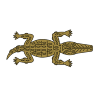
alligator
Ẹghughu
Crocodile

In the riverine area surrounding Benin City, there are two types of crocodile. The Ẹghughu, known in English as the dwarf or bush crocodile, is believed to be more docile ( ; Ọbazee 2025, p. 133). The second type is the Àgbákà, the aggressive Nile crocodile ( ; Ọbazee 2025, p. 11).

Crocodiles are one of the important animals represented in the historical Emwin Arhe, and they are known as Olokun’s guards or the “policemen” of the waters. The powerful and ferocious qualities of these animals might explain why warrior figures are often depicted wearing Uhunmwu-Ẹkuẹ (pendant masks) in the shape of crocodile heads on Ama-Ẹrọnmwọn (bronze relief plaques) ( ). Olokun devotees use crocodiles as sacrificial animals in offerings during the worship of Olokun.

1 annotation
Ẹghughu
Iru
Sacred jug

On the Ama-Ẹrọnmwọn (bronze relief plaques) and Aken'ni Elao (carved tusks), a particularly sacred type of brass Iru is shown being carried by members of the Emuru. These are globular jug-like vessels cast in brass with a long neck, topped with a ram’s head form. However, fragments of a similarly shaped bronze object (E 1902.457) have been identified, suggesting that this may have been a rattle rather than a vessel ( ).

Members of the Emuru guild, which dates back to the reign of Ọba Ẹwuare I, are shown holding Iru, particularly on the Ama-Ẹrọnmwọn. According to oral tradition, these Iru were taken by Ọba Ewuare from Olokun’s palace. Their spiritual powers were manifested through voices chanting “ise,” the affirmation used in Edo prayers. However, when Olua succeeded Ẹwuare I, he smashed the Uru and found nothing inside them. Only afterwards were the Emuru instructed to carry Uru resembling those taken by Ewuare ( ; ; Chief Osuma in Bradbury 1958, B.S. 113).

1 annotation
Iru
Ọba
King

The Ọba is the monarch of the Edo people and Kingdom. The current reigning monarch, Ọba Ẹwuare II, is the fortieth Ọba of the current dynasty, which is traditionally understood to have begun around 1170 AD ( ). Over the centuries, the role and conception of the monarch have shifted, and the Emwin Arre (royal treasures) and the visual language they carry provide important evidence for understanding these developments. Although Emwin Arhe served a variety of functions within court life and ritual, “their primary purpose was to glorify the godlike king and the history of the powerful empire” (Plankensteiner 2007, p. 25). Representations of the Ọba are therefore ubiquitous across Benin court arts and frequently occupy a central position within their visual language.

Representations of the Ọba can be recognised through a combination of characteristics, including his size, as he is usually depicted larger than other figures, and his position within compositions, where he may appear in front of or be supported by other figures, as in the Royal Triad motif. The Ọba is also distinguished by particular items of regalia, including the Oro projection from his crown, the distinctive beaded swag extending from his right hip, the Ewu ivie (coral-beaded shirt), and Ukpan obọ eva (crossed coral-beaded baldrics).

Since the early 20th century, scholars have sought to identify individual Ọbas represented on Emwin Arhe by analysing the regalia and other attributes of figures identified as monarchs, as well as the combinations of motifs and figures appearing on particular objects. Oral traditions and historical accounts, alongside European archival sources, have also played an important role in determining the identities of specific Ọbas (e.g., , ; ). Just as the institution of the monarchy developed and changed over time, so too did the ways in which Ọbas were represented by artists working within the royal guilds, including the Igun-Ẹrọnmwọn and Igbesamwan.

1 annotation
Ọba

Provenance

8 events
Production
1888 (approximate)
The object was produced by Unknown member(s) of the Emada in Benin City.
Looted
February 22, 1897 (day approximate) to June 1899 (year approximate)
The object was looted from Ovonramwẹ N’Ogbaisi by Ernest Percy Stuart Roupell from Benin Kingdom.
Purchase
June 30, 1898
The object was purchased by the British Museum from Ernest Percy Stuart Roupell with its destination in London.
Exhibition
1970 to 1973
The object was exhibited at London.
Exhibition
sometime in 1993 to sometime in 1997
The object was exhibited at London.
Exhibition
April 2007 to October 2008
The object was exhibited at Bristol.
Exhibition
May 2007 to September 2008
The object was exhibited at Vienna, later moved to Berlin.
Exhibition
June 2014 to September 2014
The object was exhibited at Hong Kong.

Related archival documents

1 documents
See all
Date

Institution data

British Museum
The data was transferred directly by the institution.
Last updated: 2025-06-10
Language: english
Institution fieldValue
Registration number
object id
Af1898,0630.2
PRN
object id
EAF14549
Object Type
designation
stool
Description
description
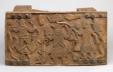
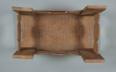
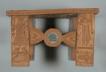
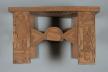
Stool (agba); made of wood of mortice and tenon construction. Carved on top surface with central figure of Oba holding eben sword. Flanked by European trader in boat on right and attendant holding umbrella over Oba's head on left. Images of trade goods, a crocodile and two snakes between. Four rectangular legs of stool also carved on front surfaces with human and animal figures. Secured to top surface with ? brass nails. Inset circular mirrors in centre of stretchers on four sides.
Ethnic name (made by)
ethnic attribution
Edo
Date
1850-1897 (circa)
Production place
production place
Made in: Benin City
Findspot
place collected
Found/Acquired: Benin City
Materials
material
wood ~glass ~brass (?)
Technique
production technique
carved
Dimensions
dimensions
Height: 39.50 cm~Width: 62.50 cm~Depth: 33.50 cm
Curator’s comments
provenance
Plankensteiner 2007 This chair hails from the collection of Ernest Roupell, who took part in the Punitive of 1897 and was later a district administrator in Benin. According to the British Museum’s inventory, this object was in the possession of the last king, ‘Overami’. According to Roupell, the attendants of the Oba always carried it with them, and Oba Ovonramwen was sitting on it when he was sentenced to exile in September 1898. In Benin, three types of stools were in use: the barrel-shaped ekete, nowadays covered with white fabric, on which the king sits during all public ceremonies; the erhe or round bronze or wooden stool (Hess 1983). Interestingly, the rectangular type is considered in Benin to be the oldest form of throne, supposedly introduced by the second Ogiso ruler Ere. This type of chair is particular, however-consisting of several parts joined together by tenons- appears to have been fashioned after European models. The chair displayed here consists of nine interlocking parts, all richly carved with ornaments and figurative scenes. In the centre of the scene, on the seat, stands a king in his ceremonial coral attire, with upraised eben sword and a Y-shaped object, the ends of which are formed from two hands. Standing to his right and shielding him with a parasol is a dignitary with the characteristic uguakpata hairstyle, still common today (see Aisien 2001). Near the king on the left is a European standing in a boat depicted with upraised sabre, and wearing a suit and hat. On the outside of the boat, below it and above the king on the right, barrels are portrayed – presumably the sort in which palm oil, an important commodity in the 19th century, was traded. Furthermore, various vessels, a stemmed glass, and animals are associated with the god of sea- crocodiles and snakes – can be seen. Three dignitaries and a European are depicted on the four legs of the stool.; Read & Dalton 1899: Stool of brown wood on four legs connected by shaped rails, all carved in relief. On the top the king stands dressed in a shirt, cap and anklets, all apparently made of coral beads; in his right hand he holds a dagger, in his left a bifid object; an attendant on his left holds an umbrella over him, and on his right hand is a European in a boat holding up a chain and a cutlass; the field is filled with figures of snakes, a crocodile, barrels, cannon, etc. On the four legs are (1.) a chief holding up a dagger and an elephant's head; below, a fish; (2.) a man in profile with spear and curved sword; below, a European with cutlass, hooked staff and drinking glass; (3.) a chief standing, holding a spear and curved dagger; below, a leopard; (4.) a European standing with cutlass and walking stick; below, a leopard; this last subject is upside down. The circular panels on the rails have had trade mirrors set in them and three still remain. This stool is said to have belonged to Overami, the late King of Benin.; Note from EPS Roupell (3 June 1898): "Overami's stool. This is the stool used by him since he came to the throne some 9 years ago. It was carried in by an attendant when he came in to submit & also at his trial."
Bibliographic references
bibliography
Barley 2010: pp.140-1~Plankensteiner 2007: 271~Read & Dalton 1899: pl VIII.3
Exhibition history
exhibition history
Exhibited: 1970-1973, London, Museum of Mankind, Divine Kingship in Africa 1993-1997, London, Museum of Mankind, Great Benin: a West African Kingdom 2007-2008 Apr-Oct, Bristol, Empire and Commonwealth Museum, Slavery, Abolition and the Making of Modern Britain 2007 May-Sept, Vienna, Museum für Völkerkunde, Benin. Kings and Rituals: Court Arts from Nigeria 2007-2008 Oct-Jan, Paris, Musée du quai Branly, Benin. Kings and Rituals: Court Arts from Nigeria 2008 Feb-May, Berlin, Staatliche Museen zu Berlin, Ethnologisches Museum, Benin. Kings and Rituals: Court Arts from Nigeria 2008 Jun-Sept, Chicago, The Art Institute of Chicago, Benin. Kings and Rituals: Court Arts from Nigeria 2014 Jun-Sep, Hong Kong Heritage Museum, The Extraordinary in the Ordinary: Chairs for Viewing the World Through Time
Condition
condition
Good; top surface damaged at left edge. Missing mirror and partly missing long stretcher on one side. Cracked mirrror on on one shirt stretcher, tarnished mirroe on opposite short stretcher.
Associated events
event
Associated Event: British to Benin City - Feb 1897
Acquisition name (acquisition)
provenance
Captain Ernest Percy Stuart Roupell
Acquisition name (excavator)
provenance
Field Collection by: Captain Ernest Percy Stuart Roupell
Acquisition date
accession date
30 June 1898
Acquisition notes (excavation)
provenance
This stool was looted from Benin City in 1897 by Captain Ernest Roupell.
Sensitive Content

Digital Benin collates digital material from institutions, and some of this material is inherently colonial and contains words, terms and phrases that are inaccurate, derogatory and harmful towards African and African diasporic communities. Catalogue transcriptions, book titles, exhibition titles and museum titles may contain harmful terms. We recognise the potential for the material to cause physical and mental distress as well as evoke strong emotions. Owing to the scale of the collection’s data, a process to implement sensitive-content warnings in the displayed data is still incomplete. The material within the catalogue does not represent Digital Benin’s views. Digital Benin maintains a strong anti-colonial, anti-racist position and affirms its support for centring the humanity of historically marginalised and disenfranchised communities. Read more about the background of this statement here