

Eingangsnummer
12443
Edo designations
English designations
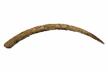
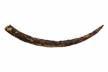
Altar Tusk
Categories
Altar & Shrine Objects
Location
Reiss-Engelhorn-Museen, Museum Weltkulturen D5, 68159 Mannheim, Germany
Loading...
Altar Tusk
Altar Tusk

Iconographies

12 annotations
Ugianranran
Manilla

Ugianranran (manillas) are highly important objects in the visual language of the Emwin Arhe (royal treasures). Although Ugianranran were made in a variety of sizes, forms, and weights, they share the characteristics of being made from copper or copper alloys, namely brass or bronze, and having a curved, ring- or horseshoe-shaped form.

In the early years of trade between the Portuguese and Edo, during the late 15th and early 16th centuries, manillas were made primarily of copper. During the early 16th century, Edo traders increasingly sought manillas made of brass. This changing preference is believed to have corresponded with the growing demand for brass among artists of the Igun-Ẹrọnmwọn ( ). During the 17th and early 18th centuries, the Dutch also traded manillas with the Edo, although to a lesser extent than the Portuguese. Recent scientific analysis has shown similarities between the composition of metals in manillas from the southern Rhineland region of Germany and the copper alloys used in some Emwin Arhe, supporting earlier scholarship suggesting that manillas were used by casters to produce Emwin Arhe (Skowronek et al. 2023).

When depicted on objects, Ugianranran are often shown alongside or being held by figures identified as Portuguese. In one case, figures identified as Benin traders or royal emissaries are shown holding manillas in their hands ( ). This is particularly the case on the Ama-Ẹrọnmwọn (bronze relief plaques), which are believed to have been commissioned by Ọba Esigie. Esigie is understood to have encouraged the production of artworks, made possible in part by the increased supply of manillas and other copper-alloy objects resulting from trade ( ). Ugianranran are therefore associated with overseas trade, wealth, and Olokun, the deity of the seas ( ). In addition to being held by figures or appearing alongside them on artworks, Ugianranran sometimes serve as focal decorative motifs, further indicating their symbolic and economic potency.

1 annotation
Ugianranran
Ikpotoki
Portuguese Figure

Ikpotoki figures (Portuguese figures) are easily distinguished by their European-style clothing, including hats and helmets, as well as by their facial features, particularly their thin, straight noses and straight hair. The objects Ikpotoki figures are shown wearing or holding provide further indications of their relationship with the Benin Kingdom. When they hold or are positioned alongside Ugianran (manillas), for example, they indicate trade, commerce, and wealth, while weaponry such as firearms, swords, or spears indicates their role as mercenaries in the service of the Ọba. In 1515, Ọba Ẹsigie went to war against the Attah of Idah, the ruler of a neighbouring kingdom. Portuguese mercenaries and weapons assisted the Edo in winning the battle, enabling the further expansion of the Kingdom. Ẹsigie’s reign was particularly important for strengthening ties between the Benin Kingdom and the Portuguese Empire, and he is believed to have spoken fluent Portuguese. With Ẹsigie’s encouragement, Portuguese missionaries established churches in the Benin Kingdom ( ; ), while Portuguese trading factories were also established ( ). Ọba Ẹsigie allowed his son to be baptised and sent him to Portugal to be educated; following his return, he became Ọba Orhogbua ( ).

1 annotation
Ikpotoki
Ubanu'hi / Obanu'hi
Ubanu'hi / Obanu'hi
Inifinity Symbol

The Ubanu'hi (infinity symbol) is a kind of guilloche or interlaced strapwork motif that can be angular or rounded. It was used by Edo artists in the decoration of many Emwin Arhe (royal treasures) and is ubiquitous in Benin royal arts. Ubanu'hi is a shortened form of “uba no Ọba ya de agbon ke ehimwin yi”, which means “the rope with which the Ọba ties the heaven and earth together” (pers. comm. Chief John Igbineweka Inneh n’Igbesawman, 2022). Similarly, Paula Ben-Amos Girshick (in Plankensteiner 2007, pp. 339, 341) described this as “Ọba n’iri agbon”, or the “rope of the world” pattern.

According to Ọbabanmu Ineh (in Blackmun 1984, p. 51), the use of this motif indicates that objects were carved by members of the Igbesanmwan. However, the motif is found on all types of Emwin Arhe (royal treasures), not only those made of ivory or wood. On the flanges of the Ama (relief plaques) alone, Kathryn Gunsch (2018, pp. 75–77) identified three different versions of the Ubanu'hi and, through her analysis of over 850 plaques, found that these different Ubanu'hi forms align with other characteristics, such as dimensions, the prevalence of ornamental motifs, and stylistic qualities. Together, these provide evidence, she argues, of different production groups among the plaque makers .

Kate Ezra (1992, pp. 209, 264) went on to argue that the use of these motifs indicates that certain objects were used in a “royal context” and were associated with “royal patronage”.

2 annotations
Ubanu'hi / Obanu'hi
Ubanu'hi / Obanu'hi
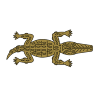
alligator
Ẹghughu
Crocodile

In the riverine area surrounding Benin City, there are two types of crocodile. The Ẹghughu, known in English as the dwarf or bush crocodile, is believed to be more docile ( ; Ọbazee 2025, p. 133). The second type is the Àgbákà, the aggressive Nile crocodile ( ; Ọbazee 2025, p. 11).

Crocodiles are one of the important animals represented in the historical Emwin Arhe, and they are known as Olokun’s guards or the “policemen” of the waters. The powerful and ferocious qualities of these animals might explain why warrior figures are often depicted wearing Uhunmwu-Ẹkuẹ (pendant masks) in the shape of crocodile heads on Ama-Ẹrọnmwọn (bronze relief plaques) ( ). Olokun devotees use crocodiles as sacrificial animals in offerings during the worship of Olokun.

1 annotation
Ẹghughu
Colar Bead
Odigba
Coral beaded collar

Odigba (coral-beaded collar) is a rigid neck collar made of coral beads, worn as part of ceremonial attire only by senior princes who have been made Enigie (Inneh 2007, p. 107). Although Ibafe (2007, p. 43) argued that the Odigba was introduced during the Ogiso period (c. 900–c. 1170 AD) by Ogiso Ere, along with other symbolically important Emwin Arhe, such as the Ada (ceremonial sword) and the Ẹbẹn (ceremonial sword), this seems unlikely, as coral was only introduced in the late 15th century through trade with Portuguese merchants.

1 annotation
Odigba
Uhunmwu-Ẹkuẹ
Pendant Mask

Uhunmwu-Ẹkuẹ (pendant masks) formed part of the ceremonial regalia worn by court dignitaries to indicate their rank or function and are frequently represented among the Emwin Arhe (royal treasures), particularly those made of brass, bronze, or ivory.

Different animals were depicted on Uhunmwu-Ẹkuẹ, particularly the heads of leopards and crocodiles. The most common type features the face or head of an Ọba. Other examples take the form of an elephant head incorporating the trunk-hand motif, a ram’s head, or, in a very small number of cases, the face of a Portuguese man. Different figures appear to have worn Uhunmwu-Ẹkuẹ with different imagery. For example, warrior chiefs are often depicted wearing leopard-head pendant masks, whereas crocodile-head Uhunmwu-Ẹkuẹ are generally shown being worn only by the Ọba and his Enọbare (Blackmun 2007, cat. no. 137, p. 365).

1 annotation
Uhunmwu-Ẹkuẹ
Ẹkirẹ
Frog

Ẹkirẹ is the Edo term for frog ( ; Ọbazee 2025, p. 135). The Ẹkirẹ carries significant and often ambiguous symbolic importance, primarily linked to its liminal nature and association with spiritual and magical powers. As an amphibian that lives on the threshold between water and land, the Ẹkirẹ is seen as a messenger of Olokun. This connection reinforces the Ọba’s (king’s) ability to bridge the human and spiritual realms, a concept consistently present in Benin art.

While not as common as the mudfish, frogs appear on various Benin artworks, including Aken'ni Elao (carved tusks), pendant plaques, and Ẹrhẹ (royal stools). Their presence often relates to medicinal and occult practices. Frogs can be used in powerful curses, with a jumping frog signifying failure, and a frog, along with a coiled fish, used in rituals to release such curses. They are also associated with Osun, the deity of medicine, and scenes of snakes swallowing frogs can represent supernatural attacks or strong spiritual powers. For warriors, the Ẹkirẹ could even symbolise an aspect of their protective equipment and was used in palace rituals to encourage success in battle ( ).

1 annotation
Ẹkirẹ
Ukpan obọ eva
Crossed Beaded Baldrics

The Ukpan obọ eva (coral-bead crossed baldrics) were worn as part of the ehaingbehia, the full ceremonial regalia, by only high-ranking members of the palace, including the Ọba himself, the Iy’Ọba, the Edaiken, and the Ezọmọ (Ben-Amos 1999, pp. 68, 141; Osadolor in Plankensteiner 2007, cat. no. 70, pp. 322–323).

1 annotation
Ukpan obọ eva
Ẹkpẹn
Leopard

The Ẹkpẹn (leopard) is an animal that appears most often among the motifs decorating the Emwin Arhe (royal treasures). The Ẹkpẹn symbolises the valour and strength of the Ọba, as well as his political authority. The Benin people eulogise the Ọba as the ‘ẹkpẹn n'owa’ (leopard of the home).

When a hunter kills a leopard, he must say “ẹkpẹn n'oha” (I killed a bush leopard), as it is taboo to say that a hunter killed a leopard without specifying that it is a bush leopard, as otherwise this would “be tantamount to symbolically killing the king” (Nevadomsky 1988, p. 81). For this reason, leopards of the bush are called Atalakpa to distinguish them from those that represent the Ọba.

1 annotation
Ẹkpẹn
Ada
Ceremonial sword

The Ada is a symbol of authority usually borne in the presence of the Ọba by a designated holder, the Omada, which translates as ‘Ada bearer’. The Ọba has almost exclusive rights to the use of the Ada, except when he permits titled chiefs, such as the Oliha, to possess one. During the Ogiso period, predating the current Ọba dynasty, the Ada is said to have been a symbol of ancestral power, with the ability to control the future (Ben-Amos 1995, p. 25). The Ada is ranked higher than the Ẹbẹn, another symbolically important ceremonial sword.

1 annotation
Ada
Ukhurhẹ
Ancestral Staff

Representations of figures, often the Ọba, with an Ukhurhẹ (Ancestral Staff) in their right hand recur in a number of Emwin Arre (royal treasures), particularly those carved in wood as Agba (royal stools), cast in brass as part of Osogan (Osun staffs) and Ikẹgobọ (altars to the hand), and carved in ivory as Aken'ni Elao (carved tusks).

Ukhurhẹ are rattle staffs, usually made from wood, although brass examples are believed to have been owned by the Ọba. Ukhurhẹ were, and continue to be, commissioned when the paternal head of a family passes away as a way of commemorating them ( ). Following a ceremony in which they are installed on the family’s ancestral altar, Ukhurhẹ are typically lined up against the back of the altar and are used to communicate with ancestors and the spirit world. When depicted on the Emwin Arhe, Ukhurhẹ are usually held in the right hand of the Ọba, while an Ughavan (celts) is carried in his left hand.

1 annotation
Ukhurhẹ

Provenance

4 events
Production
1750 (year uncertain/approximate) to February 22, 1897 (day approximate)
The object was produced by Unknown member(s) of the Igbesamwan guild in Benin City.
Looted
February 22, 1897 (day approximate) to June 1899 (year approximate)
The object was looted by February 1897 Unknown member of the British colonial military campaign on Benin from Benin Kingdom.
Unknown
February 22, 1897 (day approximate) to 1925
The object is known to have come into contact with Hans Meyer, later in Leipzig.
Purchase
1925
The object was purchased by the Reiss-Engelhorn-Museen, Museum Weltkulturen from Hans Meyer from Leipzig to Mannheim.

Institution data

Reiss-Engelhorn-Museen, Museum Weltkulturen
The data was transferred directly by the institution.
Last updated: 2021-09-23
Language: german
Institution fieldValue
Alte Inventarnummer
object id
Alte Nummer
object id
3436
Eingangsnummer
object id
12443
Inventarnummer
object id
IV Af 3088
Titel (Museumsobjekt)
designation
Elefantenzahn
Material
material
Elfenbein; Holz; Lack
Maße zum Objekt
dimensions
Länge: 161,00 cm; Breite: 40,00 cm; Höhe: 12,00 cm; Länge (Sockel): 35,00 cm; Breite (Sockel): 23,00 cm; Höhe (Sockel): 7,50 cm
Objektbezeichnung
object type
Stoßzahn
Fundort/Herkunft
production place
Benin-Reich <hist.>
Voreigentümer/in
prior source
provenance
Meyer, Hans, Dr.
Ethnie/Sprachgruppe
ethnic attribution
Sammlung
department and institution
VK IV Afrika
Eingangsjahr
accession date
1925
Eingangsart
accession method
Kauf
Bild
images
rem/Maria Schumann
Sensitive Content

Digital Benin collates digital material from institutions, and some of this material is inherently colonial and contains words, terms and phrases that are inaccurate, derogatory and harmful towards African and African diasporic communities. Catalogue transcriptions, book titles, exhibition titles and museum titles may contain harmful terms. We recognise the potential for the material to cause physical and mental distress as well as evoke strong emotions. Owing to the scale of the collection’s data, a process to implement sensitive-content warnings in the displayed data is still incomplete. The material within the catalogue does not represent Digital Benin’s views. Digital Benin maintains a strong anti-colonial, anti-racist position and affirms its support for centring the humanity of historically marginalised and disenfranchised communities. Read more about the background of this statement here