Loading...
Relief Plaque
Relief Plaque
Relief Plaque
Relief Plaque
Relief Plaque
Identifikationsnummer
C 2434
Edo designations
English designations
Categories
Institution Location
1 Adesogbe (Plymouth) Road, P.M.B. 1115, Benin City , Edo State
Identifikationsnummer
C 2434
Edo designations
English designations
Relief Plaque
Categories
Palace Architecture & Ornamentation
Institution Location
1 Adesogbe (Plymouth) Road, P.M.B. 1115, Benin City , Edo State

Iconographies

7 annotations
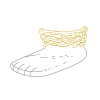
Anklet
Ẹguẹn
Anklet

Ẹguẹn are worn by the Ọba and chiefs as part of their Ehaengbehia, the full regalia worn during special ceremonies. Ẹguẹn are worn around the ankles or calves and can be made from beads, ivory, brass or even iron. A separate category, called Elubase, refers to those which have integrated rattles or crotal bell attachments, however both are described as anklets in English.

As early as 1899, Read and Dalton commented that the anklets worn by figures shown on plaques were a signifier of high rank. Today, anklets continue to signify social status, with the Ọba wearing many ivory and coral anklets stretching up his calves as part of his ceremonial regalia. However, anklets were not the preserve of the Ọba alone, and different kinds and quantities were worn by other members of the royal court and Edo people. For example, Flora Kaplan described a photograph of Iy’Ọba Aghahowa N’Errua, who took her title in 1981, in which she wears coral anklets as one of a number of insignia of her newly invested high rank. In contrast, brass anklets would be worn by young male attendants to the Ọba (see attendant figure), such as sword bearers or Emada pages.

2 annotations
Ẹguẹn
Ẹguẹn
Water fern
Ebe Amẹ
Water Fern

Ebe Amẹ refers to a wide variety of plants, particularly the leaves of the water fern or river leaf, found in riverine areas of southern Nigeria. Artists from the Igun-Ẹrọnmwọn used these as a decorative motif in the background of most Ama-Ẹrọnmwọn (bronze relief plaques). The petals of the Ebe Amẹ, like the points of the ἀghàdàgháda (crossroads), represent the four cardinal directions: north, east, south, and west. The number four plays a foundational role in the Edo calendar, which is structured around four market days.

1 annotation
Ebe Amẹ
Shield
Asa
Shield

Asa (shields) are a crucial attribute of warriors and warrior chiefs, forming part of their ceremonial and battle attire as represented on the Emwin Arre (royal treasures). Asa were usually made from elephant or crocodile skin and used by warriors for protection during hand-to-hand combat. Interestingly, the form of Asa depicted on historic royal artefacts differs from those found in museum collections today, reflecting changes in shield shapes and designs over time.

1 annotation
Asa
Portuguese Head
Uhunmwu Ikpotoki
Portuguese Head

These motifs are known as Uhunmwu Ikpotoki in Edo, which translates as ‘Portuguese head’ in English. Portraits of Portuguese men, featuring only their heads and sometimes their shoulders, were used by artists as motifs on the Emwin Arre (royal treasures), in particular on the Ama-Ẹrọnmwọn (bronze relief plaques) and Aken'ni Elao (carved altar tusks). Also included here are a series of two or three conjoined spirals, which are interpreted as abstract forms of this motif.

One of the earliest suggestions that many of the European figures depicted on objects were Portuguese was made two years after the 1897 British Colonial Military Campaign on Benin City by the British Museum curators Charles Hercules Read and Ormonde Maddock Dalton, based on testimony from seven chiefs in the aftermath of the military campaign. The long, straight hair, beards, and domed hats together led to the identification of these representations as Europeans.

When included within the visual imagery of the Emwin Arhe, the Portuguese are associated with the new Atlantic trade and the consequent wealth that emerged following first contact with the Portuguese in the late 15th century. For this reason, Portuguese heads are also often associated with the sea deity Olokun. Eisenhofer argued that the Portuguese figures and heads as motifs on the royal treasures are symbols of the king’s power: “these depictions of foreigners helped to build and strengthen the king’s image.”

When incorporated into the design of the Ama-Ẹrọnmwọn (bronze relief plaques), Curnow instead argued that these motifs could in fact indicate events that took place during Ọba Esigie’s reign. Ọba Esigie is associated with the Portuguese, as they became increasingly important during his reign, assisting with battles against the Igala from Idah, bringing Catholicism to Benin, and introducing weaponry such as guns and cannons, which were instrumental in the expansion of the kingdom.

1 annotation
Uhunmwu Ikpotoki
snake
Ẹyẹn
Snake

Ẹyẹn (snakes) are among the most common animals depicted by Edo artists on the Emwin Arre (royal treasures). The varied depictions of these reptiles suggest different snake species, including the Ikpin (python), Arhunmoto (puff adder), and Olose (red-black striped snake); therefore, here we use the generic term for snake: Ẹyẹn.

The identification of snake motifs and depictions as Ikpin, as well as the importance accorded to this species, is a subject of scholarly debate. Paula Ben-Amos argued that the Edo admired the “stature, colouration and crushing power” of the python, which was in turn associated with Olokun. She went on to identify the brass figures of snakes that formerly adorned the roof of the palace, as well as several other snakes, as pythons. Joseph Nevadomsky argued instead that the importance of the Ikpin had been overstated.

Some of these snake representations may in fact be the Arhunmwoto (puff adder). The first to suggest this was the German curator Felix von Luschan in his early research into the Benin royal treasures. Nevadomsky suggested that the large head, narrow neck, and rough scales are indicative of either the puff adder, a symbol of “material wealth, tribute, and gifts,” or the Gaboon viper.

Another kind of snake that may be depicted is the Olose (red-black striped snake). It has the praise name “king of the snakes” in Edo. Olose is also closely connected to the deity Olokun, both because of its attractiveness and because it inhabits wet environments such as forest streams, which in turn flow into rivers and the sea, where Olokun lives. Although the exact meanings of these different snakes vary, they share the characteristic of being spiritually powerful creatures.

1 annotation
Ẹyẹn
Crossroads
Aghadaghada
Crossroads

According to Paula Ben-Amos, this motif is known as Aghadaghada, a “play on the word ada,” meaning “crossroads.” The design appears as a background motif on a small number of Ama-Ẹrọnmwọn (bronze relief plaques) and is associated with Olokun and the period of close contact between the Benin Kingdom and the Portuguese Empire during the reigns of Ọba Ọzọlua, Ọba Ẹsigie, and Ọba Orhogbua. At the time of Ben-Amos’s research, the same symbol was drawn in chalk at the centre of Olokun shrine courtyards in Benin City. William Fagg described the design more literally as a “circled cross” and suggested that the Ama-Eronmwon bearing this background motif may have been cast by a particular ‘master’ or member of the Igun-Ẹrọnmwọn.

More broadly, the cross, with its four points, references the number four, which has significance in Edo belief: the Edo week consists of four days, and each day is divided into four parts ( ). Other cross forms are treated as distinct motifs and are discussed separately under Uman-Ague (equal-armed cross).

1 annotation
Aghadaghada

Provenance

5 events
Production
1504 (approximate) to 1550 (approximate)
Production of the Ama-Ẹrọnmwọn by the Igun-Ẹrọnmwọn guild in Benin City
Loot
February 19, 1897 (day approximate) to June 1899 (month approximate)
Looting of the Emwin Arre - Inalienable Cultural Artefacts - during the Invasion of the Benin Kingdom in February 1897 and until the end of overt military activity in June 1899
Purchase
February 22, 1897 (year approximate) to 1899
The object was purchased by the MKG Museum fur Kunst und Gewerbe from Albrecht Thomsen.
Purchase
1899
Purchase of Benin objects from the Museum für Kunst und Gewerbe by the Museum für Völkerkunde in Hamburg, 1899
Restitution
December 16, 2022
Transfer of ownership of 179 Emwin-Arre from the MARKK Museum am Rothenbaum to Omo n'Oba n'Edo Uku Akpolokpolo, Ọba of Benin, and the National Commission for Museums and Monuments, 16 December 2022

Related archival documents

2 documents
See all
Museum Catalogue
Staatsbibliothek zu Berlin
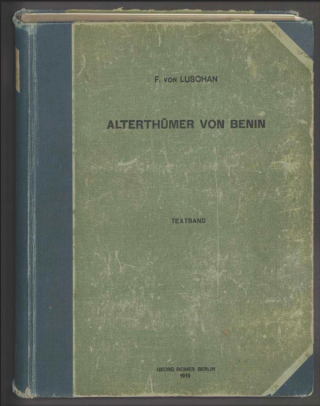
Die Altertümer von Benin
Date
January 1, 1919 at 12:00:00 AM
An archival document representing a Correspondence of 2 page(s)
Correspondence
Ethnologisches Museum, Staatliche Museen zu Berlin
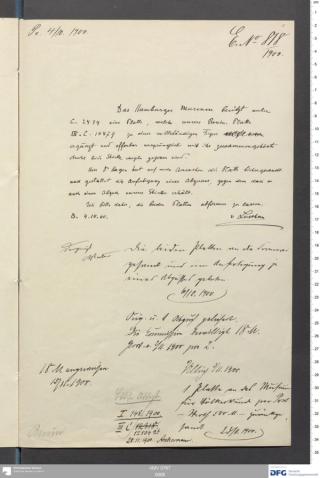
Die Erwerbung ethnologischer Gegenstände aus der Benin-Expedition. Vol. 4
Date
October 4, 1900

Institution data

MARKK Museum am Rothenbaum Kulturen und Künste der Welt
The data was transferred directly by the institution.
Last updated: 2022-06-10
Languages: german, english
Institution fieldValue
Identifikationsnummer
object id
C 2434
Titel
designation
Reliefplatte Unterkörper eines Würdenträgers (Meister des eingekreisten Kreuzes)
Materialien
material
ANORGANISCH/Metall/Gelbguß
Heutiges Staatsgebiet des Herstellungsortes
production place
Afrika/Westafrika/Nigeria/Benin-Reich
Provenienz/Name
prior source
provenance
Brinckmann
Provenienz Objektitinerar Akteure Orte Daten
provenance
Museum für Kunst und Gewerbe Hamburg
Provenienz/Affiliation
provenance
Museum für Kunst und Gewerbe Hamburg
Provenienz/Country
provenance
Germany
Provenienz/Date of Birth
provenance
23.5.1843
Provenienz/Date of Death
provenance
08.02.1915
Provenienz/First Name
provenance
Justus
Provenienz/No
provenance
6
Provenienz/Place of Birth
provenance
Hamburg
Provenienz/Place of Death
provenance
Hamburg
Provenienz/Profession
provenance
Art Historian, Museum Director
Provenienz/Role-Function/0
provenance
Intermediary
Provenienz/Role-Function/1
provenance
Provenienz/Sex
provenance
male
Provenienz/Short Biography
provenance
Justus Brinckmann (1843-1915) was the first director of the Museum für Kunst und Gewerbe in Hamburg and in 1874 was the leading figure in its foundation.
Provenienz/Street
provenance
Steintorplatz 1
Provenienz/Town
provenance
Hamburg
Hersteller kulturhist. Herkunftsgesellschaft
ethnic attribution
--/Edo
Heutiger Aufbewahrungsort Sammlung
department and institution
Museum am Rothenbaum. Kulturen und Künste der Welt (MARKK)
Akquisitionsdatum
accession date
1899
Alte Inventarnummer
object id
Inventurdatum
16.12.2009
Label Text (deu)
description
Reliefplatte: Unterkörper eines Würdenträgers Meister des eingekreisten Kreuzes, unbekannte Werkstatt der Bronzegießergilde Igun Eronmwon / Königreich Benin, Nigeria, 16./17. Jh. / Gelbguss / Ankauf vom Museum für Kunst und Gewerbe Hamburg, 1899, Inv. Nr. C 2434 Der obere Teil dieses PlattenPaares mit Darstellung des Oberkörpers befindet sich im Ethnologischen Museum in Berlin. Zusammen stellen die Platten einen Krieger mit einem Bündel von Pfeilen oder Kurzspeeren und einem Schild dar. Als Krieger ist der Mann auch wegen des Halsschmucks aus Leopardenzähnen erkennbar. Der Name des Meisters nimmt Bezug auf das Hintergrundmotiv der eingekreisten Kreuze. Platten mit diesem Motiv haben ein flacheres Relief, sind in schwererem Guss gefertigt und zeichnen sich durch eine stilisierte Darstellung aus.
Label Text (eng)
description
Relief Plaque: Lower Body of a Dignitary Master of the Circled Cross, Unidentified workshop of the Bronze Casters Guild Igun Eronmwon / Benin Kingdom, Nigeria, 16th/17th century / Brass / Acquired from the Museum für Kunst und Gewerbe Hamburg, 1899, Inv. no. C 2434 The upper part of this pair of plaques depicting the torso is kept at the Ethnological Museum in Berlin. The two plaques represent a warrior holding a bundle of arrows or short spears and a shield. His neck ornament made of leopard teeth is a further element identifying the man as a warrior. The master’s name is derived from his recurring use of circled crosses as background motif. Plaques with this motif are distinguished by a lower relief, heavier cast and more stylized representations.
Maße
dimensions
Länge: 40,00 cm; Breite: 37,00 cm; Tiefe: 5,00 cm; Gewicht: 10,70 kg
Sensitive content

Sensitive Content Digital Benin includes colonial material that may contain inaccurate, derogatory or harmful language relating to African and African diasporic communities. Such language may appear in catalogue records, transcriptions, and book, exhibition or museum titles. We recognize that this material may cause distress. Sensitive-content warnings are being implemented across the collection, but this process is ongoing. The language does not reflect Digital Benin’s views; we take an anti-colonial and anti-racist position and are committed to centring the humanity of historically marginalised communities.

Read more about our approach