Loading...
ObjectID
291927
Edo designations
English designations
Categories
Institution Location
37 Quai Branly, 75007 Paris, France
ObjectID
291927
Edo designations
English designations
Relief Plaque
Categories
Palace Architecture & Ornamentation
Institution Location
37 Quai Branly, 75007 Paris, France

Iconographies

11 annotations

Iconography image
Ẹbẹn
Ceremonial Sword

Ẹbẹn are a type of ceremonial sword of significant importance in the Benin Kingdom. During ceremonies, titled chiefs would hold them or toss them during dances, thereby paying homage to the Ọba at these public events, particularly when a chief receives a certain status. It is forbidden for Ẹbẹn to touch the ground, so the chief must take extra precautions to avoid dropping the Ẹbẹn during the dance. Therefore, the Okae-Odionmwan (head of executioners) dances with the Umozo (warfare or executioner’s sword) behind the dancing chief.

There are two central ceremonial swords used in the royal court of the Benin Kingdom, one of which is the Ẹbẹn, along with the Ada (ceremonial swords). They are distinguished by their blades: the Ẹbẹn blade reflects the shape of a leaf or an oar. Sometimes, it is decorated with openwork designs and/or brass inlays, most commonly shaped as small Ẹbẹn and Ẹkpẹn (leopards). The handle of the Ẹbẹn also has an unusual ring-shaped form, which further differentiates it from the Ada.

1 annotation
Ẹbẹn
leopard teeth
Akọn Ẹkpen
Leopard Teeth Neck Ornament

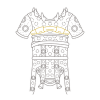
Akọn Ẹkpẹn are necklaces or neck ornaments made of strung leopard’s teeth. They are worn by figures to signify their high rank and military prowess, as well as by their leaders, the Ezọmọ or Iyasẹ. They are often worn alongside quadrangular Ẹroro (bells) and Ohian Ẹkpẹn (leopard tunics).

The Akọn Ẹkpẹn is clearly and profoundly related to the symbolism of the Ẹkpẹn (leopard) and its association with the Ọba (king), who is metaphorically referred to as ‘ẹkpẹn ne owa’, the ‘leopard of the home’. On the other hand, the Ẹkpẹn is often referred to as the ‘king of the bush’, embodying ferocity, aggression, strength, and leadership—qualities attributed to the Ọba. This intricate link between the leopard, the monarch, and his military leaders reinforces the complex hierarchy and spiritual authority central to Benin’s courtly art.

1 annotation
Akọn Ẹkpen
Bell
Ẹroro
Bell

Ẹroro (bells) frequently appear as ornaments worn by figures depicted on the Emwin Arre, particularly on Ama-Ẹrọnmwọn (bronze relief plaques) and Aken’ni Elao (carved tusks). These Ẹroro are most commonly quadrangular in form or, less commonly, cylindrical with rounded tops. Quadrangular Ẹroro worn around the neck are often part of the attire that indicates that figures can be interpreted as warriors, alongside the Akọn Ẹkpẹn (leopard tooth neck ornament) and the Ohian Ẹkpẹn (leopard tunics).

1 annotation
Ẹroro
Water fern
Ebe Amẹ
Water Fern

Ebe Amẹ refers to a wide variety of plants, particularly the leaves of the water fern or river leaf, found in riverine areas of southern Nigeria. Artists from the Igun-Ẹrọnmwọn used these as a decorative motif in the background of most Ama-Ẹrọnmwọn (bronze relief plaques). The petals of the Ebe Amẹ, like the points of the ἀghàdàgháda (crossroads), represent the four cardinal directions: north, east, south, and west. The number four plays a foundational role in the Edo calendar, which is structured around four market days.

1 annotation
Ebe Amẹ
Fortified chest band
Uko ugbo-ohamwen
Fortified chest band

Uko ugbo-ohamwen is a chest band often worn around the chests of warriors depicted on the Ama-Ẹrọnmwọn (relief plaques) and is fortified with charms. The band was worn to increase the strength and endurance of warriors. This fortified chest band has also been referred to as ukugba olila.Ine n’Igun in Bradbury 1959, B.S. 245

1 annotation
Uko ugbo-ohamwen
Feather
Igan
Feather

Igan (feathers) are commonly depicted tucked into the headdresses and hats of chiefs represented on Emwin Arre (royal treasures). These feathers are from the Oɛɣohɔ (vulturine fish eagle) and symbolise respected old age and proper chieftaincy.

1 annotation
Igan
Shield
Asa
Shield

Asa (shields) are a crucial attribute of warriors and warrior chiefs, forming part of their ceremonial and battle attire as represented on the Emwin Arre (royal treasures). Asa were usually made from elephant or crocodile skin and used by warriors for protection during hand-to-hand combat. Interestingly, the form of Asa depicted on historic royal artefacts differs from those found in museum collections today, reflecting changes in shield shapes and designs over time.

1 annotation
Asa
Colar Bead
Odigba
Coral beaded collar

Odigba (beaded collar) is a rigid neck collar made of beads, worn as part of ceremonial attire only by senior princes who have been made Enigie. Although Ibafe (2007, p. 43) argued that the Odigba was introduced during the Ogiso period (c. 900–c. 1170 AD) by Ogiso Ere, along with other symbolically important Emwin Arre, such as the Ada (ceremonial sword) and the Ebẹn (ceremonial sword). The Odigba was initially made of beads, while coral was incorporated only later, following its introduction through trade with Portuguese merchants in the late fifteenth century.

1 annotation
Odigba
Star beads
Ititi ako
Star beads

The Ititi ako is a cluster of coral beads, usually three or four, attached to a pin and used to embellish the royal crowns on Uhunmwu-Elao (commemorative heads) and Uhunmwu-Ẹkuẹ (pendant masks). These bead clusters are also known as star beads, which indicate the prosperous destiny of an individual or wearer. Apart from enhancing the appearance of the wearer, they also represent the individual’s high social status. Judging from their presence on a variety of head sculptures, both men and women wore Ititi ako.

1 annotation
Ititi ako
Stacked beaded anklet
Iviawẹ
Stacked Beaded Anklet

Ọba gha ye Ivie gie ọwan, ẹ ghi tama rẹn ehe nọ gha bae yi (When the Ọba gifts you a bead, he doesn’t tell you how to wear it) (Daniel Inneh, pers. comm., 27 September 2025).

Iviawẹ (also spelled ĺvîowẹ) are coral-beaded anklets, often worn stacked together. Many of the figures depicted on the Emwin Arre (royal treasures) in brass, bronze, ivory, and wood are shown wearing these. According to Daniel Inneh (pers. comm., 27 September 2025), beads were sent to people whom the Ọba wished to honour, although there was no directive on how to wear them.

Mostly, people who wear Iviawẹ are identified as palace chiefs or priests and priestesses. However, today anyone can wear them as cultural identifiers or fashion pieces.

1 annotation
Iviawẹ
Wrapper
Ukpọn
Wrapper

Ukpọn is the Edo term for cloth and is used here to refer to the wrappers or kilts worn by many of the figures depicted on the Emwin Arre (royal treasures). The cloth worn around the waist may be plain, but it is more commonly richly decorated with motifs associated with the monarchy, power, and wealth, such as the Ọba'nui (infinity symbol) and Uhunme Ikpotoki (Portuguese heads).

The Benin Kingdom was renowned for its textile production, both for local use and for trade. Within the royal court, members of the Owina n’Ido produced ukhuen cloth for the Ọba and other members of the court, who wore it as wrappers during festivals and ceremonies.

Alongside locally produced textiles, imported cloth was also an important commodity in the Benin Kingdom’s trade networks. Textiles were exchanged with neighbouring production centres, particularly Ijebu, while European traders brought silks, woollens, linens, and cotton from Europe and Asia from the 15th century onwards.

1 annotation
Ukpọn

Provenance

8 events
Production
1504 (approximate) to 1550 (approximate)
Production of the Ama-Ẹrọnmwọn by the Igun-Ẹrọnmwọn guild in Benin City
Loot
February 19, 1897 (day approximate) to June 1899 (month approximate)
Looting of the Emwin Arre - Inalienable Cultural Artefacts - during the Invasion of the Benin Kingdom in February 1897 and until the end of overt military activity in June 1899
Purchase
May 1, 1930
Sale at Foster's, May 1st, 1930, 'A Catalogue of Highly Important Collection of Benin Bronzes formed by the late G. W. Neville Esq.'
Unknown
May 1, 1930 to 1934
The object is known to have come into contact with Louis Carré and Charles Alfred Marius Ratton.
Purchase
1938
The object was purchased by Josef Mueller from Louis Carré.
Inheritance
1977
The object was inherited by Jean Paul Barbier-Mueller and Musée Barbier-Mueller from Josef Mueller.
Purchase
1997
Acquisition of the Barbier-Mueller collection by the MAAO
Rehousing
2003 to 2006
Establishment of the musée du quai Branly - Jacques Chirac

Related archival documents

3 documents
See all
Image not provided by the institution.
CorrespondenceAccession Record
musée du quai Branly - Jacques Chirac
73.1996.4 (Barbier)
Date
January 1, 1996 to December 31, 1996
Image not provided by the institution.
Official ReportCorrespondence
musée du quai Branly - Jacques Chirac
Collection Nigériane Barbier-Mueller : acquisition
Date
January 1, 1993 to January 1, 1997
Image not provided by the institution.
Accession Record
musée du quai Branly - Jacques Chirac
British Museum - Londres
Date
December 1, 1947 to June 1, 1948

Institution data

musée du quai Branly - Jacques Chirac
The data was transferred directly by the institution.
Last updated: 2022-09-27
Language: french
Institution fieldValue
Numéro d'objet
object id
73.1997.4.1
ObjectID
object id
291927
Tri titres
designation
Plaque
Description
description
Plaque figurant deux guerriers identiques en haut relief sur un fond décoré de fleurs quatrilobées. Les visages sont stylisés. Les deux personnages sont très parés, sous un collier en dents de léopard ils portent des clochettes carrées sur la poitrine partiellement cachées par des colliers de perles entortillés. Ils tiennent tous deux le sabre "eben" et un bouclier. Lacune dans le coin supérieur gauche et en bas de la plaque. Le pied droit du guerrier de droite a disparu.
Matériaux et techniques
material
production technique
Alliage de cuivre. Fonte à la cire perdue
Dimensions
dimensions
40 × 33,5 × 10,5 cm
Date
date made
16e - 17e siècle
Toponyme
production place
Afrique > Afrique occidentale > Nigéria
Unité patrimoniale
production place
Afrique
Provenance historique
provenance
Autres numéros : A 97-4-1 : MNAAO - Inventaire. Ancienne collection L. Carré; ancienne collection J.P. Barbier-Mueller
Culture
ethnic attribution
Ethnonyme
ethnic attribution
Edo
Date d'entrée dans les collections nationales
accession date
1997-01-29 00:00:00
Mode d'entrée
accession method
Achat
Statut de l'objet
display status
Inscription à l'inventaire
Bibliographie
bibliography
Références publiées
bibliography
- Kerchache J. (sous la direction de) : Sculptures Afrique, Asie, Océanie, Amériques, 2000, Paris, RMN, Musée du quai Branly, pp 131-133.
Crédits photographiques
license
musée du quai Branly - Jacques Chirac, photo Hughes Dubois
Donateur
prior owner
Usage
Ces plaques étaient destinées à orner les colonnes en boisde la salle d'audience du palais royal à Bénin.
Sensitive content

Sensitive Content Digital Benin includes colonial material that may contain inaccurate, derogatory or harmful language relating to African and African diasporic communities. Such language may appear in catalogue records, transcriptions, and book, exhibition or museum titles. We recognize that this material may cause distress. Sensitive-content warnings are being implemented across the collection, but this process is ongoing. The language does not reflect Digital Benin’s views; we take an anti-colonial and anti-racist position and are committed to centring the humanity of historically marginalised communities.

Read more about our approach