Loading...
Object Number
24.535
Edo designations
English designations
Categories
Institution Location
49 Washington St, Newark, NJ 07102, United States
Object Number
24.535
Edo designations
English designations
Relief Plaque
Categories
Palace Architecture & Ornamentation
Institution Location
49 Washington St, Newark, NJ 07102, United States

Iconographies

6 annotations

Sword
Agbada
Sword

Agbada is a type of short sword with a double-edged blade, used by warriors in hand-to-hand combat. Warrior figures carrying Agbada are often depicted on the Ama-Ẹrọnmwọn (bronze relief plaques), both in scenes of combat and in ceremonial contexts.

1 annotation
Agbada
Armcuff
Ikoro
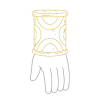
Armcuff

Ikoro (armcuffs) are made from different materials using different techniques, including brass sheet, cast bronze, and ivory. They were crafted by different guilds depending on the material used: artists of the Igun-Ẹrọnmwọn cast them in brass or hammered and incised them from brass sheet, whereas artists of the Igbesamwan carved ivory Ikoro. Ikoro were made in different qualities, from rather simple examples with abstract geometric decoration to finely carved ivory examples with brass or copper inlays. Ikoro are worn in pairs on both forearms by chiefs and the Ọba during ceremonies and festivals. Figures depicted on the Emwin Arre (royal treasures) are often shown wearing such pairs.

1 annotation
Ikoro
Water fern
Ebe Amẹ
Water Fern

Ebe Amẹ refers to a wide variety of plants, particularly the leaves of the water fern or river leaf, found in riverine areas of southern Nigeria. Artists from the Igun-Ẹrọnmwọn used these as a decorative motif in the background of most Ama-Ẹrọnmwọn (bronze relief plaques). The petals of the Ebe Amẹ, like the points of the ἀghàdàgháda (crossroads), represent the four cardinal directions: north, east, south, and west. The number four plays a foundational role in the Edo calendar, which is structured around four market days.

1 annotation
Ebe Amẹ
Wrapper
Ukpọn
Wrapper

Ukpọn is the Edo term for cloth and is used here to refer to the wrappers or kilts worn by many of the figures depicted on the Emwin Arre (royal treasures). The cloth worn around the waist may be plain, but it is more commonly richly decorated with motifs associated with the monarchy, power, and wealth, such as the Ọba'nui (infinity symbol) and Uhunme Ikpotoki (Portuguese heads).

The Benin Kingdom was renowned for its textile production, both for local use and for trade. Within the royal court, members of the Owina n’Ido produced ukhuen cloth for the Ọba and other members of the court, who wore it as wrappers during festivals and ceremonies.

Alongside locally produced textiles, imported cloth was also an important commodity in the Benin Kingdom’s trade networks. Textiles were exchanged with neighbouring production centres, particularly Ijebu, while European traders brought silks, woollens, linens, and cotton from Europe and Asia from the 15th century onwards.

1 annotation
Ukpọn
Single Beaded Baldric
Ukpan obọ ọkpa
Single Beaded Baldric

Ukpan obọ ọkpa is a single baldric worn diagonally across the torso, from the left shoulder to the right hip. Barbara Blackmun described these baldrics as an “Ẹkpẹn band,” worn by figures as “a sign of distinction” ( ).

1 annotation
Ukpan obọ ọkpa
Forehead markings
Ikharo
Forehead markings

Ikharo are linear keloid markings depicted on the forehead of Uhunmwu-Elao (commemorative heads) in groups of three or four above each eye. The exact meaning of Ikharo is debated; some have argued that they relate to the gender or tribal identification of the person on whom they are depicted. For example, Gabriel Ọbazee has argued that they were worn only by men; however, their use in depictions is not consistent with this, and the Iy’Ọba are also shown wearing them. Flora Kaplan argued that they are instead a stylistic feature employed by artists that varied over time.

The naming of these markings differs between publications. For example, Ekhaguosa Aisien and Joseph Nevadomsky describe these markings as “agbaguda n'ehae”, which they write translates literally as “blades of the forehead”. However, Aisien later went on to call these “ikharo”, as used here. Kate Ezra referred to these forehead markings as ikharo, meaning “tribal mark [of eye]”.

1 annotation
Ikharo

Provenance

4 events
Production
1504 (approximate) to 1550 (approximate)
Production of the Ama-Ẹrọnmwọn by the Igun-Ẹrọnmwọn guild in Benin City
Loot
February 19, 1897 (day approximate) to June 1899 (month approximate)
Looting of the Emwin Arre - Inalienable Cultural Artefacts - during the Invasion of the Benin Kingdom in February 1897 and until the end of overt military activity in June 1899
Unknown
February 22, 1897 (day approximate) to 1924
The object is known to have come into contact with Walter Dormitzer.
Purchase
1924
The object was purchased by the Newark Museum of Art from Walter Dormitzer.

Institution data

Newark Museum of Art
The data was transferred directly by the institution.
Last updated: 2021-09-01
Language: english
Institution fieldValue
Object Number
object id
24.535
Sort Number
object id
24 535
Object Name
designation
object type
Plaque
Description
description
Fragment of bronze relief. Man shown front view, with figured loin cloth and long sword. At upper corner is arm holding ring-handled sword (rest town away). Surface of background covered with incised three-petalled flowers against ground of incised dot
Medium
material
Copper alloy
Geographic Origin
production place
Benin, Edo State, Nigeria
Vendor
prior source
Walter Dormitzer
Provenance
provenance
Walter Dormitzer, by at least 1924; Newark Museum, purchase, 1924
Department
department and institution
Arts of Global Africa
Object Credit Line
accession date
Purchase 1924
Object Status
accession method
Accession
Current Location
display status
[24.535] The Newark Museum, M020, AFCabinet42, 8, [May-14-2013], Permanent Location
Copyright
license
Unknown artist, not researched
Classification
Anthropology
Photo Credit
license
Unrecorded artist, Plaque Benin, Edo State, Nigeria Copper alloy, 12 ¼ x 6 ½ in. Purchase 1924 24.535 Collection of The Newark Museum of Art Photo by Richard Goodbody
Sensitive content

Sensitive Content Digital Benin includes colonial material that may contain inaccurate, derogatory or harmful language relating to African and African diasporic communities. Such language may appear in catalogue records, transcriptions, and book, exhibition or museum titles. We recognize that this material may cause distress. Sensitive-content warnings are being implemented across the collection, but this process is ongoing. The language does not reflect Digital Benin’s views; we take an anti-colonial and anti-racist position and are committed to centring the humanity of historically marginalised communities.

Read more about our approach