Loading...
Relief Plaque
Relief Plaque
ID
212004
Edo designations
English designations
Categories
Institution Location
1 Adesogbe (Plymouth) Road, P.M.B. 1115, Benin City , Edo State
ID
212004
Edo designations
English designations
Relief Plaque
Categories
Palace Architecture & Ornamentation
Institution Location
1 Adesogbe (Plymouth) Road, P.M.B. 1115, Benin City , Edo State

Iconographies

7 annotations

Colar Bead
Odigba
Coral beaded collar

Odigba (beaded collar) is a rigid neck collar made of beads, worn as part of ceremonial attire only by senior princes who have been made Enigie. Although Ibafe (2007, p. 43) argued that the Odigba was introduced during the Ogiso period (c. 900–c. 1170 AD) by Ogiso Ere, along with other symbolically important Emwin Arre, such as the Ada (ceremonial sword) and the Ebẹn (ceremonial sword). The Odigba was initially made of beads, while coral was incorporated only later, following its introduction through trade with Portuguese merchants in the late fifteenth century.

1 annotation
Odigba
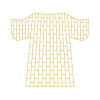
Coral Beaded Shirt
Ewu ivie
Coral Beaded Shirt

The Ewu ivie (coral bead shirt) is made of strings of coral beads. This heavy shirt was part of the ceremonial regalia worn only by a small number of high-ranking members of the palace: the Ọba, the Edaiken, the Iy’Ọba, and the Ezọmọ. The Ewu ivie would be worn along with the Odigba (coral bead collar).

1 annotation
Ewu ivie
Ubanu'hi / Obanu'hi
Ubanu'hi
Inifinity Symbol

The Ubanu'hi (infinity symbol) is a kind of guilloche or interlaced strapwork motif that can be angular or rounded. It was used by Edo artists in the decoration of many Emwin Arhe (royal treasures) and is ubiquitous in Benin royal arts. Ubanu'hi is a shortened form of “uba no Ọba ya de agbon ke ehimwin yi”, which means “the rope with which the Ọba ties the heaven and earth together” (pers. comm. Chief John Igbineweka Inneh n’Igbesawman, 2022). Similarly, Paula Ben-Amos Girshick described this as “Ọba n’iri agbon”, or the “rope of the world” pattern.

According to Ọbabanmu Ineh, the use of this motif indicates that objects were carved by members of the Igbesanmwan. However, the motif is found on all types of Emwin Arhe (royal treasures), not only those made of ivory or wood. On the flanges of the Ama-Ẹrọnmwọn (relief plaques) alone, Kathryn Gunsch identified three different versions of the Ubanu'hi and, through her analysis of over 850 plaques, found that these different Ubanu'hi forms align with other characteristics, such as dimensions, the prevalence of ornamental motifs, and stylistic qualities. Together, these provide evidence, she argues, of different production groups among the plaque makers.

Kate Ezra went on to argue that the use of these motifs indicates that certain objects were used in a “royal context” and were associated with “royal patronage”.

Ubanu’hi can also be spelt Obanu'hi, indicating different intonations in the pronunciation of the words.

1 annotation
Ubanu'hi
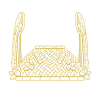
Beaded Crown
Ẹde
Beaded Crown

Although many other members of the Benin royal court wore a variety of hats and forms of headwear, only the Ọba may wear the Ẹde (beaded crown). The Ọba must never be seen bare-headed, and successive Ọba introduced different styles and types of crowns.

Across different media and objects, Ọba are depicted wearing various types of crowns, all elaborately crafted from coral beads. Some feature tall projections rising from the crown, known as Oro, while others have curved projections extending from either side of the head, known as the winged cap. The latter was introduced only in the 19th century, most likely by Ọba Osẹmwẹndẹ. Depictions of Ọba Ẹsigie on Ama-Ẹrọnmwọn (bronze relief plaques) show him wearing an elaborate crown decorated with large jasper or coral beads.

1 annotation
Ẹde
Mudfish
Ewi
Mudfish

Depictions of Ewi (mudfish) are among the most frequent motifs in the Emwin Arre (royal treasures). Mudfish hold an important place in Edo belief, both as representations of the god Olokun and as symbols of royalty, as well as of “prosperity, peace, well-being and fertility”. Mudfish are also particularly common animals for sacrifice, and mudfish-shaped Orhiẹvbẹ (kola-nut boxes) were used to make offerings or store kola nuts.

Yet, the appearance of Ewi across the Emwin Arhe is not consistent, and it has been argued that different species of mudfish were depicted by Edo artists, each with different qualities and capabilities. For example, the electric shock of Malapterurus electricus resembles the fierceness of the Ọba, while the liminal qualities of the Synodontis clarias mudfish, which lives both on land and in water, similarly reflect the Ọba’s rule over land and sea.Gallagher 1983, p. 93 With these different qualities in mind, the mudfish is an important symbol of Benin kingship and royalty.

Sometimes the Ọba was depicted by artists with mudfish rather than legs (see Ọba with Mudfish Legs).

1 annotation
Ewi
Water fern
Ebe Amẹ
Water Fern

Ebe Amẹ refers to a wide variety of plants, particularly the leaves of the water fern or river leaf, found in riverine areas of southern Nigeria. Artists from the Igun-Ẹrọnmwọn used these as a decorative motif in the background of most Ama-Ẹrọnmwọn (bronze relief plaques). The petals of the Ebe Amẹ, like the points of the ἀghàdàgháda (crossroads), represent the four cardinal directions: north, east, south, and west. The number four plays a foundational role in the Edo calendar, which is structured around four market days.

1 annotation
Ebe Amẹ
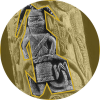
king with mudfish legs
Ọba Ohẹn
King with Mudfish Legs

This motif of an Ọba with legs represented as two mudfish is often interpreted as Ọba Ohẹn, who reigned c. 1334–1370. According to oral traditions, Ohẹn suffered from paralysis of the legs and unsuccessfully attempted to conceal his condition from the chiefs and members of the royal court. The Iyasẹ Emuze eventually hid in the Ọba’s chambers to discover his secret. When Ohẹn discovered this, he ordered the Iyasẹ to be executed. However, the people learned of the order and turned against the Ọba. According to the tradition, they plotted to kill him ritually by digging a hole beneath his throne and stoning him with Orhue (white kaolin chalk) when he fell into it.

Not all representations of an Ọba with mudfish legs, however, are understood to refer to Ohẹn. Variations in the objects and animals carried by the figure are thought to indicate different meanings. Members of the Igbesamwan and Igun-Ẹrọnmwọn have emphasised the significance of these accompanying motifs (Blackmun 1984, pp.249–255). When the mudfish-legged Ọba is shown holding aquatic creatures such as crocodiles, for example, the image has been interpreted as a “cosmological image” representing the correspondence between the two monarchs: the Ọba of Benin, ruler of the land, and Olokun, ruler of the waters. By contrast, representations in which the Ọba holds swords or staffs have been interpreted specifically as depictions of Ọba Ohẹn.

1 annotation
Ọba Ohẹn

Provenance

6 events
Production
1504 (approximate) to 1550 (approximate)
Production of the Ama-Ẹrọnmwọn by the Igun-Ẹrọnmwọn guild in Benin City
Loot
February 19, 1897 (day approximate) to June 1899 (month approximate)
Looting of the Emwin Arre - Inalienable Cultural Artefacts - during the Invasion of the Benin Kingdom in February 1897 and until the end of overt military activity in June 1899
Unknown
January 1898 to July 1898
Acquisition of Benin objects by F. Erdmann in Benin City in 1898
Transfer
July 1898 (year approximate)
Transfer of Benin objects acquired by F. Erdmann from Benin City to Hamburg, 1898
Purchase
1899
Purchase of Benin objects from Bey & Co. by the Berlin Museum für Völkerkunde, 1899
Restitution
August 25, 2022
Transfer of ownership of 512 Emwin Arre from the collection of the Ethnological Museum, State Museums of Berlin to Omo n'Oba n'Edo Uku Akpolokpolo, Ọba of Benin, and the National Commission for Museums and Monuments, Nigeria, 25 August 2022

Related archival documents

1 documents
See all
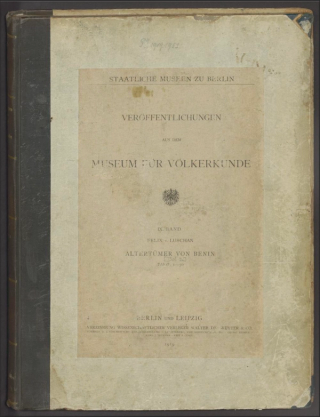
Museum Catalogue
Staatsbibliothek zu Berlin
Die Altertümer von Benin
Date
January 1, 1919 at 12:00:00 AM

Institution data

Ethnologisches Museum, Staatliche Museen zu Berlin
The data was transferred directly by the institution.
Last updated: 2021-06-14
Language: german
Institution fieldValue
ID
object id
212004
Sachbegriff
designation
Sachbegriff: Reliefplatte
Titel
designation
Titel: König
Objektref.
description
E 1151/1898, Erwerbung: I/41/1899: III C 8348-8531, Altertümer (Benin), H. Bey, Hamburg, 1898, Heinrich Bey (1882)
Texte Online
description
Online Beschreibung, Der König ist an seinen Insignien, Kappe und Hemd aus Korallen und große Korallenperle an einem Halsband, erkannbar. Die beiden Welse verweisen auf die Beziehung des Königs zu Olokun, dem Herrn des Meeres. [Benin_Königreich]
Material / Technik
material
Material: Messing; Ausgabe: Messing
Material / Technik // Alle
material
Messing, Messing
Maße
dimensions
40,10 x 18,50 x 4,30 cm; 2,40 kg
Objekttyp
object type
Allgemein
Sachbegr. Ausgabe
object type
Reliefplatte (Relief plaque)
Anzahl Teile
object count
1
Datierung
date made
16. Jh.
Geogr. Bezüge
production place
Nigeria ( Land ); Benin ( Königreich )
Geogr. Bezüge // Alle
production place
Nigeria, Benin
Beteiligte
prior source
Heinrich Bey (1882), Sammler
Beteiligte // (Name, Sortierung=kleinste)
prior source
Bey, Heinrich
Veräußerer
prior source
null
Erwerb. Notiz
provenance
Erwerbung von: H. Bey; Notiz: Rückführung Leipzig; Ausgabe: 16. Jh., im Auftrag von Oba Esigie (reg. 1517-1550) oder seines Sohnes Oba Orhogbua (reg. 1550-1570), Königspalast, Benin-Stadt; durch Erbschaft an Oba Ovonramwen (ca. 1857-1914; reg. 1888-97), Königspalast, Benin-Stadt; geplündert im Zusammenhang mit der britischen Eroberung von Benin, 1897; in unbekanntem Besitz nach der Eroberung des Königreichs Benin; gesammelt im Auftrag der Firma Bey & Co., zwischen 1897 und 1898 im Gebiet des späteren kolonialen Nigeria; verkauft an das Königliche Museum für Völkerkunde in Berlin, 1899.
Verw. Institution
department and institution
Ethnologisches Museum, Staatliche Museen zu Berlin
Erwerb. Datum
accession date
1899
Besitzart
accession method
Erwerbungsart
accession method
Ankauf
Digital Assets
images
III C 8418.JPG, Repro Digitalisat
Erwerb. Nr.
I/41/1899
Ident. Nr.
object id
III C 8418
Ident. Nr. // (Sortiernr.)
object id
0003 C 08418
Obj. Status
vorhanden
object_images/creator
license
Jörg von Bruchhausen
Sensitive content

Sensitive Content Digital Benin includes colonial material that may contain inaccurate, derogatory or harmful language relating to African and African diasporic communities. Such language may appear in catalogue records, transcriptions, and book, exhibition or museum titles. We recognize that this material may cause distress. Sensitive-content warnings are being implemented across the collection, but this process is ongoing. The language does not reflect Digital Benin’s views; we take an anti-colonial and anti-racist position and are committed to centring the humanity of historically marginalised communities.

Read more about our approach