Loading...
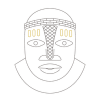
Odudua Mask
Odudua Mask
Odudua Mask
Object Number
2005-6-2
Edo designations
English designations
Categories
Institution Location
950 Independence Ave SW, Washington, DC 20560, United States
Object Number
2005-6-2
Edo designations
English designations
Odudua Mask
Categories
Ceremonial Objects
Institution Location
950 Independence Ave SW, Washington, DC 20560, United States

Iconographies

3 annotations
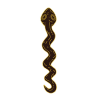
snake
Ẹyẹn
Snake

Ẹyẹn (snakes) are among the most common animals depicted by Edo artists on the Emwin Arre (royal treasures). The varied depictions of these reptiles suggest different snake species, including the Ikpin (python), Arhunmoto (puff adder), and Olose (red-black striped snake); therefore, here we use the generic term for snake: Ẹyẹn.

The identification of snake motifs and depictions as Ikpin, as well as the importance accorded to this species, is a subject of scholarly debate. Paula Ben-Amos argued that the Edo admired the “stature, colouration and crushing power” of the python, which was in turn associated with Olokun. She went on to identify the brass figures of snakes that formerly adorned the roof of the palace, as well as several other snakes, as pythons. Joseph Nevadomsky argued instead that the importance of the Ikpin had been overstated.

Some of these snake representations may in fact be the Arhunmwoto (puff adder). The first to suggest this was the German curator Felix von Luschan in his early research into the Benin royal treasures. Nevadomsky suggested that the large head, narrow neck, and rough scales are indicative of either the puff adder, a symbol of “material wealth, tribute, and gifts,” or the Gaboon viper.

Another kind of snake that may be depicted is the Olose (red-black striped snake). It has the praise name “king of the snakes” in Edo. Olose is also closely connected to the deity Olokun, both because of its attractiveness and because it inhabits wet environments such as forest streams, which in turn flow into rivers and the sea, where Olokun lives. Although the exact meanings of these different snakes vary, they share the characteristic of being spiritually powerful creatures.

1 annotation
Ẹyẹn
alligator
Ẹghughu
Crocodile

In the riverine area surrounding Benin City, there are two types of crocodile. The Ẹghughu, known in English as the dwarf or bush crocodile, is believed to be more docile. The second type is the Àgbákà, the aggressive Nile crocodile.

Crocodiles are one of the important animals represented in the historical Emwin Arre, and they are known as Olokun’s guards or the “policemen” of the waters. The powerful and ferocious qualities of these animals might explain why warrior figures are often depicted wearing Uhunmwu-Ẹkuẹ (pendant masks) in the shape of crocodile heads on Ama-Ẹrọnmwọn (bronze relief plaques). Olokun devotees use crocodiles as sacrificial animals in offerings during the worship of Olokun.

1 annotation
Ẹghughu
Forehead markings
Ikharo
Forehead markings

Ikharo are linear keloid markings depicted on the forehead of Uhunmwu-Elao (commemorative heads) in groups of three or four above each eye. The exact meaning of Ikharo is debated; some have argued that they relate to the gender or tribal identification of the person on whom they are depicted. For example, Gabriel Ọbazee has argued that they were worn only by men; however, their use in depictions is not consistent with this, and the Iy’Ọba are also shown wearing them. Flora Kaplan argued that they are instead a stylistic feature employed by artists that varied over time.

The naming of these markings differs between publications. For example, Ekhaguosa Aisien and Joseph Nevadomsky describe these markings as “agbaguda n'ehae”, which they write translates literally as “blades of the forehead”. However, Aisien later went on to call these “ikharo”, as used here. Kate Ezra referred to these forehead markings as ikharo, meaning “tribal mark [of eye]”.

1 annotation
Ikharo

Provenance

5 events
Production
unknown to February 22, 1897 (day approximate)
Production of Aro Ododua in Benin
Loot
February 19, 1897 (day approximate) to June 1899 (month approximate)
Looting of the Emwin Arre - Inalienable Cultural Artefacts - during the Invasion of the Benin Kingdom in February 1897 and until the end of overt military activity in June 1899
Purchase
1959 to 1984
The object was purchased by Paul & Ruth Tishman.
Purchase
1984
Acquisition of the Tishman collection by the Walt Disney Company, 1984
Gift
2005
Gift of the Walt Disney-Tishman African Art Collection to the National Museum of African Art, Smithsonian Institution

Institution data

Smithsonian National Museum of African Art
The data was transferred directly by the institution.
Last updated: 2021-08-20
Language: english
Institution fieldValue
Object Number
object id
2005-6-2
Local Name
edo designation
Object Name
designation
object type
Crest mask
Medium
material
Copper alloy, iron
Depth IN
dimensions
8.7795323
Dimensions
dimensions
H x W x D: 71.1 x 24.1 x 22.3cm (28 x 9 1/2 x 8 3/4in.)
Height IN
dimensions
27.9921411
Width IN
dimensions
9.4881941
Classification
object type
Mask
Object Type
object type
Tradition-based
Begin Date
date made
1700
Date
date made
18th century
End Date
date made
1799
Maker1
producer
Benin kingdom court style
Maker2
producer
Edo artist
Primary Country
production place
Nigeria
Credit Line
prior source
Gift of Walt Disney World Co., a subsidiary of The Walt Disney Company
Photography Credit
license
Photograph by Franko Khoury National Museum of African Art Smithsonian Institution
TIFF
images
2005-6-2_D20060010.tif; 2005-6-2_D20060011.tif; 2005-6-2_D20060012.tif
Status Flags
Disney-Tishman Collection
Sensitive content

Sensitive Content Digital Benin includes colonial material that may contain inaccurate, derogatory or harmful language relating to African and African diasporic communities. Such language may appear in catalogue records, transcriptions, and book, exhibition or museum titles. We recognize that this material may cause distress. Sensitive-content warnings are being implemented across the collection, but this process is ongoing. The language does not reflect Digital Benin’s views; we take an anti-colonial and anti-racist position and are committed to centring the humanity of historically marginalised communities.

Read more about our approach