Loading...
Relief Plaque
Relief Plaque
Relief Plaque
Object Number
1991.17.25
Edo designations
English designations
Categories
Institution Location
1000 5th Ave, New York, NY 10028, United States
Object Number
1991.17.25
Edo designations
English designations
Relief Plaque
Categories
Palace Architecture & Ornamentation
Institution Location
1000 5th Ave, New York, NY 10028, United States

Iconographies

6 annotations
Switch
Unwẹnrhiẹnọtan
Switch

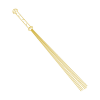
The Unwẹnrhiẹnọtan (switch) is made from branches of a tall shrub and is held by the Ọba and certain chiefs, such as the Osuan and Ooton, during sacrificial rituals and ceremonies, particularly Ugie Erha Ọba. Figures carrying Unwẹnrhiẹnọtan are depicted in brass on the Ama-Ẹrọnmwọn (bronze relief plaques) and also carved in ivory on the Aken'ni Elao (altar tusk).

According to Barbara Blackmun, the Unwẹnrhiẹnọtan “is required whenever the sacrifice of a living creature takes place within the Ọba’s palace complex, to drive away intrusive spiritual forces. The upright position of this essential implement suggests that the person who holds it is about to preside over a sacrificial ceremony.”

1 annotation
Unwẹnrhiẹnọtan
Headdress/crown with single projection
Oro
Headdress/crown with single projection

Figures wearing a headdress with a single protrusion from the crown of the head, known as the Oro, are found only among the Ọba and a select category of palace dignitaries whose ancestors originated in ancient Ile Ife. Only the Osa and Osuan, custodians of the Uwen and Ora deities, as well as members of the Emuru, who are responsible for the care of Iru vessels, may wear a headdress with the Oro. The identification of different figures is therefore interpreted based on the combination of the Oro with other items of regalia. Artists in the Igun-Ẹrọnmwọn and Igbesamwan depicted figures with the Oro on Ama-Ẹrọnmwọn (bronze relief plaques) and Aken'ni Elao (carved tusks), respectively. The Oro would either be made of coral beads as part of the crown or headdress, or be woven from itoto fibre.

1 annotation
Oro
Colar Bead
Odigba
Coral beaded collar

Odigba (beaded collar) is a rigid neck collar made of beads, worn as part of ceremonial attire only by senior princes who have been made Enigie. Although Ibafe (2007, p. 43) argued that the Odigba was introduced during the Ogiso period (c. 900–c. 1170 AD) by Ogiso Ere, along with other symbolically important Emwin Arre, such as the Ada (ceremonial sword) and the Ebẹn (ceremonial sword). The Odigba was initially made of beads, while coral was incorporated only later, following its introduction through trade with Portuguese merchants in the late fifteenth century.

1 annotation
Odigba
Long gown
Ẹwuọsotọ
Long gown

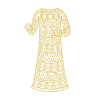
Ėwùϙsዕtỏ is the Edo term for a long, woven garment. .The Osuan, the high priest of Uwen, and the Ooton may both wear the Ėwùϙsዕtỏ, making it difficult to distinguish between the two figures based on their attire alone. In depictions on Aken'ni Elao, figures identified as Ooton are more commonly represented than the Osuan specifically. Both figures are also depicted holding Unwẹnrhiẹnọtan (switches) alongside the Ėwùϙsዕtỏ.

Today, neither the Osuan nor the Ooton wears the long gown, although both are associated with a distinctive hairstyle. On ivory and brass Emwin Arre (royal treasures), the Ooton or Osuan is depicted wearing the Ėwùϙsዕtỏ with his left hand placed on his chest, over a bulge beneath the gown. This bulge is understood to conceal the jawbone of the deceased Iyasẹ, which the Ooton wears. According to Barbara Blackmun, because the Iyasẹ was the leader of the opposition to the Ọba, the jawbone became the “locus of the Iyasẹ’s disturbing dissent as he voices disagreement.” As a result, the Iyasẹ’s family was required to give the jawbone to members of the Ooton guild, who kept it in the royal palace.

1 annotation
Ẹwuọsotọ
Water fern
Ebe Amẹ
Water Fern

Ebe Amẹ refers to a wide variety of plants, particularly the leaves of the water fern or river leaf, found in riverine areas of southern Nigeria. Artists from the Igun-Ẹrọnmwọn used these as a decorative motif in the background of most Ama-Ẹrọnmwọn (bronze relief plaques). The petals of the Ebe Amẹ, like the points of the ἀghàdàgháda (crossroads), represent the four cardinal directions: north, east, south, and west. The number four plays a foundational role in the Edo calendar, which is structured around four market days.

1 annotation
Ebe Amẹ
Osuan
Osuan
Osuan

“Only Osa and the Osuan know what is in the palm frond”.

The title of Osuan is paired with that of Osa, and both were created by Ọba Ewuare I to protect the Ọba and the Edo people as a whole. According to Inneh, the Osuan is responsible for Ora, the deity associated with fertility. The Osuan is therefore responsible for ensuring the fecundity of the land and people of the Kingdom.

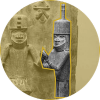
During ceremonies such as Ugie and Oduduwa, the Osa and Osuan support the Ọba on either side, a pose that is frequently reflected in the visual language of Emwin Arre (royal treasures). Both are often depicted wearing basketry headwear with a pointed Oro projection, similar to the headwear still worn by holders of these titles today. The Osuan, as well as other members of the Ooton guild to which the titleholder belongs, are often depicted holding an Unwẹnrhiẹnọtan (switch) in one or both hands. This pose reflects the historical role of the Osuan during sacrificial ceremonies, when the Unwẹnrhiẹnọtan was held aloft to “fend off intrusive spirits that crowded around as the victim died”.

During the Igue festival, both the Osa and Osuan wrap raffia palm cloth around their waists, which “indicate[s] the deep secrecy of the inner details of the palace worship and Ugie ceremonies”.

1 annotation
Osuan

Provenance

4 events
Production
1504 (approximate) to 1550 (approximate)
Production of the Ama-Ẹrọnmwọn by the Igun-Ẹrọnmwọn guild in Benin City
Loot
February 19, 1897 (day approximate) to June 1899 (month approximate)
Looting of the Emwin Arre - Inalienable Cultural Artefacts - during the Invasion of the Benin Kingdom in February 1897 and until the end of overt military activity in June 1899
Purchase
1970s to 1991
The object was purchased by Klaus Gunther & Amelia 'Dolly' Perls.
Gift
1991
Gift of the Perls collection of Benin objects to the Metropolitan Museum of Art, 1991

Institution data

Metropolitan Museum of Art
The data was transferred directly by the institution.
Last updated: 2021-07-30
Language: english
Institution fieldValue
Object Number
object id
1991.17.25
Object Sort Number
object id
1991 17 25
Primary Rendition No
object id
DT6561
Title
designation
object type
Plaque: Palace Priest (Ooton)
Medium
material
Brass
Dimensions
dimensions
(Approx.) H. 18 3/8 × W. 8 × D. 2 1/2 in. (46.7 × 20.3 × 6.4 cm)
Classification
object type
Metal-Sculpture
Date
date made
16th–17th century
Geo: City
production place
Court of Benin
Geo: Country
production place
Nigeria
Credit Line
prior source
Gift of Mr. and Mrs. Klaus G. Perls, 1991
Provenance
provenance
Mr. and Mrs. Klaus G. Perls, New York, until 1991Court of Benin Objects in the Michael C. Rockefeller Wing, Metropolitan Museum of Art
Dynasty
reign associated name
Oranmiyan
Culture
ethnic attribution
Edo peoples
ExhibitionHistory
exhibition history
Royal Art of Benin from the Perls Collection The Metropolitan Museum of Art, January 16, 1992–September 13,1992
Bibliography
bibliography
Ezra, Kate. Royal Art of Benin: The Perls Collection in the Metropolitan Museum of Art. New York: The Metropolitan Museum of Art, 1992, p. 138, no. 39.
Published References
bibliography
"ROYAL ART OF BENIN. The Perls Collection in The Metropolitan Museum of Art." Kate Ezra. The Metropolitan Museum of Art and Harry N. Abrams Inc., New York 1992 Fig. 39
Sensitive content

Sensitive Content Digital Benin includes colonial material that may contain inaccurate, derogatory or harmful language relating to African and African diasporic communities. Such language may appear in catalogue records, transcriptions, and book, exhibition or museum titles. We recognize that this material may cause distress. Sensitive-content warnings are being implemented across the collection, but this process is ongoing. The language does not reflect Digital Benin’s views; we take an anti-colonial and anti-racist position and are committed to centring the humanity of historically marginalised communities.

Read more about our approach