Loading...


Accession Number
1980.31
Institution
de Young museum Edo designations

English designations
Categories
Institution Location
50 Hagiwara Tea Garden Dr, San Francisco, CA 94118, United States
Accession Number
1980.31
Institution
de Young museum Edo designations
English designations
Relief Plaque
Categories
Palace Architecture & Ornamentation
Institution Location
50 Hagiwara Tea Garden Dr, San Francisco, CA 94118, United States
Iconographies
4
annotations

Ebe Amẹ
Water Fern
1 annotation

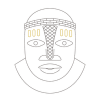
Ikharo
Forehead markings
1 annotation

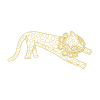
Ẹkpẹn
Leopard
1 annotation


Odigba
Coral beaded collar
1 annotation

Provenance
6
events

Institution data
de Young museum
The data was transferred directly by the institution.
Last updated: 2021-11-02
Language: english
| Institution field | Value |
|---|---|
Accession Number object id | 1980.31 |
DESCRIPTION description | |
Media material | Bronze Or Brass |
Dimensions dimensions | 17 3/4 x 7 (45.1 x 17.8 cm) |
TITLE object type | Plaque |
Date date made | 16th century |
Continent production place | Africa |
Country production place | Nigeria |
REGION production place | Court of Benin |
Credit Line prior source | Museum purchase, William H. Noble Bequest Fund |
Provenance/Former Ownership History provenance | Purchased by Mr. James Willis for the Fine Arts Museums at Sotheby Parke Bernet & Co., 34-35 New Bond Street, London WIA 2AA on June 16, 1980 (lot 17). |
Culture/People ethnic attribution | Edo |
Department department and institution | Africa, Oceania, and the Americas |
Acquisition Date accession date | 7/1/80 |
Additional notes notes | The dealer James Willis bid at auction on behalf of the museum. “European private collector” (Sotheby’s 1980 sale catalogue) Dutch collector (“Schwartz” - Leloup, email 2015) (“Schwarz” - Fagg, 1958). Possibly Adolph Schwartz, Amstelveen, The Netherlands) till 1980 Hélène Leloup, Paris, dealer and collector sold it to Schwartz John Hewett, Bog Farm, Kent, England, dealer Collection in Switzerland (Fagg, 1958) |
REMARKS notes | Published in Tryptych, FAMSF Autumn 1980 pp. 12-15 "Girl with Leopard: A Benin Bronze Plaque" K. Berrin |
Exhibition History exhibition history | “West Africa Court and Tribal Art,” Arts Council 1967, L’Art redacted e, Dakar and Paris, 1966 “Benin Art” March 2 - May 2, 1983, The Museum of Cultural History, LA, CA “Animals in African Art: From the Familiar to the Marvelous” traveling exhibition organized by The Museum for African Art, New York, NY (Montgomery Museum of Fine Arts, Montgomery, AL Feb-April 1996; Joslyn Art Museum, Omaha, Nebraska, May - July 1996; Mint Museum, Charlotte, North Carolina, Sept-Dec 1996; Dallas Art Museum, Dallas, TX, Feb-April 1997) M.H. de Young-Art of the Americas: Art and Ethnography -3/28/98-7/5/98 |
Location display status | de Young Gallery 40 |
PUBLICATIONS bibliography | Warren M. Robbins and Nancy Ingram Nooter, African Art in American Collections, Washington DC: Smithsonian Press, 1989, pg. 217, fig. 559 |
Publication History bibliography | Fagg, 1969, pl. ZII a, No.72 Fagg, 1958, pl. I Leuzinger, 1972, p.102, K7 (ill.) Meauze, 1967 Berrin, Kathy "Girl with Leopard: A Benin Bronze Plaque," Triptych, FAM/AAM/SFO, Autumn 1980, pp. 12-15 |
Century date made | 16th Century AD |
Object Type object type | Sculpture |
Sections
About
Other
Sensitive content
Sensitive Content Digital Benin includes colonial material that may contain inaccurate, derogatory or harmful language relating to African and African diasporic communities. Such language may appear in catalogue records, transcriptions, and book, exhibition or museum titles. We recognize that this material may cause distress. Sensitive-content warnings are being implemented across the collection, but this process is ongoing. The language does not reflect Digital Benin’s views; we take an anti-colonial and anti-racist position and are committed to centring the humanity of historically marginalised communities.