Loading...
Object ID
312524
English designations
Categories
Institution Location
1000 5th Ave, New York, NY 10028, United States
Object ID
312524
English designations
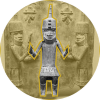
Pendant Plaque
Categories
Ceremonial Regalia
Contextual Objects: Beyond Benin
Institution Location
1000 5th Ave, New York, NY 10028, United States

Iconographies

5 annotations
Supporter
Enobare
Supporter

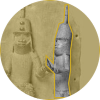
Enobare is the term used for the supporting figures who are typically depicted alongside the Ọba, holding his arms or hands as part of the Royal Triad motif. Their identities are interpreted variously: they may represent the Osa and Osuan, who support the Ọba during certain ceremonial contexts, or, particularly in representations dating to the 18th century, the Edaiken (crown prince) and Ezọmọ.

2 annotations
Enobare
Enobare
Colar Bead
Odigba
Coral beaded collar

Odigba (beaded collar) is a rigid neck collar made of beads, worn as part of ceremonial attire only by senior princes who have been made Enigie. Although Ibafe (2007, p. 43) argued that the Odigba was introduced during the Ogiso period (c. 900–c. 1170 AD) by Ogiso Ere, along with other symbolically important Emwin Arre, such as the Ada (ceremonial sword) and the Ebẹn (ceremonial sword). The Odigba was initially made of beads, while coral was incorporated only later, following its introduction through trade with Portuguese merchants in the late fifteenth century.

1 annotation
Odigba
King
Ọba
King

The Ọba is the monarch of the Edo people and Kingdom. The current reigning monarch, Ọba Ẹwuare II, is the fortieth Ọba of the current dynasty, which is traditionally understood to have begun around 1170 AD. Over the centuries, the role and conception of the monarch have shifted, and the Emwin Arre (royal treasures) and the visual language they carry provide important evidence for understanding these developments. Although Emwin Arhe served a variety of functions within court life and ritual, “their primary purpose was to glorify the godlike king and the history of the powerful empire”.Plankensteiner 2007, p. 25 Representations of the Ọba are therefore ubiquitous across Benin court arts and frequently occupy a central position within their visual language.

Representations of the Ọba can be recognised through a combination of characteristics, including his size, as he is usually depicted larger than other figures, and his position within compositions, where he may appear in front of or be supported by other figures, as in the Royal Triad motif. The Ọba is also distinguished by particular items of regalia, including the Oro projection from his crown, the distinctive beaded swag extending from his right hip, the Ewu ivie (coral-beaded shirt), and Ukpan obọ eva (crossed coral-beaded baldrics).

Since the early 20th century, scholars have sought to identify individual Ọbas represented on Emwin Arhe by analysing the regalia and other attributes of figures identified as monarchs, as well as the combinations of motifs and figures appearing on particular objects. Oral traditions and historical accounts, alongside European archival sources, have also played an important role in determining the identities of specific Ọba. Just as the institution of the monarchy developed and changed over time, so too did the ways in which Ọbas were represented by artists working within the royal guilds, including the Igun-Ẹrọnmwọn and Igbesamwan.

1 annotation
Ọba
Royal Triad
Royal Triad
Royal Triad

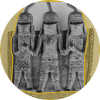
The Royal Triad is a motif composed of three figures, with a central figure supported on either side by two others. The motif has multiple meanings and interpretations. When understood on the human level, the central seated or standing figure is identified as the Ọba, flanked by two Enobare who each support one of his arms. This pose “encapsulates Edo ideals of kingship,” in which “even the most powerful of Benin's divinely ordained rulers cannot stand alone. He must maintain a careful balance between his authority over the Edo people and their acquiescence in his leadership”. The identities of the supporting Enobare are interpreted variously. They have been identified as the Osa and Osuan, who support the Ọba in this manner during the Ugie Oro and Ododua festivals, although it is possible that the Edaiken (crown prince) and Ezọmọ performed these roles during the 18th century ( ).

In some examples, the central figure has mudfish in place of legs. These figures have sometimes been interpreted as representations of the deity Olokun. Barbara Blackmun alternatively suggested that the triad may represent the high god Osanobua, his son and deity Olokun, and Olokun’s child, Ohen, who in turn represents the Ọba.

The number three is considered an “uncanny” number in Edo thought and “is never used lightly”, being associated with the “threat of occult sanctions or forces”.

The Royal Triad appears on almost all Aken'ni Elao (carved tusks), as well as on some Ẹgogo (gongs) and pendant plaques, and less frequently on Ama-Ẹrọnmwọn (bronze relief plaques). The motif is also referred to as the “supporting triad motif” or “linked supporting triad motif”.

1 annotation
Royal Triad

Provenance

7 events
Production
unknown to February 22, 1897 (day approximate)
The object was produced.
Loot
February 19, 1897 (day approximate) to June 1899 (month approximate)
Looting of the Emwin Arre - Inalienable Cultural Artefacts - during the Invasion of the Benin Kingdom in February 1897 and until the end of overt military activity in June 1899
Inheritance
1899 to 1965
The object was inherited by Sybil Murray from Eric Madder Murray.
Auction
March 29, 1965
Sale at Sotheby's, London, March 29th, 1965
Purchase
1969
The object was purchased by Nelson Aldrich Rockefeller from Merton Daniel Simpson and Merton D. Simpson Gallery.
Loan
1969 to 1978
The object was loaned by Nelson Aldrich Rockefeller to New York Museum of Primitive Arts.
Bequest
1979
N. A. Rockefeller bequest to the Metropolitan Museum of Art, 1979

Institution data

Metropolitan Museum of Art
The data was downloaded via a public data access of the institution.
Last updated: 2025-06-02
Language: english
Institution fieldValue
Is Highlight
False
Is Timeline Work
True
Is Public Domain
license
True
Object ID
object id
312524
Department
department and institution
Arts of Africa, Oceania, and the Americas
AccessionYear
accession date
1979
Object Name
object type
Pendant
Title
designation
Protective Pendant
Culture
ethnic attribution
Lower Niger Bronze Industry
Object Date
date made
15th–19th century
Object Begin Date
date made
1400
Object End Date
date made
1897
Medium
material
Brass
Dimensions
dimensions
H. 6 1/8 in. × W. 6 in. × D. 1 3/4 in. (15.5 × 15.2 × 4.4 cm)
Credit Line
prior source
The Michael C. Rockefeller Memorial Collection, Bequest of Nelson A. Rockefeller, 1979
Country
production place
Nigeria
River
place collected
Lower Niger River region
Classification
object type
Metal-Ornaments
Link Resource
weblink
http://www.metmuseum.org/art/collection/search/312524
Repository
department and institution
Metropolitan Museum of Art, New York, NY
Tags
iconography
Men
Tags AAT URL
iconography
http://vocab.getty.edu/page/aat/300025928
Tags Wikidata URL
iconography
https://www.wikidata.org/wiki/Q8441
Sensitive content

Sensitive Content Digital Benin includes colonial material that may contain inaccurate, derogatory or harmful language relating to African and African diasporic communities. Such language may appear in catalogue records, transcriptions, and book, exhibition or museum titles. We recognize that this material may cause distress. Sensitive-content warnings are being implemented across the collection, but this process is ongoing. The language does not reflect Digital Benin’s views; we take an anti-colonial and anti-racist position and are committed to centring the humanity of historically marginalised communities.

Read more about our approach