Loading...
ID Number
1955.13
Edo designations
English designations
Categories
Institution Location
106 Central St, Wellesley, MA 02481, United States
ID Number
1955.13
Edo designations
English designations
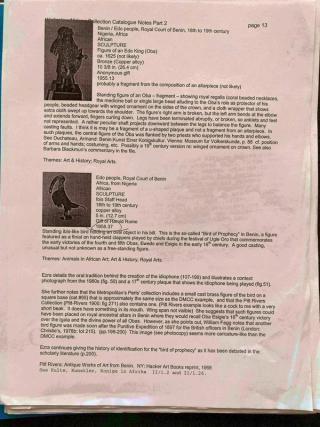
Male Figure
Categories
Figures
Institution Location
106 Central St, Wellesley, MA 02481, United States

Iconographies

2 annotations

Royal/Ewuare Bead
Ivie okpagbaru/Ivie Ewuare
Royal/Ewuare Bead

This oval-shaped bead with faceted sides is known as the Ivie okpagbaru or Ivie Ẹwuare (the ‘royal bead’ or ‘Ẹwuare bead’). The association of Ọba Ẹwuare with this bead is based on a story in which Ẹwuare took beads from the deity Olokun, sanctifying his royal position and, in turn, receiving the title ‘Lord of the Land’, in contrast to Olokun’s title ‘Lord of the Sea’. The Ivie okpagbaru/Ivie Ẹwuare is a distinctive motif that can be used to identify representations of the Ọba.

Due to the association of beads with Olokun, it is unsurprising that this bead has come to symbolise wealth when used to decorate Emwin Arre (royal treasures). ). Paula Ben-Amos associated the bead with a different narrative and the name ‘One Bead Does Not Go around the Neck’. Ben-Amos suggests that the bead is in fact the one that was fought over by Ọba Ẹsigie and his brother Aruanran when they struggled for the right to the throne in the early 16th century.

1 annotation
Ivie okpagbaru/Ivie Ewuare
Colar Bead
Odigba
Coral beaded collar

Odigba (beaded collar) is a rigid neck collar made of beads, worn as part of ceremonial attire only by senior princes who have been made Enigie. Although Ibafe (2007, p. 43) argued that the Odigba was introduced during the Ogiso period (c. 900–c. 1170 AD) by Ogiso Ere, along with other symbolically important Emwin Arre, such as the Ada (ceremonial sword) and the Ebẹn (ceremonial sword). The Odigba was initially made of beads, while coral was incorporated only later, following its introduction through trade with Portuguese merchants in the late fifteenth century.

1 annotation
Odigba

Provenance

3 events
Production
unknown to February 22, 1897 (day approximate)
The object was produced by Unknown member(s) of the Igun-Ẹrọnmwọn guild.
Loot
February 19, 1897 (day approximate) to June 1899 (month approximate)
Looting of the Emwin Arre - Inalienable Cultural Artefacts - during the Invasion of the Benin Kingdom in February 1897 and until the end of overt military activity in June 1899
Gift
1955
The object was given as a gift to the Davis Museum at Wellesley College.

Related archival documents

9 documents
See all
An archival document representing a Research notes of 1 page(s)
Research notes
Davis Museum at Wellesley College
Davis Museum Benin Kingdom Files
An archival document representing a Exhibition records of 1 page(s)
Exhibition record
Davis Museum at Wellesley College
Davis Museum Benin Kingdom Files
An archival document representing a Manuscript for publication of 1 page(s)
Manuscript for publication
Davis Museum at Wellesley College
Davis Museum Benin Kingdom Files

Institution data

Davis Museum at Wellesley College
The data was transferred directly by the institution.
Last updated: 2022-01-18
Language: english
Institution fieldValue
ID Number
object id
1955.13
Title
designation
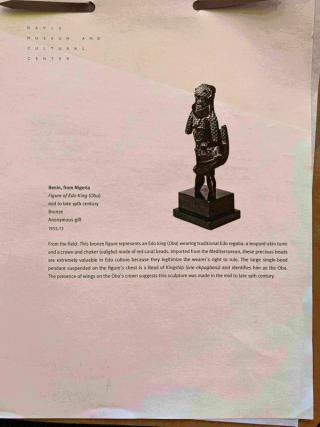
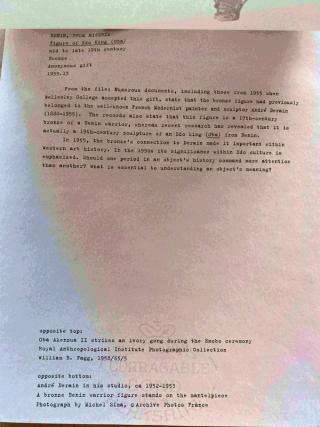
Figure of an Oba (King)
Materials
material
Bronze (copper alloy)
Measurements
dimensions
overall: 10 3/8 in. (26.4 cm)
Category
object type
SCULPTURE
Object Name
object type
Figurine
Date Made
date made
mid- to late-19th century
Maker
producer
Igun Eronmwon Brass Casters Guild
Place Made
production place
Nigeria
Credit Line
prior source
Anonymous gift
Culture
ethnic attribution
Edo
Legal Status
legal status
PERMANENT COLLECTION
Sensitive content

Sensitive Content Digital Benin includes colonial material that may contain inaccurate, derogatory or harmful language relating to African and African diasporic communities. Such language may appear in catalogue records, transcriptions, and book, exhibition or museum titles. We recognize that this material may cause distress. Sensitive-content warnings are being implemented across the collection, but this process is ongoing. The language does not reflect Digital Benin’s views; we take an anti-colonial and anti-racist position and are committed to centring the humanity of historically marginalised communities.

Read more about our approach