Loading...
OBJEKTE_ID
1798012
Edo designations

English designations
Categories
Institution Location
Johannispl. 5-11, 04103 Leipzig, Germany
OBJEKTE_ID
1798012
Edo designations
English designations
Wooden Altar Panel
Categories
Altar & Shrine Objects
Institution Location
Johannispl. 5-11, 04103 Leipzig, Germany
Iconographies
2
annotations

Ọbo Eni
Trunk hand
1 annotation


Ogho
Ram
1 annotation

Provenance
4
events
Institution data
Staatliche Ethnographische Sammlungen Sachsen und Staatliche Kunstsammlungen Dresden
The data was transferred directly by the institution.
Last updated: 2021-09-28
Language: german
| Institution field | Value |
|---|---|
INV_NR object id | MAf 29790 |
OBJEKTE_ID object id | 1798012 |
KURZTITEL designation | Reliefplatte |
Object-name-and-materials designation material | Reliefschnitzerei Holz, geschnitzt Stierkopf,an den Seiten 2 Elefantenköpfe |
TITEL designation | Reliefschnitzerei;Holzplatte |
INTERNETKOMMENTAR description notes | Die Reliefplatte ist Bestandteil des kulturellen und künstlerischen Erbe des vermutlich 800jährigen Königreiches von Benin. Das Königreich, welches auf dem Gebiet des heutigen südwestlichen Nigeria gelegen hat, wurde 1897 von den Briten erobert und die höfischen Kunstwerke gelangten als Kriegsbeute nach Europa. Die Reliefplatte aus Holz zeigt einen Stierkopf und zwei Elefantenrüssel, die in einer Hand auslaufen. Sie stellen wichtige zeremonielle Embleme des Königtums dar. |
KATALOGTEXT description | Übernahme Altdaten (Zustand): H.M. 1760, 11441 |
MATERIAL material | Holz |
MASSEBEMERKUNG dimensions | 46 x 45 x 5,7 cm |
MASSETABANGABE dimensions | Gesamt |
MASSETABBEMERKUNG dimensions | |
MASSETABBREITE dimensions | 45 |
MASSETABDURCHMESSER dimensions | |
MASSETABEINHEITLAENGE dimensions | cm |
MASSETABEINHEITLAENGE_IDS dimensions | 1 |
MASSETABHOEHE dimensions | 46 |
MASSETABTIEFE dimensions | 5,7 |
Dimensions_weight weight | H: 46 cm W: 45 x 5,7 cm |
MASSETABEINHEITGEWICHT weight | |
MASSETABEINHEITGEWICHT_ID weight | |
MASSETABGEWICHT weight | |
OBJEKTBEZ object type | Plastik |
KONVOLUT provenance object count | SES Benin-Objekte; SES Dossier Benin-Objekte, Überlieferung an die Kontaktstelle für Sammlungsgut aus kolonialen Kontexten |
ORT_DATUM_BIS date made | ;1900 |
ORT_DATUM_KONKRET date made | ';' |
ORT_DATUM_VON date made | ;1800 |
MATTECHBEMERKUNG production technique | dunkelbraunes Holz, Vorderseite mit Hochreliefschnitzerei |
TECHNIK production technique | geschnitzt |
ORTE production place | Federal Republic of Nigeria; |
ORTZEITBEMERKUNG production place | Königreich Benin, 19. Jh. |
Ort_Zeit-Bemerkung production place | Königtum Benin, 19.Jh. |
REGIONEN production place | Benin |
Collector/Previous-owner prior source | Herrmann Meyer, Leipzig |
ERWERBUNG prior source | Schenkung 1932 von Herrmann Meyer |
PERSON prior source | unbekannt;Meyer, Herrmann;Meyer, Herrmann |
Acquisition-Details provenance | Donated by Herrmann Meyer, Leipzig |
EIGENTUEMER provenance | |
PROVENIENZ provenance | Herrmann Meyer (bis 1932) |
PROVENIENZSTATUS provenance | |
EREIGNISSE event | Herstellung;; |
ETHNIEN ethnic attribution | Edo |
Institution department and institution | Staatliche Ethnographische Sammlungen Sachsen - GRASSI Museum für Völkerkunde Leipzig |
MUSEUM department and institution | MVL |
Institutional-acquisition-date accession date | 1932 |
Comments notes | Hermann August Heinrich Meyer, 1871-1932, German Explorer, Ethnologist and Bibliograph er |
PRAESENZ display status | ausgestellt |
BIBLIOGRAPHIE bibliography | |
ERWAEHNTIN bibliography | Ausstellungsverzeichnis Peter Göbel 1994-2000, Nr. 67 |
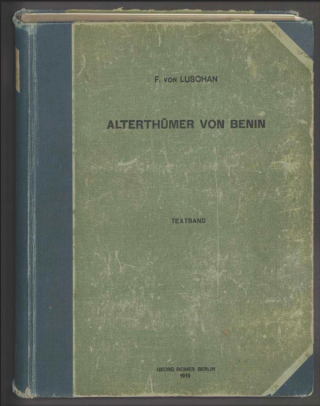
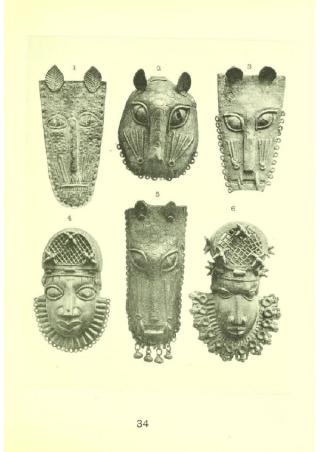
LITERATUR bibliography | vgl. Luschan, Die Altertümer von Benin, Bd.VIII S. 318, Abb. 463; S. 492 Abb. 857; S. 497 Abb. 868 (Sockelfries) (lt. Karteikarte) |
LIT_LITERATUR bibliography | |
BILDUNTERSCHRIFT images | Übernahme Altdaten|Region original: Zuordnungsgruppe => Joruba-, Edo- (Benin-) Gruppe; Gebiet => Benin; Region-Umzug => Benin|Region bei Datenübergabe: Afrika>Westafrika>Nigeria>Benin |
ALTINVENTARE | |
AUTHENTIZITAETSZUSATZ | ;; |
AUTHZUSAETZE_IDS | ;; |
Additional-IDs object id | 34 (original number) |
Dokumentname | MAf 29790 |
EREIGNISSE_IDS | 12;; |
ETHNIEN_IDS | 2796 |
ETH_AUTHZUSAETZE | |
ETH_AUTHZUSAETZE_IDS | |
ETH_EREIGNISSE | Sammelereignis |
ETH_EREIGNIS_IDS | 17 |
FERTIG | 1 |
FLAG | EXP |
FOTOFELD | Neg. Af. Obj. 4083,|Glasnegativ und Abzug in Aktenstück 1932/9 |
FUNKTION | Hersteller;Sammler;Vorbesitzer |
GEAENDERT_AM | |
GLEICHRANGIG | |
GND_ID_OBEZ | 22955 |
GND_ID_SCHLAGWORT | 81139;22165;22955;24148;93792;35730 |
GRUNDDATEN | 1 |
INTERNETFREIGABE | 1 |
INVENTURDATUM | 15.05.01;04.03.21 |
INVNR_MERKMALE_IDS | 577;581 |
KONVOLUTE_IDS | 959;1409 |
KOORDINATEN | (10 8); |
LEIHVERKEHR exhibition history | |
LIT_ABBILDUNG | |
LIT_BAND_SEITE | |
LIT_BEMERKUNG | |
LIT_LITERATUR_IDS | |
LIT_NUMMERE | |
LIT_STA_INETFREIGABE | |
MAND_ID | 1 |
MATERIALIEN_IDS | 1230 |
MERKMAL | Aktenstück;Originalnummer |
MUSEEN_ID | 34 |
ORTE_IDS | 2328926; |
ORT_AUTHZUSAETZE | ; |
ORT_AUTHZUSAETZE_IDS | ; |
ORT_BEZUG | ; |
ORT_EREIGNISSE | Sammelereignis;Herstellung |
ORT_EREIGNISSE_IDS | 17;12 |
PND_BEZUG | ;; |
PND_FUNKTIONEN_IDS | -2;642;127 |
PND_INETFREIGABE | 1;1;0 |
PND_PERSONEN_IDS | 12797488;11042285;11042285 |
PRAESENZEN_WERT_ID | -38 |
PROVSTATUS_WERT_ID | |
REGIONEN_IDS | 612 |
REG_EREIGNISSE | Sammelereignis |
REG_EREIGNIS_IDS | 17 |
SAMMLUNG | Afrika |
SAMMLUNGEN_ID | 534 |
SCHLAGWORT | Elefant;Ornament;Plastik;Relief;Stier;Tier |
TECHNIKEN_IDS | 91 |
UNTERGEORDNET | |
VORLAGEN | |
WEITERE_NUMMERN object id | 1932/9;34 |
WISSENSCHAFT | 1 |
XRAY | ### |
Sections
About
Other
Sensitive content
Sensitive Content Digital Benin includes colonial material that may contain inaccurate, derogatory or harmful language relating to African and African diasporic communities. Such language may appear in catalogue records, transcriptions, and book, exhibition or museum titles. We recognize that this material may cause distress. Sensitive-content warnings are being implemented across the collection, but this process is ongoing. The language does not reflect Digital Benin’s views; we take an anti-colonial and anti-racist position and are committed to centring the humanity of historically marginalised communities.