Loading...


OBJEKTE_ID
1707297


English designations
Categories
Institution Location
Johannispl. 5-11, 04103 Leipzig, Germany
OBJEKTE_ID
1707297
English designations
Charm
Crotal Bell
Categories
Musical Instruments
Institution Location
Johannispl. 5-11, 04103 Leipzig, Germany
Iconographies
2
annotations

Uhunmwu Ikpotoki
Portuguese Head
1 annotation


Ẹghughu
Crocodile
1 annotation

Provenance
5
events
Institution data
Staatliche Ethnographische Sammlungen Sachsen und Staatliche Kunstsammlungen Dresden
The data was transferred directly by the institution.
Last updated: 2021-09-28
Language: german
| Institution field | Value |
|---|---|
INV_NR object id | 16183 |
OBJEKTE_ID object id | 1707297 |
KURZTITEL designation | Schellenstab |
Object-name-and-materials designation material | Schellenstab Gelbguss (Kupfer) Vogel- und Krokodilmotive sowie zwei Portugiesen-Gesichter |
TITEL designation | Schellenstab;Klapper aus Bronze |
INTERNETKOMMENTAR description notes | Den Schellenstab zieren Vogel- und Krokodilmotive sowie zwei Portugiesen-Gesichter, Hinweise auf die Götter Osun und Olokun und auf deren übernatürliche Fähigkeiten. (MVD, S. D.) |
KATALOGTEXT description | |
MATERIAL material | Bronze;Kupfer |
MASSEBEMERKUNG dimensions | 29 x 4,5 x 4,5 cm|L: 29 cm |
MASSETABANGABE dimensions | gesamt |
MASSETABBEMERKUNG dimensions | |
MASSETABBREITE dimensions | |
MASSETABDURCHMESSER dimensions | 4,5 |
MASSETABEINHEITLAENGE dimensions | cm |
MASSETABEINHEITLAENGE_IDS dimensions | 1 |
MASSETABHOEHE dimensions | 29 |
MASSETABTIEFE dimensions | |
Dimensions_weight weight | H: 29 cm W: 4,5 x 4,5 cm |
MASSETABEINHEITGEWICHT weight | |
MASSETABEINHEITGEWICHT_ID weight | |
MASSETABGEWICHT weight | |
OBJEKTBEZ object type | Ritualobjekt |
KONVOLUT provenance object count | Sammlung Arthur Baessler; SES Benin-Objekte; William D. Webster, London; SES Dossier Benin-Objekte, Überlieferung an die Kontaktstelle für Sammlungsgut aus kolonialen Kontexten |
ORT_DATUM_BIS date made | 1897;1901 |
ORT_DATUM_KONKRET date made | ';' |
ORT_DATUM_VON date made | ; |
MATTECHBEMERKUNG production technique | Gelbguss (Kupfer) |
TECHNIK production technique | gegossen |
ORTE production place | Federal Republic of Nigeria;Benin City |
ORTZEITBEMERKUNG production place | Königreich Benin, vor 1897 |
Ort_Zeit-Bemerkung production place | Königreich Benin, vor 1897 |
REGIONEN production place | Benin |
Collector/Previous-owner prior source | Arthur Baessler, Berlin, purchased from William D. Webster, London, in 1901 |
ERWERBUNG prior source | Schenkung 1901 von Arthur Baessler ||| |
PERSON prior source | unbekannt;Webster, William Downing;Baessler, Arthur |
Acquisition-Details provenance | Donated by Arthur Baessler, Berlin |
EIGENTUEMER provenance | SES/Freistaat Sachsen |
PROVENIENZ provenance | William D. Webster, London (bis 1901); Arthur Baessler, Berlin (erworben 1901 von William D. Webster, bis 1901) |
PROVENIENZSTATUS provenance | SKD-Eigentum |
EREIGNISSE event | Herstellung;Provenienz;Provenienz |
ETHNIEN ethnic attribution | |
Institution department and institution | Staatliche Ethnographische Sammlungen Sachsen - Museum für Völkerkunde Dresden |
MUSEUM department and institution | MVD |
Institutional-acquisition-date accession date | 1901 |
Comments notes | Arthur Baessler, 1857-1907, German Ethnologist and Athropologist; William Downing Webster, 1868-1913, English Dealer and Collector of Ethnographica |
PRAESENZ display status | nicht ausgestellt |
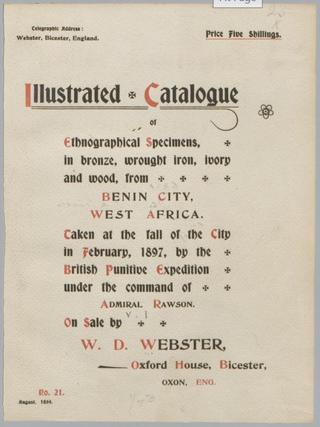
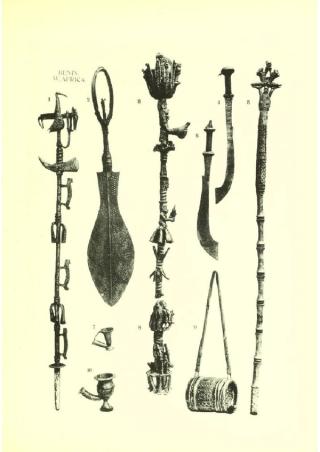
BIBLIOGRAPHIE bibliography | Silvia Dolz: Schätze aus Afrika: Benin. Die Schenkung Baessler [Ausst.Kat.]. Dresden, 2006|Wolf, Siegfried: Benin. Europäerdarstellungen der Hofkunst eines afrikanischen Reiches. Aus dem Staatlichen Museum für Völkerkunde Dresden: Leipzig, 1972|von Luschan, Felix: Die Altertümer von Benin. 3 Bd. In: Veröffentlichungen aus dem Museum für Völkerkunde, Staatliche Museen zu Berlin, Bd. VIII-X. Berlin/Leipzig, 1919|Webster, W. D.: Illustrated Catalogue of Ethnographical Specimens, in Bronze, Wrought Iron, Ivory and Wood, from Benin City, West Africa. Bd. 21 (August). Bicester, 1899 |
ERWAEHNTIN bibliography | MVD, 2006, S. 26 u. Abb. 72|Wolf, 1972, Taf. 24-25 u. S. 35|Luschan, 1919, 459 (?)|Webster, 1899, 11 (?) |
LITERATUR bibliography | |
LIT_LITERATUR bibliography | Deimel 2006 [Schätze aus Afrika, ...] |
BILDUNTERSCHRIFT images | Übernahme Altdaten|Region original: Großregion => Westafrika; Land => Nigeria; Gebiet => Benin|Ethnie original: kein Eintrag|Region bei Datenübergabe: Afrika>Westafrika>Nigeria>Benin |
ALTINVENTARE | |
AUTHENTIZITAETSZUSATZ | ;; |
AUTHZUSAETZE_IDS | ;; |
Additional-IDs object id | 6906 (original number) |
Dokumentname | 16183_1; 16183_2 |
EREIGNISSE_IDS | 12;15;15 |
ETHNIEN_IDS | |
ETH_AUTHZUSAETZE | |
ETH_AUTHZUSAETZE_IDS | |
ETH_EREIGNISSE | |
ETH_EREIGNIS_IDS | |
FERTIG | 1 |
FLAG | EXP |
FOTOFELD | Neg.Tasche Nr. 341/27 |
FUNKTION | Hersteller;Händler;Schenker |
GEAENDERT_AM | 14.06.2021 |
GLEICHRANGIG | |
GND_ID_OBEZ | 265724 |
GND_ID_SCHLAGWORT | 55676;19029;21285;22165;265724;134379 |
GRUNDDATEN | 1 |
INTERNETFREIGABE | 1 |
INVENTURDATUM | |
INVNR_MERKMALE_IDS | 581 |
KONVOLUTE_IDS | 582;959;1409;1191 |
KOORDINATEN | (10 8);(6,33504 5,62749) |
LEIHVERKEHR exhibition history | |
LIT_ABBILDUNG | 72 |
LIT_BAND_SEITE | Seite 55 |
LIT_BEMERKUNG | farbig |
LIT_LITERATUR_IDS | 821 |
LIT_NUMMERE | |
LIT_STA_INETFREIGABE | 1 |
MAND_ID | 1 |
MATERIALIEN_IDS | 1116;1120 |
MERKMAL | Originalnummer |
MUSEEN_ID | 35 |
ORTE_IDS | 2328926;2347283 |
ORT_AUTHZUSAETZE | ; |
ORT_AUTHZUSAETZE_IDS | ; |
ORT_BEZUG | ; |
ORT_EREIGNISSE | Herstellung;Erwerbung |
ORT_EREIGNISSE_IDS | 12;9 |
PND_BEZUG | ;; |
PND_FUNKTIONEN_IDS | -2;645;133 |
PND_INETFREIGABE | 1;1;0 |
PND_PERSONEN_IDS | 12797488;12821279;12106249 |
PRAESENZEN_WERT_ID | -67 |
PROVSTATUS_WERT_ID | -43 |
REGIONEN_IDS | 612 |
REG_EREIGNISSE | Erwerbung |
REG_EREIGNIS_IDS | 9 |
SAMMLUNG | Afrika |
SAMMLUNGEN_ID | 535 |
SCHLAGWORT | Gesicht <Motiv>;Kult;Musikinstrument;Ornament;Ritualobjekt;Tier <Motiv> |
TECHNIKEN_IDS | 75 |
UNTERGEORDNET | |
VORLAGEN | |
WEITERE_NUMMERN object id | 6906 |
WISSENSCHAFT | 1 |
XRAY | ### |
Sections
About
Other
Sensitive content
Sensitive Content Digital Benin includes colonial material that may contain inaccurate, derogatory or harmful language relating to African and African diasporic communities. Such language may appear in catalogue records, transcriptions, and book, exhibition or museum titles. We recognize that this material may cause distress. Sensitive-content warnings are being implemented across the collection, but this process is ongoing. The language does not reflect Digital Benin’s views; we take an anti-colonial and anti-racist position and are committed to centring the humanity of historically marginalised communities.