Loading...
Object Number
16-43-50/B1479
Edo designations
English designations
Categories
Institution Location
11 Divinity Ave, Cambridge, MA 02138, United States
Object Number
16-43-50/B1479
Edo designations
English designations
Female Figure
Categories
Figures
Institution Location
11 Divinity Ave, Cambridge, MA 02138, United States

Iconographies

6 annotations
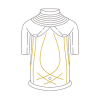
tribal marks
Iwu
Facial and Body Markings

Iwu are facial and body markings (scarifications) that were historically worn by Edo men and women. However, since the 1960s, the practice has been nearly extinct. ). In the past, Iwu were used as a way of proving that one was an Edo citizen, and the ceremony of having Iwu completed was an important rite of passage for men and women. The Osiwu, who also practised circumcision and other surgical procedures, would carry out the procedure of adding Iwu. There are different types of Iwu: ‘blades’ worn on the torso (Iwu-eko), and those worn on the face, such as Ikharo (three or four markings above the eyebrows), Irho (two narrow ‘blades’ worn on each cheek), Ovbihue (nasal ‘blades’), Ovbi-agbanmwen (chin ‘blade’), and Igho-okpa/Ukpgho (three forehead ‘blades’).

The number of Iwu also varied depending on the identity of the person wearing them. For example, royal men would wear six ‘blades’ on their torso, whilst men who were not royal would wear seven ‘blades’. Meanwhile, the Ọba’s female children would wear fifteen ‘blades’, and all other women would wear sixteen.

1 annotation
Iwu
Stacked beaded anklet
Iviawẹ
Stacked Beaded Anklet

Ọba gha ye Ivie gie ọwan, ẹ ghi tama rẹn ehe nọ gha bae yi (When the Ọba gifts you a bead, he doesn’t tell you how to wear it) (Daniel Inneh, pers. comm., 27 September 2025).

Iviawẹ (also spelled ĺvîowẹ) are coral-beaded anklets, often worn stacked together. Many of the figures depicted on the Emwin Arre (royal treasures) in brass, bronze, ivory, and wood are shown wearing these. According to Daniel Inneh (pers. comm., 27 September 2025), beads were sent to people whom the Ọba wished to honour, although there was no directive on how to wear them.

Mostly, people who wear Iviawẹ are identified as palace chiefs or priests and priestesses. However, today anyone can wear them as cultural identifiers or fashion pieces.

1 annotation
Iviawẹ
Ubanu'hi / Obanu'hi
Ubanu'hi
Inifinity Symbol

The Ubanu'hi (infinity symbol) is a kind of guilloche or interlaced strapwork motif that can be angular or rounded. It was used by Edo artists in the decoration of many Emwin Arhe (royal treasures) and is ubiquitous in Benin royal arts. Ubanu'hi is a shortened form of “uba no Ọba ya de agbon ke ehimwin yi”, which means “the rope with which the Ọba ties the heaven and earth together” (pers. comm. Chief John Igbineweka Inneh n’Igbesawman, 2022). Similarly, Paula Ben-Amos Girshick described this as “Ọba n’iri agbon”, or the “rope of the world” pattern.

According to Ọbabanmu Ineh, the use of this motif indicates that objects were carved by members of the Igbesanmwan. However, the motif is found on all types of Emwin Arhe (royal treasures), not only those made of ivory or wood. On the flanges of the Ama-Ẹrọnmwọn (relief plaques) alone, Kathryn Gunsch identified three different versions of the Ubanu'hi and, through her analysis of over 850 plaques, found that these different Ubanu'hi forms align with other characteristics, such as dimensions, the prevalence of ornamental motifs, and stylistic qualities. Together, these provide evidence, she argues, of different production groups among the plaque makers.

Kate Ezra went on to argue that the use of these motifs indicates that certain objects were used in a “royal context” and were associated with “royal patronage”.

Ubanu’hi can also be spelt Obanu'hi, indicating different intonations in the pronunciation of the words.

1 annotation
Ubanu'hi
Colar Bead
Odigba
Coral beaded collar

Odigba (beaded collar) is a rigid neck collar made of beads, worn as part of ceremonial attire only by senior princes who have been made Enigie. Although Ibafe (2007, p. 43) argued that the Odigba was introduced during the Ogiso period (c. 900–c. 1170 AD) by Ogiso Ere, along with other symbolically important Emwin Arre, such as the Ada (ceremonial sword) and the Ebẹn (ceremonial sword). The Odigba was initially made of beads, while coral was incorporated only later, following its introduction through trade with Portuguese merchants in the late fifteenth century.

1 annotation
Odigba
Waist beads
Àkpólú
Waist beads

Àkpólú, also spelt Àkpólo, are strings of coral beads worn around the lower waist or hips by women and girls. Before colonial rule in the Benin Kingdom, children were traditionally not permitted to wear clothing until the Ọba gave them cloth to wear; the Àkpólú was an exception to this practice, allowing children to wear these coral bead strands around the waist.

1 annotation
Àkpólú
Manilla
Ugianranran
Manilla

Ugianranran (manillas) are highly important objects in the visual language of the Emwin Arre (royal treasures). Although Ugianranran were made in a variety of sizes, forms, and weights, they share the characteristics of being made from copper or copper alloys, namely brass or bronze, and having a curved, ring- or horseshoe-shaped form.

In the early years of trade between the Portuguese and Edo, during the late 15th and early 16th centuries, manillas were made primarily of copper. During the early 16th century, Edo traders increasingly sought manillas made of brass. This changing preference is believed to have corresponded with the growing demand for brass among artists of the Igun-Ẹrọnmwọn. During the 17th and early 18th centuries, the Dutch also traded manillas with the Edo, although to a lesser extent than the Portuguese. Recent scientific analysis has shown similarities between the composition of metals in manillas from the southern Rhineland region of Germany and the copper alloys used in some Emwin Arhe, supporting earlier scholarship suggesting that manillas were used by casters to produce Emwin Arhe.Skowronek et al. 2023

When depicted on objects, Ugianranran are often shown alongside or being held by figures identified as Portuguese. In one case, figures identified as Benin traders or royal emissaries are shown holding manillas in their hands.( This is particularly the case on the Ama-Ẹrọnmwọn (bronze relief plaques), which are believed to have been commissioned by Ọba Esigie. Esigie is understood to have encouraged the production of artworks, made possible in part by the increased supply of manillas and other copper-alloy objects resulting from trade. Ugianranran are therefore associated with overseas trade, wealth, and Olokun, the deity of the seas. In addition to being held by figures or appearing alongside them on artworks, Ugianranran sometimes serve as focal decorative motifs, further indicating their symbolic and economic potency.

1 annotation
Ugianranran

Provenance

5 events
Production
unknown to February 22, 1897 (day approximate)
Production of Okhuo and Iy’Ọba figures by the Igbesamwan guild in Benin City
Loot
February 19, 1897 (day approximate) to June 1899 (month approximate)
Looting of the Emwin Arre - Inalienable Cultural Artefacts - during the Invasion of the Benin Kingdom in February 1897 and until the end of overt military activity in June 1899
Unknown
1902 (approximate) to 1916
The object is known to have come into contact with William Ockelford Oldman.
Purchase
1902 (approximate) to 1916
The object was purchased by Oric Bates from William Ockelford Oldman.
Gift
1916
The object was given as a gift by Oric Bates to the Peabody Museum of Archaeology and Ethnology at Harvard University.

Institution data

Peabody Museum of Archaeology and Ethnology at Harvard University
The data was transferred directly by the institution.
Last updated: 2021-09-10
Language: english
Institution fieldValue
Object Number
object id
16-43-50/B1479
Display Title
designation
Ivory female figurine with manillas
Inventory Description
description
object type
Statue, carved ivory, standing female, incised body designs, beads and hair
Object Description
description
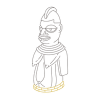
Ivory figurine of scarified, elaborately coiffed female wearing beads at neck, arms, ankles, and hips.
Materials
material
Elephant ivory
Dimensions
dimensions
Overall: 38 x 10.5 x 9 cm (14 15/16 x 4 1/8 x 3 9/16 in.)
Classication
object type
Statue
Quantity
object count
1
Date
date made
16th century - 18th century
GeoLocale
production place
West Africa
Geography/Provenience
production place
Africa\Nigeria
Credit Line
prior source
Gift of Oric Bates, 1916
Provenance: Collector
prior source
provenance
Collector: British Punitive Force; Dealer: William O. Oldman
Provenance: Acquisition
provenance
Donor: Mr. Oric Bates
Culture/Period
ethnic attribution
Benin
Department
department and institution
Ethnographic
Image Credit Line Reproduction
license
Gift of Oric Bates, 1916. Image © President and Fellows of Harvard College, Peabody Museum of Archaeology and Ethnology, 16-43-50/B1479
URL
weblink
https://collections.peabody.harvard.edu/objects/114218
Digital File Number
60740386
Sensitive content

Sensitive Content Digital Benin includes colonial material that may contain inaccurate, derogatory or harmful language relating to African and African diasporic communities. Such language may appear in catalogue records, transcriptions, and book, exhibition or museum titles. We recognize that this material may cause distress. Sensitive-content warnings are being implemented across the collection, but this process is ongoing. The language does not reflect Digital Benin’s views; we take an anti-colonial and anti-racist position and are committed to centring the humanity of historically marginalised communities.

Read more about our approach