Loading...
Inventory no. [ObjInventarNrS]
13804
Institution
Weltkulturen Museum Frankfurt am Main Edo designations

English designations
Categories
Institution Location
Schaumainkai 29-37, 60594 Frankfurt am Main, Germany
Inventory no. [ObjInventarNrS]
13804
Institution
Weltkulturen Museum Frankfurt am Main Edo designations
English designations
Fan
Categories
Ceremonial Objects
Institution Location
Schaumainkai 29-37, 60594 Frankfurt am Main, Germany
Provenance
4
events
Institution data
Weltkulturen Museum Frankfurt am Main
The data was transferred directly by the institution.
Last updated: 2021-04-20
Language: english
| Institution field | Value |
|---|---|
Inventory no. [ObjInventarNrS] object id | 13804 |
Object designation [ObjTitelOriginalS] designation object type | Fan |
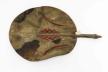
Description [ObjReserve02M] description | 13804. Oblong fur disc ,applied ornaments of red cotton fabric. Hair trim spotted. Sewn to wooden handle, which is stitched with leather. "... leatherworkers, who used to have their own ward. The fans ... are of cowskin or buckskin, decorated with shapes of red cloth, which is now bought in Lagos. The thread with which the cloth shapes are stitched to the fan is antelope skin. A hole is made with a spike before the stitching with the needle is done. the leatherworker uses scissors, which, he says, he has always had and, therefore, may have had them since the time of the first Portuguese contacts with Benin. The wooden handle, which is covered with skin, the craftsman fashions himself with an adze. (Dark 22). LIT Dark 1962: The Art of Benin. Chicago |
Mat./Technique [ObjTechMatM] material | Skin. Fabric. Wood |
Dimensions [ObjMasse1S] dimensions | D 41- 52; L 70, total |
Dating [ObjDatierungS] date made | |
Year from [ObjJahrVonL] date made | |
Year until [ObjJahrBisL] date made | |
Geographical reference [ObjGeografieS] production place | Kingdom of Benin (Africa->West Africa->Nigeria) |
Name sorting [KueSortierungS_0] prior source | Oldman, William Ockelford |
Name sorting [KueSortierungS_1] prior source | |
First Name 2 [KueVorNameS_1] provenance | |
First name [KueVorNameS_0] provenance | William Ockelford |
Function collector 2 [OkuFunktionS_1] provenance | |
Function collector [OkuFunktionS_0] provenance | Merchant |
Inventory note [ObjFeld07M] provenance | 03 |
Last Name 2 [KueNameS_1] provenance | |
Last name [KueNameS_0] provenance | Oldman |
Date of acquisition[ObjFeld04M] accession date | ca. 1910 |
Acquisition type [ObjFeld02M] accession method | |
Comemnts[ObjCreditlineM] notes | |
Exhibition exhibition history | |
Literature bibliography | |
Type [ObjSystematikS] object type | Household goods |
Type of ownership [ObjFeld01M] accession method | |
Type of person 2 [KueTypS_1] | |
Type of person [KueTypS_0] | Person |
Weltkulturen Museum Frankfurt am Main
The data was transferred directly by the institution.
Last updated: 2021-04-20
Language: german
| Institution field | Value |
|---|---|
Inventarnr. [ObjInventarNrS] object id | 13804 |
Beschreibung [ObjReserve02M] description | 13804. Oblonge Fellscheibe ,aufgelegte Ornamente aus rotem Baumwollstoff. Haarbesatz gefleckt. Angenäht an Holzgriff, dieser mit Leder umnäht. "... leatherworkers, who used to have their own ward. The fans ... are of cowskin or buckskin, decorated with shapes of red cloth, which is now bought in Lagos. The thread with which the cloth shapes are stitched to the fan is antelope skin. A hole is made with a spike before the stitching with the needle is done. the leatherworker uses scissors, which, he says, he has always had and, therefore, may have had them since the time of the first Portuguese contacts with Benin. The wooden handle, which is covered with skin, the craftsman fashions himself with an adze. (Dark 22). LIT Dark 1962: The Art of Benin. Chicago |
Mat./Technik [ObjTechMatM] material production technique | Haut. Stoff. Holz |
Maßangaben [ObjMasse1S] dimensions | D 41- 52; L 70, ges |
Gattung [ObjSystematikS] object type | Hausrat |
Objektbezeichnung [ObjTitelOriginalS] object type | Fächer |
Datierung [ObjDatierungS] date made | |
Jahr bis [ObjJahrBisL] date made | |
Jahr von [ObjJahrVonL] date made | |
Geogr. Bezug [ObjGeografieS] production place | Königtum Benin (Afrika->Westafrika->Nigeria) |
Nachname 2 [KueNameS_1] prior source | |
Nachname [KueNameS_0] prior source | Oldman |
Namensortierung [KueSortierungS_0] prior source | Oldman, William Ockelford |
Namenssortierung [KueSortierungS_1] prior source | |
Vorname 2 [KueVorNameS_1] prior source | |
Vorname [KueVorNameS_0] prior source | William Ockelford |
Funktion Sammler 2 [OkuFunktionS_1] prior source role | |
Funktion Sammler [OkuFunktionS_0] prior source role | Händler |
Erwerbsdatum [ObjFeld04M] accession date | ca. 1910 |
Besitzart [ObjFeld01M] accession method | |
Erwerbungsart [ObjFeld02M] accession method | |
Bemerkungen [ObjCreditlineM] notes | |
Inventar Notiz [ObjFeld07M] notes | 03 |
Ausstellung exhibition history | |
Literatur bibliography | |
Personentyp 2 [KueTypS_1] | |
Personentyp [KueTypS_0] | Person |
Sections
About
Other
Sensitive content
Sensitive Content Digital Benin includes colonial material that may contain inaccurate, derogatory or harmful language relating to African and African diasporic communities. Such language may appear in catalogue records, transcriptions, and book, exhibition or museum titles. We recognize that this material may cause distress. Sensitive-content warnings are being implemented across the collection, but this process is ongoing. The language does not reflect Digital Benin’s views; we take an anti-colonial and anti-racist position and are committed to centring the humanity of historically marginalised communities.