Loading...
Inventarnummer
005382
Edo designations
English designations
Categories
Institution Location
1 Adesogbe (Plymouth) Road, P.M.B. 1115, Benin City , Edo State
Inventarnummer
005382
Edo designations
English designations
Relief Plaque
Fragment
Categories
Palace Architecture & Ornamentation
Institution Location
1 Adesogbe (Plymouth) Road, P.M.B. 1115, Benin City , Edo State

Iconographies

5 annotations

Colar Bead
Odigba
Coral beaded collar

Odigba (beaded collar) is a rigid neck collar made of beads, worn as part of ceremonial attire only by senior princes who have been made Enigie. Although Ibafe (2007, p. 43) argued that the Odigba was introduced during the Ogiso period (c. 900–c. 1170 AD) by Ogiso Ere, along with other symbolically important Emwin Arre, such as the Ada (ceremonial sword) and the Ebẹn (ceremonial sword). The Odigba was initially made of beads, while coral was incorporated only later, following its introduction through trade with Portuguese merchants in the late fifteenth century.

1 annotation
Odigba
Forehead markings
Ikharo
Forehead markings

Ikharo are linear keloid markings depicted on the forehead of Uhunmwu-Elao (commemorative heads) in groups of three or four above each eye. The exact meaning of Ikharo is debated; some have argued that they relate to the gender or tribal identification of the person on whom they are depicted. For example, Gabriel Ọbazee has argued that they were worn only by men; however, their use in depictions is not consistent with this, and the Iy’Ọba are also shown wearing them. Flora Kaplan argued that they are instead a stylistic feature employed by artists that varied over time.

The naming of these markings differs between publications. For example, Ekhaguosa Aisien and Joseph Nevadomsky describe these markings as “agbaguda n'ehae”, which they write translates literally as “blades of the forehead”. However, Aisien later went on to call these “ikharo”, as used here. Kate Ezra referred to these forehead markings as ikharo, meaning “tribal mark [of eye]”.

1 annotation
Ikharo
Mirror
Ughegbe
Mirror

“One does not look at a mirror with bad eyes; if you are angry or hostile, you do not want to look into the mirror”.

Ughegbe (mirrors) were not only utilitarian objects in the Benin Kingdom but also spiritually and symbolically potent. Their reflective surfaces were understood as a means of seeing spirits and deities. Okunoghae in Bradbury 1960, 4 Mirrors are also associated with Olokun, their reflective surfaces being compared to the smooth, shimmering surface of the water in Olokun’s realm. They are associated with beauty and peace and are understood to have a protective function, allowing users to see danger before it arrives and to “scatter evil away”. When depicted on Emwin Arhe (royal treasures), such as brass Urhotọ, Ughegbe are often held up by attendants around figures such as the Iy’Ọba, seemingly serving as a form of protection.

Ughegbe were among the trade goods brought to the Benin Kingdom by European merchants and were therefore also valuable prestige objects. They were usually placed inside carved wooden frames with sliding covers that protected the mirror when not in use. Barbara Blackmun suggests that, given the spiritual nature of mirrors, these covers served more than a practical protective function: they also closed “the cosmic window,” thereby shielding the owner from beings that might otherwise emerge undetected from the reflection.

1 annotation
Ughegbe
Water fern
Ebe Amẹ
Water Fern

Ebe Amẹ refers to a wide variety of plants, particularly the leaves of the water fern or river leaf, found in riverine areas of southern Nigeria. Artists from the Igun-Ẹrọnmwọn used these as a decorative motif in the background of most Ama-Ẹrọnmwọn (bronze relief plaques). The petals of the Ebe Amẹ, like the points of the ἀghàdàgháda (crossroads), represent the four cardinal directions: north, east, south, and west. The number four plays a foundational role in the Edo calendar, which is structured around four market days.

1 annotation
Ebe Amẹ
Headwear
Ẹrhu
Headwear

Many different kinds of Ẹrhu (headwear) are worn by the various figures depicted in the imagery of Benin royal artefacts. Through comparisons with ceremonial regalia still worn by chiefs and members of the royal court, including the Ọba himself, some Ẹrhu have been used to identify the different figures depicted. For example, the conical hat worn by high-ranking town chiefs as part of the pangolin regalia, still worn at ceremonies, is also visible on figures on some Ama-Ẹrọnmwọn (bronze relief plaques). Other examples include the distinctive bell-shaped helmet associated with the Iyasẹ. Figures who wear a shallow-brimmed hat and a cross have been identified as Ewua or Ohensa priests.

Different kinds of helmets and headwear were worn by warriors, reflecting the many different ranks and roles in the army at any given time, as well as developing trends that were in turn represented on Emwin Arhe created at different points in time. Warrior figures wearing helmets covered in cowrie shells were carved on the Aken'ni Elao (carved tusks) (Blackmun 1984, p. 330), yet on the brass Ama, warriors are sometimes depicted wearing helmets made from crocodile hide or horsehair with a front plate (Osadolor in Plankensteiner 2007, cat. no. 238, p. 457). Helmets made from horsehair with a front plate are one of the more common types represented on the Ama-Ẹrọnmwọn, and the demand for black horse tails was noted by both Portuguese and British traders during the late 17th and 18th centuries (Osadolor in Plankensteiner 2007, cat. no. 238, p. 457). Other warriors depicted on Ama-Ẹrọnmwọn wear helmets with a rounded top, chinstrap, and sometimes also a feather tucked into the left side. These types of headwear are known as Ẹrhu Iyokuo.

Attire worn for battle also differed from that worn for ceremonial occasions, such as the pointed headwear worn in combination with an ornate leopard-head tunic by war chiefs. Depictions of figures wearing this attire on brass Ama-Ẹrọnmwọn (bronze relief plaques) have been interpreted as representing the war chiefs’ participation in the war-ritual Isiokuo festival (Osadolor in Plankensteiner 2007, cat. no. 238, p. 457).

Another distinctive form of headwear is that worn by figures identified as leopard hunters on the brass Ama-Ẹrọnmwọn (relief plaques). These large helmets cover almost all of the leopard hunters’ faces except for their noses, eyes, and upper lips, and are made of an unusual material that remains unidentifiable (Plankensteiner 2007, cat. nos. 68–69, p. 322).

European figures are also portrayed with distinctive hats, such as Portuguese three-cornered hats. These depictions reflect the artists’ keen observation and highlight the impact of European trade and military assistance (Ezra 1992).

1 annotation
Ẹrhu

Provenance

7 events
Production
1504 (approximate) to 1550 (approximate)
Production of the Ama-Ẹrọnmwọn by the Igun-Ẹrọnmwọn guild in Benin City
Loot
February 19, 1897 (day approximate) to June 1899 (month approximate)
Looting of the Emwin Arre - Inalienable Cultural Artefacts - during the Invasion of the Benin Kingdom in February 1897 and until the end of overt military activity in June 1899
Unknown
January 1898 to July 1898
Acquisition of Benin objects by F. Erdmann in Benin City in 1898
Transfer
July 1898 (year approximate)
Transfer of Benin objects acquired by F. Erdmann from Benin City to Hamburg, 1898
Unknown
October 1898
Objects offered for sale (and rejected) by Bey & Co. to the Berlin Museum für Völkerkunde, 1898
Purchase
1899
Purchase of Benin objects from Bey & Co. by the Stuttgart Linden-Museum, 1899
Restitution
December 14, 2022
Transfer of Ownership of 70 Emwin Arre from the Linden-Museum Stuttgart to Omo n'Oba n'Edo Uku Akpolokpolo, Ọba of Benin, and the National Commission for Museums and Monuments, Nigeria, 14 December 2022

Related archival documents

1 documents
See all
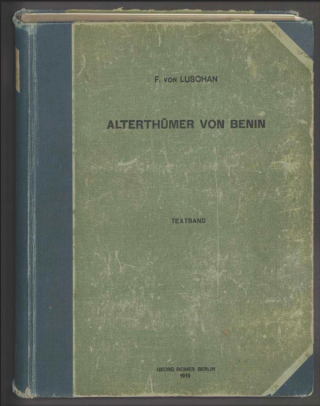
Museum Catalogue
Staatsbibliothek zu Berlin
Die Altertümer von Benin
Date
January 1, 1919 at 12:00:00 AM

Institution data

Linden-Museum Stuttgart, Staatliches Museum für Völkerkunde
The data was transferred directly by the institution.
Last updated: 2021-07-01
Languages: german, english
Institution fieldValue
Inventarnummer
object id
005382
Objektbeschreibung
description
Reliefplatte mit der Darstellung eines Mannes mit adeliger Perlen-Halskrause, Helm und einem rechteckigen Gegenstand in der Hand. Das relativ flache Relief deutet auf eine frühe Entstehung bald nach 1550. Die professionellen Metallgießer waren in einem Zunft-ähnlichen Bund organisiert, in dem Jungen ab dem Alter von 7 Jahren als Lehrlinge aufgenommen wurden. Ihre Väter mußten eine Gebühr entrichten und dem Metallgott Ogun ein Opfer darbringen. Text: Dietmar Neitzke.
Objektbeschreibung englisch
description
Relief plate depicting a man with a noble pearl ruff, helmet and a rectangular object in his hand. The relatively flat relief indicates an early origin soon after 1550. The professional metal casters were organized in a guild-like association in which boys from the age of 7 were accepted as apprentices. Their fathers had to pay a fee and make an offering to the metal god Ogun. Text: Dietmar Neitzke.
Material
material
Kupferlegierung
Material (Englischer Name)
material
Copper alloy
Technik
production technique
Wachsausschmelzverfahren
Technik (Englischer Name)
production technique
Lost wax process
Geographische Herkunft
production place
Königreich Benin
Geographische Herkunft (Englischer Name)
production place
Benin Kingdom
politische Herkunft
production place
Nigeria
Sammlung
prior source
Knorr, Karl, Heilbronn (303)
Objektgeschichte
provenance
Im Oktober 1898 bot die Hamburger Firma „H. Bey & Co“ dem Berliner Völkerkundemuseum eine Benin-Sammlung an, die direkt aus Afrika geschickt wurde. Die komplette Sammlung konnte aber auf Grund mangelnder Mittel nicht komplett gekauft werden und sollte daher auch an andere Interessenten weitervermittelt werden. Felix von Luschan vom Berliner Museum informierte daher im November 1898 Karl Graf von Linden, und bot ihm ein Vorkaufsrecht an. Das Linden-Museum stellte daraufhin 15.000 M für den Ankauf von Objekten zur Verfügung. Den Kaufpreis übernahm der Heilbronner Unternehmer Karl Knorr, weswegen die Sammlung auch als „Die Karl Knorr’sche Sammlung von Benin-Altertümern“ bekannt wurde. Von Luschan veröffentliche unter gleichem Titel (1901) eine ausführliche Beschreibung der Sammlung im Auftrag von Graf Linden und Knorr. Zu den weiteren Käufern der Sammlung gehörten unter anderem die Museen in Wien, München aber auch Personen wie Hans Meyer (Leipzig) und Eugen Rautenstrauch (Köln). Text: Markus Himmelsbach.
Objektgeschichte englisch
provenance
In October 1898, the Hamburg company "H. Bey & Co" offered the Berlin Ethnological Museum a Benin collection that came directly from Africa. However, due to a lack of funds, the entire collection could not be purchased and was therefore to be passed on to other interested parties. Felix von Luschan of the Berlin Museum therefore informed Karl Graf von Linden in November 1898, and offered him a right of first refusal. The Linden Museum then made 15,000 M available for the purchase of objects. The purchase price was paid by the Heilbronn entrepreneur Karl Knorr, which is why the collection became known as "Die Karl Knorr'sche Sammlung von Benin-Altertümern". Von Luschan published a detailed description of the collection under the same title (1901) on behalf of Count Linden and Knorr. Other buyers of the collection included the museums in Vienna and Munich, but also people such as Hans Meyer (Leipzig) and Eugen Rautenstrauch (Cologne). Text: Markus Himmelsbach.
Ethnie
ethnic attribution
Edo <E>
Eingangsdatum (Text)
accession date
1899
Objektbezeichnung Thesaurus
object type
Figurenrelief
Sensitive content

Sensitive Content Digital Benin includes colonial material that may contain inaccurate, derogatory or harmful language relating to African and African diasporic communities. Such language may appear in catalogue records, transcriptions, and book, exhibition or museum titles. We recognize that this material may cause distress. Sensitive-content warnings are being implemented across the collection, but this process is ongoing. The language does not reflect Digital Benin’s views; we take an anti-colonial and anti-racist position and are committed to centring the humanity of historically marginalised communities.

Read more about our approach