Loading...


Inventarnummer
005374
Institution
Omo n'Oba n'Edo Uku Akpolokpolo, Ọba of Benin & National Commission for Museums and Monuments, Nigeria Restituted
Previously owned by Linden-Museum Stuttgart, Staatliches Museum für Völkerkunde
Edo designations

English designations
Categories
Institution Location
1 Adesogbe (Plymouth) Road, P.M.B. 1115, Benin City , Edo State
Inventarnummer
005374
Institution
Omo n'Oba n'Edo Uku Akpolokpolo, Ọba of Benin & National Commission for Museums and Monuments, Nigeria Restituted
Previously owned by Linden-Museum Stuttgart, Staatliches Museum für Völkerkunde
Edo designations
English designations
Chest
Categories
Containers
Institution Location
1 Adesogbe (Plymouth) Road, P.M.B. 1115, Benin City , Edo State
Provenance
7
events
Institution data
Linden-Museum Stuttgart, Staatliches Museum für Völkerkunde
The data was transferred directly by the institution.
Last updated: 2021-07-01
Languages: german, english
| Institution field | Value |
|---|---|
Inventarnummer object id | 005374 |
Objektbeschreibung description | Dieses Zierornament aus Gelbguß war möglicherweise an der Außenmauer des Königspalastes befestigt. Die "Mauern von Benin" trennten nicht nur den Palast von den Wohnvierteln der Hauptstadt, sondern erstreckten sich davon ausgehend als ein Netz von Erdwällen mit einer Länge von insgesamt ca. 16.000 km durchs Reich. Text: Dietmar Neitzke. |
Objektbeschreibung englisch description | This ornamental ornament of yellow cast iron was possibly attached to the outer wall of the royal palace. The "Walls of Benin" not only separated the palace from the residential quarters of the capital, but extended from it as a network of earthen ramparts with a total length of about 16,000 km through the empire. Text: Dietmar Neitzke. |
Material material | Kupferlegierung |
Material (Englischer Name) material | Copper alloy |
Technik production technique | Wachsausschmelzverfahren |
Technik (Englischer Name) production technique | Lost wax process |
Geographische Herkunft production place | Königreich Benin |
Geographische Herkunft (Englischer Name) production place | Benin Kingdom |
politische Herkunft production place | Nigeria |
Sammlung prior source | Knorr, Karl, Heilbronn (303) |
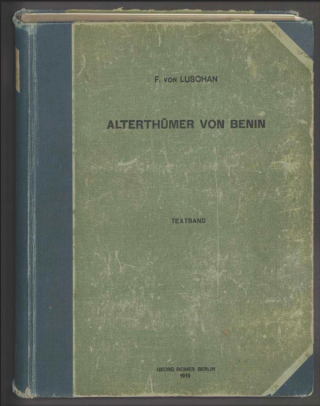
Objektgeschichte provenance | Im Oktober 1898 bot die Hamburger Firma „H. Bey & Co“ dem Berliner Völkerkundemuseum eine Benin-Sammlung an, die direkt aus Afrika geschickt wurde. Die komplette Sammlung konnte aber auf Grund mangelnder Mittel nicht komplett gekauft werden und sollte daher auch an andere Interessenten weitervermittelt werden. Felix von Luschan vom Berliner Museum informierte daher im November 1898 Karl Graf von Linden, und bot ihm ein Vorkaufsrecht an. Das Linden-Museum stellte daraufhin 15.000 M für den Ankauf von Objekten zur Verfügung. Den Kaufpreis übernahm der Heilbronner Unternehmer Karl Knorr, weswegen die Sammlung auch als „Die Karl Knorr’sche Sammlung von Benin-Altertümern“ bekannt wurde. Von Luschan veröffentliche unter gleichem Titel (1901) eine ausführliche Beschreibung der Sammlung im Auftrag von Graf Linden und Knorr. Zu den weiteren Käufern der Sammlung gehörten unter anderem die Museen in Wien, München aber auch Personen wie Hans Meyer (Leipzig) und Eugen Rautenstrauch (Köln). Text: Markus Himmelsbach. |
Objektgeschichte englisch provenance | In October 1898, the Hamburg company "H. Bey & Co" offered the Berlin Ethnological Museum a Benin collection that came directly from Africa. However, due to a lack of funds, the entire collection could not be purchased and was therefore to be passed on to other interested parties. Felix von Luschan of the Berlin Museum therefore informed Karl Graf von Linden in November 1898, and offered him a right of first refusal. The Linden Museum then made 15,000 M available for the purchase of objects. The purchase price was paid by the Heilbronn entrepreneur Karl Knorr, which is why the collection became known as "Die Karl Knorr'sche Sammlung von Benin-Altertümern". Von Luschan published a detailed description of the collection under the same title (1901) on behalf of Count Linden and Knorr. Other buyers of the collection included the museums in Vienna and Munich, but also people such as Hans Meyer (Leipzig) and Eugen Rautenstrauch (Cologne). Text: Markus Himmelsbach. |
Ethnie ethnic attribution | Edo <E> |
Eingangsdatum (Text) accession date | 1899 |
Objektbezeichnung Thesaurus object type | Bauornament |
Sections
About
Other
Sensitive content
Sensitive Content Digital Benin includes colonial material that may contain inaccurate, derogatory or harmful language relating to African and African diasporic communities. Such language may appear in catalogue records, transcriptions, and book, exhibition or museum titles. We recognize that this material may cause distress. Sensitive-content warnings are being implemented across the collection, but this process is ongoing. The language does not reflect Digital Benin’s views; we take an anti-colonial and anti-racist position and are committed to centring the humanity of historically marginalised communities.