About About
Digital Benin was developed between 2020 and 2026 through an international and interdisciplinary collaboration, bringing together researchers, developers, designers and Edo scholars and knowledge holders across Nigeria, Europe, the US and beyond. Hosted by MARKK and supported by the Ernst von Siemens Kunststiftung, Gerda Henkel Foundation and Mellon Foundation, the project connected diverse forms of knowledge and perspectives to shape research, documentation, data, design and technical infrastructure, deepening understanding of histories and continuing cultural lives of Benin heritage.
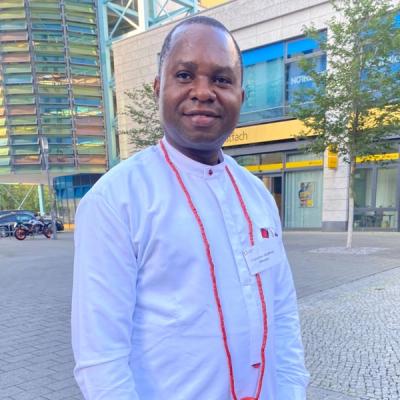
Osaisonor Godfrey Ekhator-Obogie gathers, documents and evaluates pertinent collection information in Nigerian museums and designs and executes research relating to the historical works of art in Benin City and the Edo-speaking region. He records oral traditions and local knowledge in his essential role in the project. He sets up research methodologies which include the determined and informed establishment of partnerships with stakeholders in Nigeria. His field research includes the respectful inclusion of contributions from his long-standing relationships in Benin City in his role as researcher that he brings to the project. The contributions of oral histories and traditions are accompanied by repeated introductions of the project and digital context as well as hours spent in the field with participants to conduct research, consultations and conversations prior to the video and audio documentation. He advises the research of the platform at large under the guidance of Prof. Kokunre Agbontaen at the University of Benin and the project catalyst Anne Luther. He also coordinates and supervises the research and work of project researcher Eiloghosa Obobaifo and assistant researcher Mabel Osaruemwinnomwan Oviahon. He contributes a bibliography of Edo scholars and authors from his time as a research fellow at the Institute for Benin Studies – presently he is secretary to the executive council of the institute – and established the platform’s research spaces ‘Itan Edo’ and ‘Oral History’.
Osaisonor Godfrey Ekhator-Obogie is a Research Fellow at the Institute for Benin Studies, presently the Secretary to the Executive Council of the Institute. He is a Fellow of the French Institute for Research in Africa, Nigeria (IFRA-NIGERIA) and a member of Lagos Studies Association (LSA). He serves as tour guide for visitors to the historical/heritage sites of the Ancient Benin Kingdom and has developed a flair for the promotion of the history, cultural tradition and language of Benin/Edo speaking people. His on-going PhD research is focused on the cultural history of Benin people/kingdom. His research interests are Ethnicity and Nationalism, Migration and Citizenship, Cultural History in general and Benin Studies in particular. Ekhator-Obogie graduated from Adeyemi College of Education, Ondo with a Bachelor's Degree in Arts and Education (History). He holds an M.A. in History from the Ibadan School of History in Nigeria’s premier University of Ibadan. He has also attended and read papers at academic conferences and workshops.
2017. “Akobie: An Aspect of Childhood Ritual, Indigenous Education and Socialisation in Benin Kingdom,” Umewaen: Journal of Benin and Edoid Studies 2 (1).
2018. “Usukporhu: Defending the Oba and His Harem,” The Benin Monarchy: An Anthology of Benin History.
2018. “Oba Eweka II (1914-1933): The Resilience of the Monarchy,” The Benin Monarchy: An Anthology of Benin History, co-authored.
2020. “Ame-Ogba: The Introduction and Provision of Pipe-Borne Water in Benin City, 1897-1947,” Benin Studies under the Scalpel.
Sensitive Content Digital Benin includes colonial material that may contain inaccurate, derogatory or harmful language relating to African and African diasporic communities. Such language may appear in catalogue records, transcriptions, and book, exhibition or museum titles. We recognize that this material may cause distress. Sensitive-content warnings are being implemented across the collection, but this process is ongoing. The language does not reflect Digital Benin’s views; we take an anti-colonial and anti-racist position and are committed to centring the humanity of historically marginalised communities.