About About
Digital Benin was developed between 2020 and 2026 through an international and interdisciplinary collaboration, bringing together researchers, developers, designers and Edo scholars and knowledge holders across Nigeria, Europe, the US and beyond. Hosted by MARKK and supported by the Ernst von Siemens Kunststiftung, Gerda Henkel Foundation and Mellon Foundation, the project connected diverse forms of knowledge and perspectives to shape research, documentation, data, design and technical infrastructure, deepening understanding of histories and continuing cultural lives of Benin heritage.
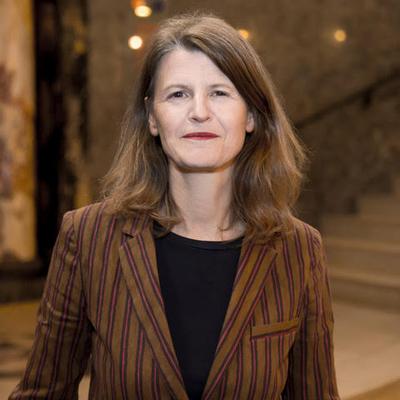
Prof. Dr. Barbara Plankensteiner, director of the MARKK, oversees the project and provides guidance for institutional contacts and introductions to the various institutions holding Benin collections. She shares her personal and professional archive and knowledge of Benin collections worldwide. Together with Jonathan Fine she introduced the project to the Benin Dialogue Group and relevant museum colleagues and scholars specialising in Benin art and history. With her long-term experience with collections and connoisseurship, she guides and oversees the inclusion of works to ensure that recent market copies were not included.
Barbara Plankensteiner is director of the Museum am Rothenbaum–World Cultures and Arts (MARKK) since 2017. Under her leadership, the museum initiated a repositioning and decolonization process that also lead to a change of name. From 2015 she was Frances and Benjamin Benenson Foundation Senior Curator of African Art at the Yale University Art Gallery, New Haven, Connecticut. Before, at the Weltmuseum Wien, she served as deputy director, chief curator and curator of the Africa collections where she had a decisive impact in the repositioning of the museum and the conceptualization of the new permanent collection. Her most well-known international exhibitions are Benin—Kings and Rituals: Court Arts from Nigeria where she was lead curator and editor of the accompanying handbook, and African Lace: A History of Trade, Creativity and Fashion in Nigeria that she co-curated and for which she co-edited the accompanying catalogue. Her research and publications focus on African art and material culture, history of ethnographic collections, and museum anthropology.
Barbara Plankensteiner is a co-founder of the Benin Dialogue Group and with Prince Gregory Akenzua the co-chair of its steering committee. One of its outcomes is the Digital Benin project.
Books
2007 (ed). Benin Kings and Rituals: Court Arts from Nigeria. Wien, Gent: Snoeck.
2010. Benin. Visions of Africa Series. Milan: 5 Continents Editions.
2018 (ed). The Art of Being a World Culture Museum: Futures and Lifeways of Ethnographic Museums in Contemporary Europe. Bielefeld: Kerber Verlag.
Articles
2007. “Introduction,” in Benin Kings and Rituals: Court Arts from Nigeria. Wien, Gent: Snoeck, pp. 21-39.
2007. “The ‘Benin Affair’ and its Consequences,” in Benin Kings and Rituals: Court Arts from Nigeria. Wien, Gent: Snoeck, pp. 199-211.
2008. “The Contemporary Production of ‘Antique’ Benin Bronzes in Benin City and Cameroon,” in Original – Copy – Fake? Examining the Authenticity of Ancient Works of Art – Focusing on African and Asian Bronzes and Terracottas,edited by Stiftung Situation Kunst Bochum. Mainz: Philipp von Zabern, pp. 178-190.
2009. The Making of … Genese und Rezeption einer Benin-Ausstellung. In Das Unbehagen im Museum. Postkoloniale Museologien herausgegeben von Schnittpunkt (Belinda Kazeem Charlotte Martinz-Turek und Nora Sternfeld), pp. 193–216. Wien: Turia + Kant.
2016. “The Benin Treasures: Difficult Legacy and Contested Heritage,” in Cultural Property and Contested Ownership: The Trafficking of Artefacts and the Quest for Restitution, edited by Brigitta Hauser-Schäublin and Lyndel Prott. Routledge, pp. 133-155.
2018. “Die ‚merkwürdigen’ Bronzen aus Benin im Hamburger Museum für Kunst und Gewerbe,”in Raubkunst?: Die Bronzen aus Benin. Herausgegeben von Sabine Schulze und Silke Reuther, Museum für Kunst und Gewerbe Hamburg, pp. 10-17.
Sensitive Content Digital Benin includes colonial material that may contain inaccurate, derogatory or harmful language relating to African and African diasporic communities. Such language may appear in catalogue records, transcriptions, and book, exhibition or museum titles. We recognize that this material may cause distress. Sensitive-content warnings are being implemented across the collection, but this process is ongoing. The language does not reflect Digital Benin’s views; we take an anti-colonial and anti-racist position and are committed to centring the humanity of historically marginalised communities.