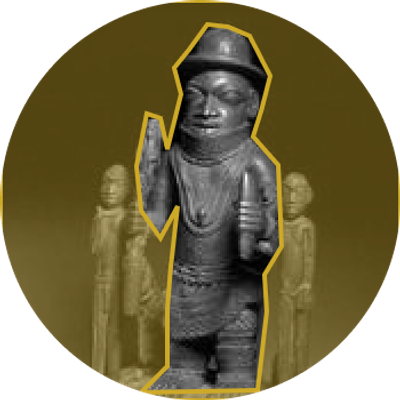
Ọba Ẹwuakpẹ (reigned c. 1701–1712) ruled during a pivotal period in Benin’s history, marking a transition from political instability towards the restoration of order. Although he ultimately triumphed and reclaimed the throne, he is often characterised as an unpopular and “melancholy monarch”.
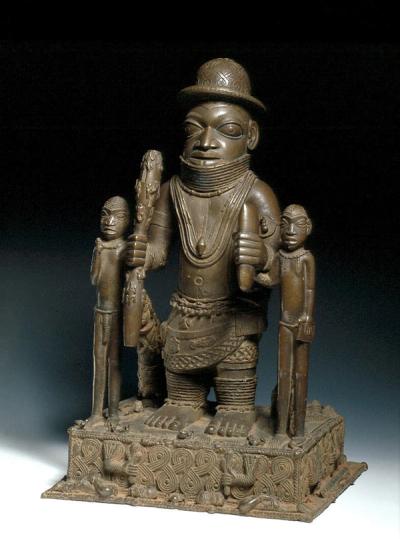
Representations of Ẹwuakpẹ reflect this transitional position. Unlike many other Ọbas, he is not depicted wearing elaborate coral-beaded regalia. Instead, he wears relatively simple attire, including an Odigba (coral-beaded collar), a small number of coral beads, and a rounded, European-style hat. His wrapper is decorated with motifs including the moon, equal-armed crosses, Portuguese heads, and the Eben (ceremonial sword). Together, these motifs have been interpreted as references to cosmic order, ancestral approval, and the restoration of royal authority.
In his right hand, Ẹwuakpẹ holds a distinctive Ukhurhe (ancestral staff) known as ukhurhe ovbi-odo, or “pestle staff”. The staff symbolised the reversal of curses and the peaceful resolution of conflict. It is associated with Ẹwuakpẹ’s revocation of the atoro law, which had allowed the Ọba to confiscate the property of chiefs, as well as his successful resolution of disputes with the chiefs and establishment of the principle of primogeniture. Through these distinctive attributes, representations of Ẹwuakpẹ emphasise his role as a restorer of political stability and order.
Sensitive Content Digital Benin includes colonial material that may contain inaccurate, derogatory or harmful language relating to African and African diasporic communities. Such language may appear in catalogue records, transcriptions, and book, exhibition or museum titles. We recognize that this material may cause distress. Sensitive-content warnings are being implemented across the collection, but this process is ongoing. The language does not reflect Digital Benin’s views; we take an anti-colonial and anti-racist position and are committed to centring the humanity of historically marginalised communities.