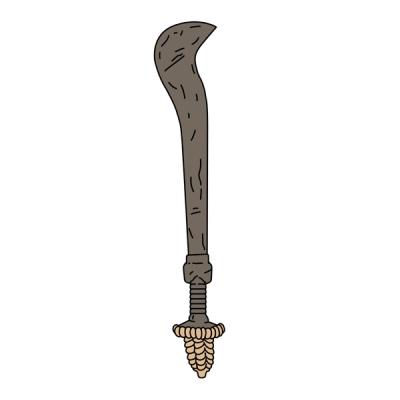
Umozo/Ọhọ
Ọhọ is the executioner’s sword, and it is one of three items given to a prince being sent out to establish a dukedom. This gives the prince the power of life and death. The blade and part of the handle is iron, and the top of the handle is brass. Both the Igun-Ematon and the Eronmwon would have made this object. During ceremonies the Enogie, a duke, rarely brings out the Ọhọ, which is used by his executioners. While the Umozo, which is the cutting sword, is used during wars. In contemporary times this is used ceremonially and during the Isiokuo festival, which is more like a victory parade.
Although used in different contexts, Ọhọ and Umozo look similar, and thus the data provided by institutions has not been able to distinguish between these two swords. For this reason, the executioner’s or warfare sword has been used for the English designation to differentiates these swords, which functioned as weaponry, from the category of ceremonial swords.
Educational Material
Digital Benin collates digital material from institutions, and some of this material is inherently colonial and contains words, terms and phrases that are inaccurate, derogatory and harmful towards African and African diasporic communities. Catalogue transcriptions, book titles, exhibition titles and museum titles may contain harmful terms. We recognise the potential for the material to cause physical and mental distress as well as evoke strong emotions. Owing to the scale of the collection’s data, a process to implement sensitive-content warnings in the displayed data is still incomplete. The material within the catalogue does not represent Digital Benin’s views. Digital Benin maintains a strong anti-colonial, anti-racist position and affirms its support for centring the humanity of historically marginalised and disenfranchised communities. Read more about the background of this statement here