Uko
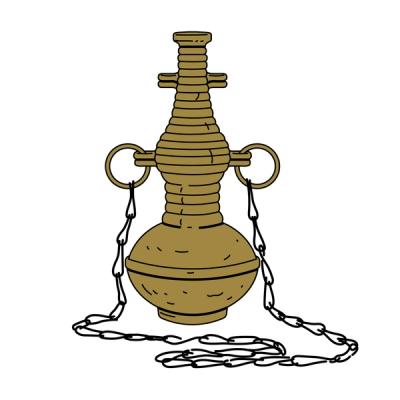
In Edo language, the word Uko means a kind of container used for different articles. This best relates to the term ‘flask’ in English.
Many flasks are part of the Benin holdings in various collections. There are two types of flasks. The first group is the most common – the containers are distinguished by their globular gourd-shaped bodies and small tube-like openings. Small lugs are often seen on the outer surface, and in several cases chains are still attached. Smaller versions may have been attached as pendants to other objects such as pendant plaques or neck ornaments. A second type are cast in the form of kneeling or sitting human figures. Some have argued that this is a woman (e.g. Plankensteiner, 2007 ), although others have said it is a wealthy chief (Enotie Ogbebor in Plankensteiner, 2022, p.146 ).
There is no consensus on the function of flasks, and indeed different flasks likely had different uses. Some have argued they may have stored powders such as gunpowder. However, a number likely contained medicinal substances and may have been used by priests, while small flasks were likely worn by individuals as charms for protection.
Flasks are also depicted on other objects, such as altars to the hand and altar tableaux, illustrating their importance.
Educational Material
Digital Benin collates digital material from institutions, and some of this material is inherently colonial and contains words, terms and phrases that are inaccurate, derogatory and harmful towards African and African diasporic communities. Catalogue transcriptions, book titles, exhibition titles and museum titles may contain harmful terms. We recognise the potential for the material to cause physical and mental distress as well as evoke strong emotions. Owing to the scale of the collection’s data, a process to implement sensitive-content warnings in the displayed data is still incomplete. The material within the catalogue does not represent Digital Benin’s views. Digital Benin maintains a strong anti-colonial, anti-racist position and affirms its support for centring the humanity of historically marginalised and disenfranchised communities. Read more about the background of this statement here