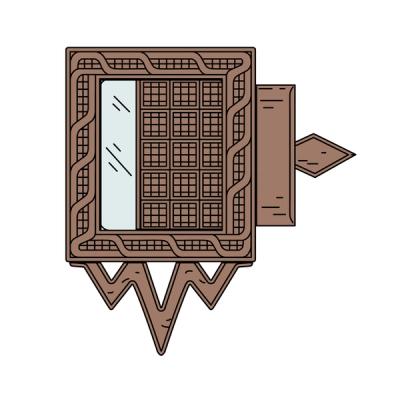
Ughegbe
Ughegbe (mirrors) are encased in carved wooden frames with a sliding wooden panel that would cover the glass when not in use. The wooden frame was carved by members of the Igbesanmwan, while the glass for the mirror would have been one of the goods traded to Benin by European merchants. Ughegbe were used mainly by priests and are viewed as portals to see beyond the physical world. They would be covered when not in use to prevent entities from the spiritual world entering the physical world where they do not belong.
In Edo culture, Ughegbe are not just everyday objects used to check one’s appearance, but they are spiritually and symbolically potent objects. As Blackmun (1984, p.309 ) wrote, ‘in present-day Benin, Ughegbe are used by those who want to see spirits or deities. … Mirrors are intimately connected with the worship of Olokun’. Mirrors may have been used during some ceremonies, as seen depicted in some carved-ivory altar tusks and cast altar tableaux (Blackmun, 1984, p.306-311 ).
Educational Material
Digital Benin collates digital material from institutions, and some of this material is inherently colonial and contains words, terms and phrases that are inaccurate, derogatory and harmful towards African and African diasporic communities. Catalogue transcriptions, book titles, exhibition titles and museum titles may contain harmful terms. We recognise the potential for the material to cause physical and mental distress as well as evoke strong emotions. Owing to the scale of the collection’s data, a process to implement sensitive-content warnings in the displayed data is still incomplete. The material within the catalogue does not represent Digital Benin’s views. Digital Benin maintains a strong anti-colonial, anti-racist position and affirms its support for centring the humanity of historically marginalised and disenfranchised communities. Read more about the background of this statement here