Oyiya
‘Agbiyagha ẹ dẹ oyiya’ (Someone whose hair is in locks would not buy a comb – meaning, only when something is needed is it seen as relevant).
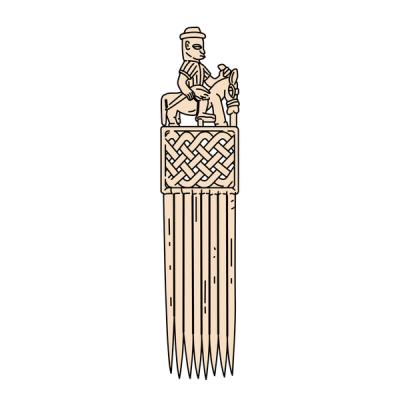
Oyiya (combs) were highly decorated by carvers to make the objects more attractive, to document events and people at the time and possibly for use by members of the royal court. The design could indicate for whom the use of the comb was intended, for example combs with the obah n’uhi, or infinity symbol, would have been used only by members of the royal court.
Oyiya in Benin were historically carved from wood or, in the case of more elaborate examples, ivory. They are usually long and thin in form, with wide-spaced teeth. In some cases, the handles are carved simply, whereas in others they feature elaborate motifs and decorations, such as figures of horses and riders. Combs would have had a functional use, to comb and plait the hair, allowing it to be dressed and styled.
Educational Material
Digital Benin collates digital material from institutions, and some of this material is inherently colonial and contains words, terms and phrases that are inaccurate, derogatory and harmful towards African and African diasporic communities. Catalogue transcriptions, book titles, exhibition titles and museum titles may contain harmful terms. We recognise the potential for the material to cause physical and mental distress as well as evoke strong emotions. Owing to the scale of the collection’s data, a process to implement sensitive-content warnings in the displayed data is still incomplete. The material within the catalogue does not represent Digital Benin’s views. Digital Benin maintains a strong anti-colonial, anti-racist position and affirms its support for centring the humanity of historically marginalised and disenfranchised communities. Read more about the background of this statement here