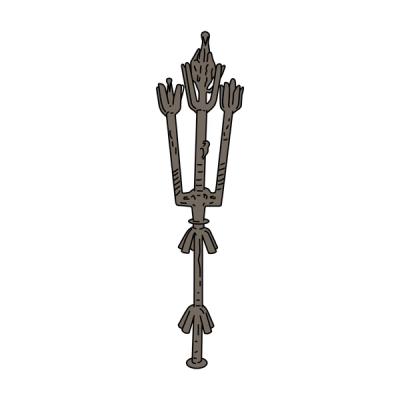
Osogan
Osogan (Osun staffs) are kept by the Osun priests, and they were usually fortified with medicine. Osun is the deity of medicine and ensures the effective use of all forms of medicines, curative or otherwise. Osun is worshipped by the professional traditional doctors called Ewaise, and their guild performs an annual festival called Ehosun in honour of the Osun deity. During the festival, medicines are believed to be strengthened, and the Osogan can stand without support, exhibiting mystic powers. Osun can also be worshipped domestically. Households with Osun shrines have special rooms where their medicine is kept, and annual rites are performed. Different priests have various ornaments on their Osogan which usually represent the powers they have attained – when a priest acquires or attains a certain power, he adds a representation of this power to his Osogan. This makes every Osogan different.
Osogan are usually made of iron, sometimes with brass cast decorations, however a smaller number of more elaborate staffs are made entirely from brass. These cast examples would have belonged to the Ọba and been used by the Ewaise (Ben-Amos Girshick in Plankensteiner, 2007, p.476 ). Osun is a deity of medicine, whose power can be invoked to protect and cure people. Osun staffs can be identified through imagery used, such as the Akala bird (a large vulture native to parts of Nigeria), the chameleon, stone celts and snakes.
Educational Material
Digital Benin collates digital material from institutions, and some of this material is inherently colonial and contains words, terms and phrases that are inaccurate, derogatory and harmful towards African and African diasporic communities. Catalogue transcriptions, book titles, exhibition titles and museum titles may contain harmful terms. We recognise the potential for the material to cause physical and mental distress as well as evoke strong emotions. Owing to the scale of the collection’s data, a process to implement sensitive-content warnings in the displayed data is still incomplete. The material within the catalogue does not represent Digital Benin’s views. Digital Benin maintains a strong anti-colonial, anti-racist position and affirms its support for centring the humanity of historically marginalised and disenfranchised communities. Read more about the background of this statement here