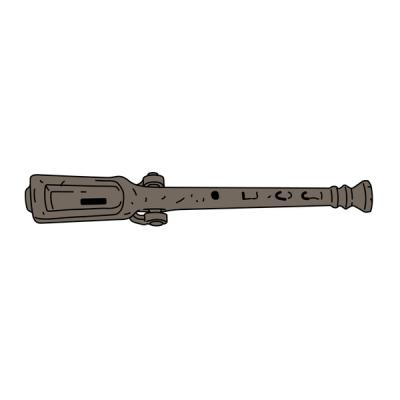
Osisi/Etu
Osisi (gun) and Etu (canon) are both types of firearms. Although the Portuguese developed trade and alliances with Benin Kingdom from the late fifteenth century onwards, a papal ban on the sale of firearms to non-Christian peoples prevented firearms being sold to the Ọba (Ryder, 1969, p.41 ). Despite this prohibition, some firearms did make their way to Benin Kingdom by the end of sixteenth century, and as other European powers such as the Dutch traded with the Ọba, different firearms were acquired.
Although early forms were large breech-loading guns or cannons, over time matchlock and flintlock guns became available (Osadolor, 2001, p.157 ). Most of these firearms were produced in Europe, however one bears a stamp indicating it was made in Asia. Then, in the eighteenth century, under the command of the Ọba, guns started to be produced locally by the Igun-Ematon (Osadolor, 2001, p.158 ).
Educational Material
Digital Benin collates digital material from institutions, and some of this material is inherently colonial and contains words, terms and phrases that are inaccurate, derogatory and harmful towards African and African diasporic communities. Catalogue transcriptions, book titles, exhibition titles and museum titles may contain harmful terms. We recognise the potential for the material to cause physical and mental distress as well as evoke strong emotions. Owing to the scale of the collection’s data, a process to implement sensitive-content warnings in the displayed data is still incomplete. The material within the catalogue does not represent Digital Benin’s views. Digital Benin maintains a strong anti-colonial, anti-racist position and affirms its support for centring the humanity of historically marginalised and disenfranchised communities. Read more about the background of this statement here