Ẹkan
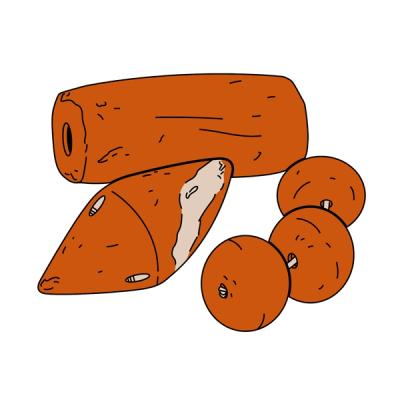
Ẹkan are beads made from the semi-precious agate stone. They look similar to the beads known as Ivie, which are used to make jewellery. However, Ẹkan are more greyish in colour and are of less value than Ivie. The Ọba in the past would control both Ivie and Ekan and one could only wear them if the Ọba gave the right to do so.
In English, the term bead is used to describe both Ẹkan and Ivie. These beads may have once been part of necklaces, crowns or other regalia worn and used by the Ọba, his wives, and other high-ranking dignitaries. It is not known whether such beads were once part of other objects and were separated after being looted in 1897, or whether they were single beads at the time and part of the loot. The red colour of these beads symbolises ‘power, blood and danger’ (Curnow in Plankensteiner 2007, p.380 ) and is innately tied with the Ọba. These beads also speak to the wide-ranging trade networks that Benin Kingdom has been part of over time. Agate and jasper were imports from northern Africa via trans-Saharan networks, whereas it is thought that the Portuguese imported coral from the Mediterranean from the fifteenth century onwards.
Educational Material
Digital Benin collates digital material from institutions, and some of this material is inherently colonial and contains words, terms and phrases that are inaccurate, derogatory and harmful towards African and African diasporic communities. Catalogue transcriptions, book titles, exhibition titles and museum titles may contain harmful terms. We recognise the potential for the material to cause physical and mental distress as well as evoke strong emotions. Owing to the scale of the collection’s data, a process to implement sensitive-content warnings in the displayed data is still incomplete. The material within the catalogue does not represent Digital Benin’s views. Digital Benin maintains a strong anti-colonial, anti-racist position and affirms its support for centring the humanity of historically marginalised and disenfranchised communities. Read more about the background of this statement here